
Seven of the ten occupations expected to generate the most new jobs in Miami between 2022 and 2030 will pay less than $18 per hour, according to the Florida Department of Economic Opportunity. Those positions — concentrated in health, hospitality, and services — produce salaries that can afford less than $1,000 per month in rent. Miami’s median rent now exceeds $3,000 per month. The city is building an economy on jobs that cannot sustain the cost of living inside it.
Capital reshapes cities differently than labor does. Investment raises property values, attracts luxury development, and expands tax bases. Those outcomes can strengthen local economies, but they also increase the cost of remaining in them. Housing markets respond to purchasing power rather than occupational necessity. The people essential to operating restaurants, schools, hospitals, hotels, and public services compete in the same housing market as households with substantially greater resources. Miami has attracted a surge of high-income relocations from New York and California that drove home prices to record highs — and that momentum, while slowing, has permanently reset the city’s cost floor.
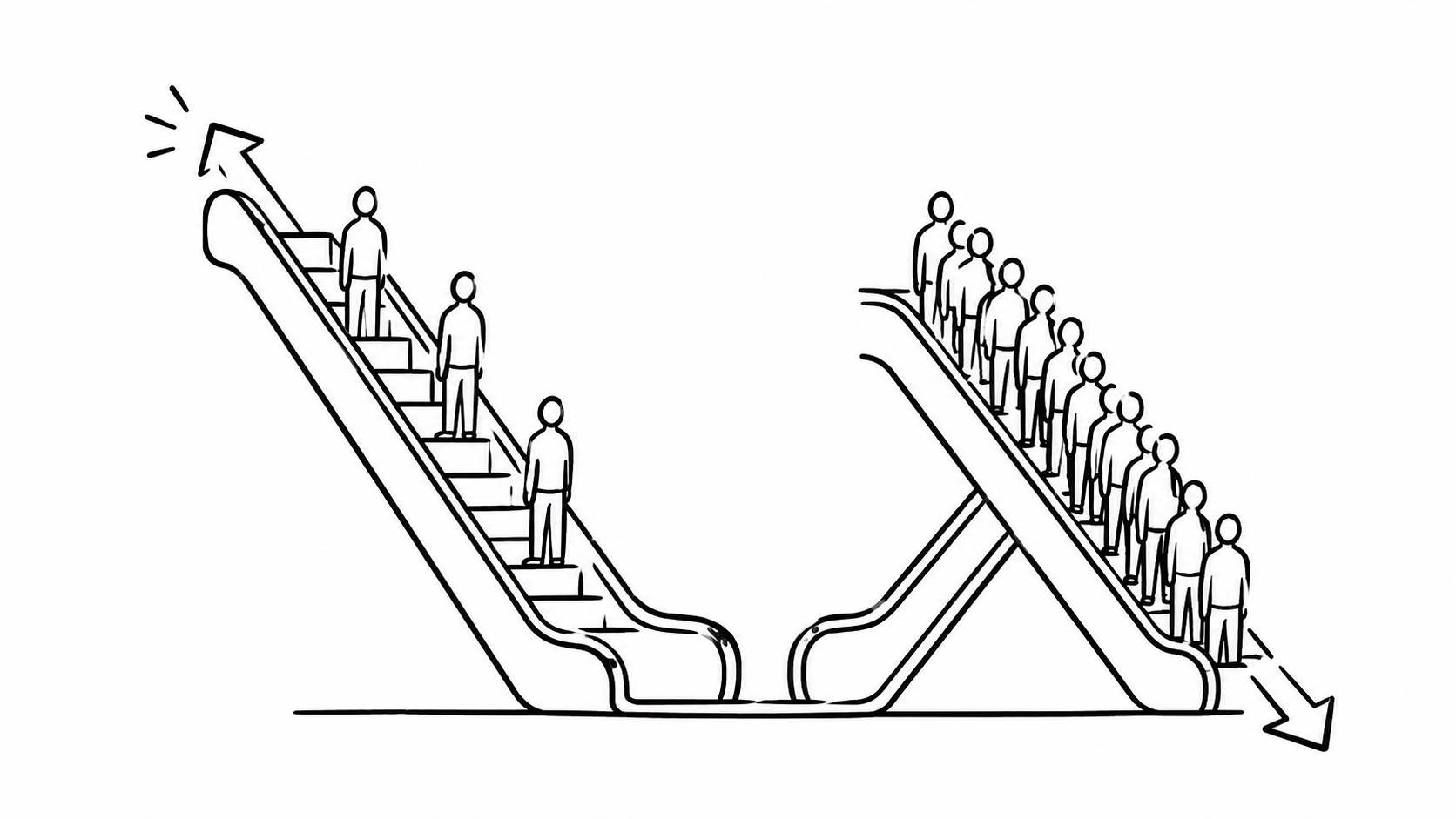
The result is a two-speed economy. One segment benefits from appreciating assets, expanding investment, and rising property values. The other experiences those same developments as higher rent, larger insurance bills, and longer commutes. Economic growth and affordability are not moving together — they are separating into distinct realities within the same city. Florida’s property insurance market now runs at nearly double the national average, according to Norada Real Estate’s April 2026 market analysis, driven by storm risk, litigation costs, and market instability. Those expenses ripple beyond homeowners into rental prices and business operating costs, compounding the affordability gap for every household that does not own an appreciating asset.
The distribution of that burden is not evenly spread. In Miami-Dade County, the homeownership rate sits at approximately 29 percent — one of the lowest of any major American metro. Wealth appreciation from rising property values accrues to fewer than one in three Miami households. The remaining 71 percent absorb rising costs without the asset appreciation that would offset them. Appreciation is being privatized. Costs are being socialized. Participation in Miami’s growing economy and participation in its wealth creation are not the same thing — and the gap between them is widening.
The institutional response is already visible. Approximately 18,500 workforce and affordable housing units are currently under construction across Miami-Dade County — a 22 percent increase — according to 2026 market data reported by Molkae Pelboim. That pipeline represents a meaningful policy response. It also confirms the scale of the failure it is responding to. A city does not build 18,500 workforce units because the market is distributing opportunity broadly. It builds them because the market has systematically excluded the workforce that sustains its economy.
This pattern connects to a national argument SSC has been building across cities. As SSC reported in Boston Is Losing Its Young Workers. The City Built the Crisis Itself., Boston exports its young workforce through housing scarcity produced by decades of restrictive governance. Miami is running the same mechanism in a different direction — importing capital while pricing out the workforce that sustains it. Two cities, opposite trajectories, same structural outcome: the people who make the economy function cannot afford to remain inside it.
The challenge for urban policymakers is larger than attracting investment. Cities compete aggressively for employers, entrepreneurs, and affluent residents because those groups generate tax revenue and economic activity. They compete less successfully to preserve affordability for workers whose wages do not rise at the same pace as housing and insurance costs. The Florida Department of Economic Opportunity data makes the consequence concrete: when Miami becomes unlivable for the workers generating most of its job growth, those workers will increasingly take their labor somewhere else.
The next urban divide will not be between thriving and struggling cities — but between cities that can sustain both capital and labor and those that can sustain only one.