
Mexico is preparing to expand its public healthcare system into a fully free, universal model beginning next year, building on reforms underway since the replacement of Seguro Popular with INSABI in 2020 and the subsequent consolidation under IMSS-Bienestar. The goal is direct and unusually clear in global policy terms: eliminate out-of-pocket costs for basic care and create a system where access is not mediated by employment, private insurance, or income level. Doctor visits, hospital care, and essential medications would be provided at no cost to patients within the public system. That sentence — no cost to patients — is doing more structural work than it might appear to, because it represents a fundamentally different answer to the question of what a government owes its population in the domain of health. Mexico is not expanding a program. It is changing the premise.
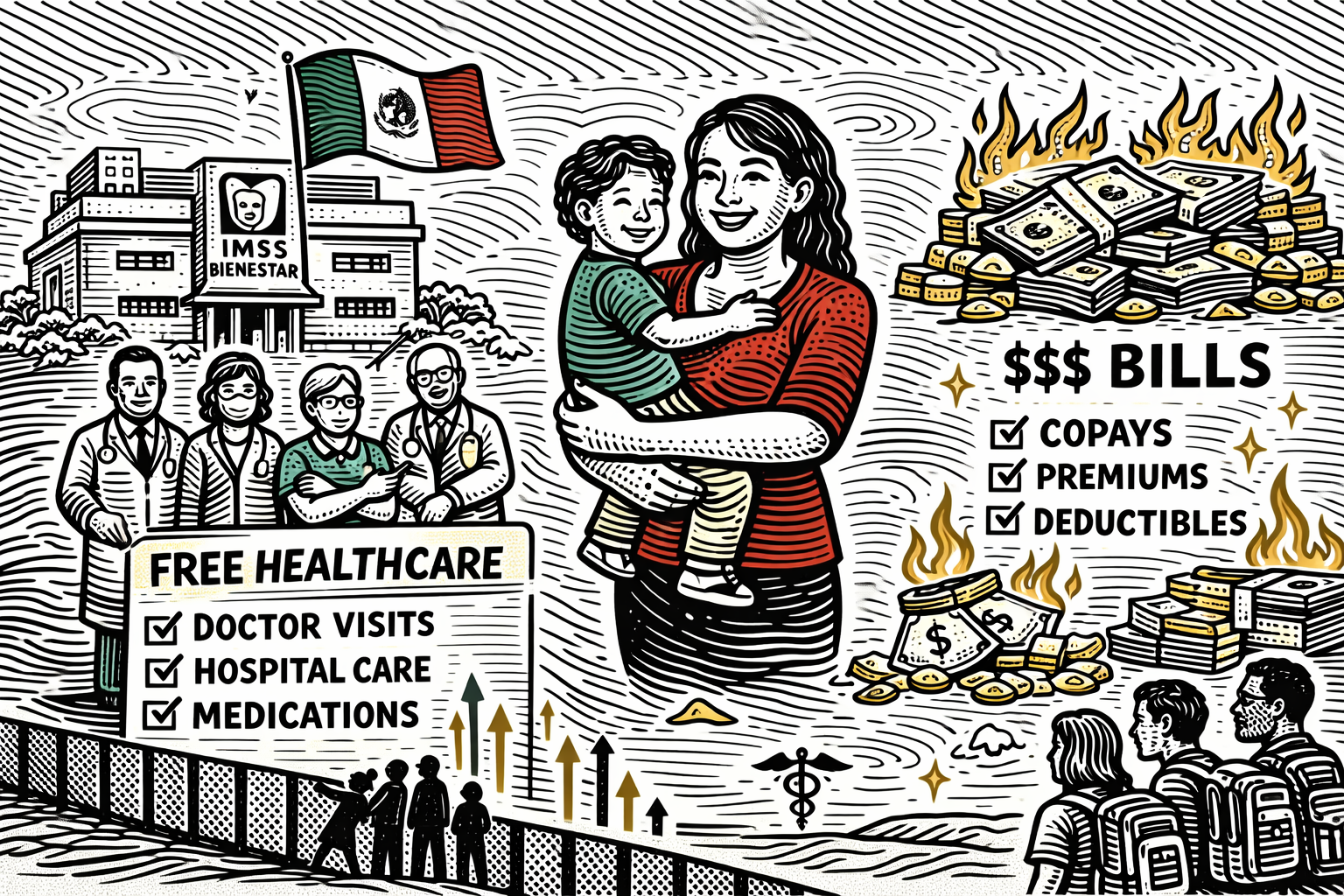
The significance of the rollout is not only domestic. It sits directly alongside the United States, where healthcare access remains fragmented across employer-sponsored insurance, private plans, Medicaid eligibility thresholds, and out-of-pocket payment structures that shape when and whether care is sought as much as whether it is needed. Roughly 8 to 9 percent of Americans remain uninsured, and millions more are underinsured — navigating deductibles, prior authorization requirements, and cost-sharing mechanisms that function as rationing systems dressed in the language of consumer choice. The contrast between the two systems is not simply about coverage rates or policy design. It is about how each country has answered the question of whether access to healthcare is a condition the state guarantees or a resource the market distributes. Mexico is moving toward the former. The United States has never fully committed to it, and the current political environment is moving further from that commitment rather than toward it.
The racial and economic dimension of who absorbs the cost of the U.S. system’s conditionality is where the policy comparison becomes a structural story. Black and Latino Americans are uninsured at significantly higher rates than white Americans — a disparity produced not by individual choices but by the architecture of a system that ties access to employment in industries where Black and Latino workers are overrepresented in jobs least likely to offer employer-sponsored coverage, and to income thresholds in a Medicaid system that varies by state in ways that concentrate gaps in the South and Southwest. Mexican-Americans living in border communities — people whose families, in some cases, straddle the very line that separates these two healthcare systems — are among the populations most likely to be uninsured on the U.S. side and most likely to benefit from universalization on the Mexican side. The geographic proximity of these two systems is not just a rhetorical device. For border communities, it is a daily material reality in which the country of your birth or residence determines whether a doctor visit costs nothing or costs everything.
Mexico’s approach is not without constraints that deserve honest acknowledgment. The public system has long faced infrastructure deficits, staffing shortages, and uneven quality between urban centers and rural regions — challenges that expanding the policy framework of universality does not automatically resolve. Longer wait times, limited specialist availability, and gaps in supply chain reliability for essential medications are likely to persist in some areas, raising genuine questions about whether universality in policy translates into consistency in experience. The rollout is simultaneously a promise and a test of execution, and the history of similar reforms in other countries suggests that the distance between declaring universal access and delivering it reliably can be significant. None of that changes the direction of the commitment. It complicates it, and the complications are worth naming because they are the work that follows the policy declaration — the harder and less visible phase where the structural transformation either materializes or stalls.
What distinguishes this moment is not the outcome, which remains to be determined, but the direction and the assumption underlying it. Mexico is moving toward treating healthcare as a guaranteed public good, accepting imperfect delivery as the cost of attempting universal access rather than accepting uneven access as the price of a market-mediated system. The United States continues to treat healthcare as a hybrid where access is negotiated through employment status, income thresholds, state residency, and market participation — a system whose complexity is not incidental but functional, serving the financial interests of the industries whose revenue depends on that complexity remaining intact. Two countries sharing a border, and in many cases sharing families, are operating on fundamentally different assumptions about who is responsible for ensuring that people receive care when they need it. That divergence is a policy story. It is also a story about power, about whose interests shape the definition of what the state owes its people, and about what it means that the answer on the U.S. side has remained conditional for this long while the country immediately to the south is attempting to remove the condition entirely.