
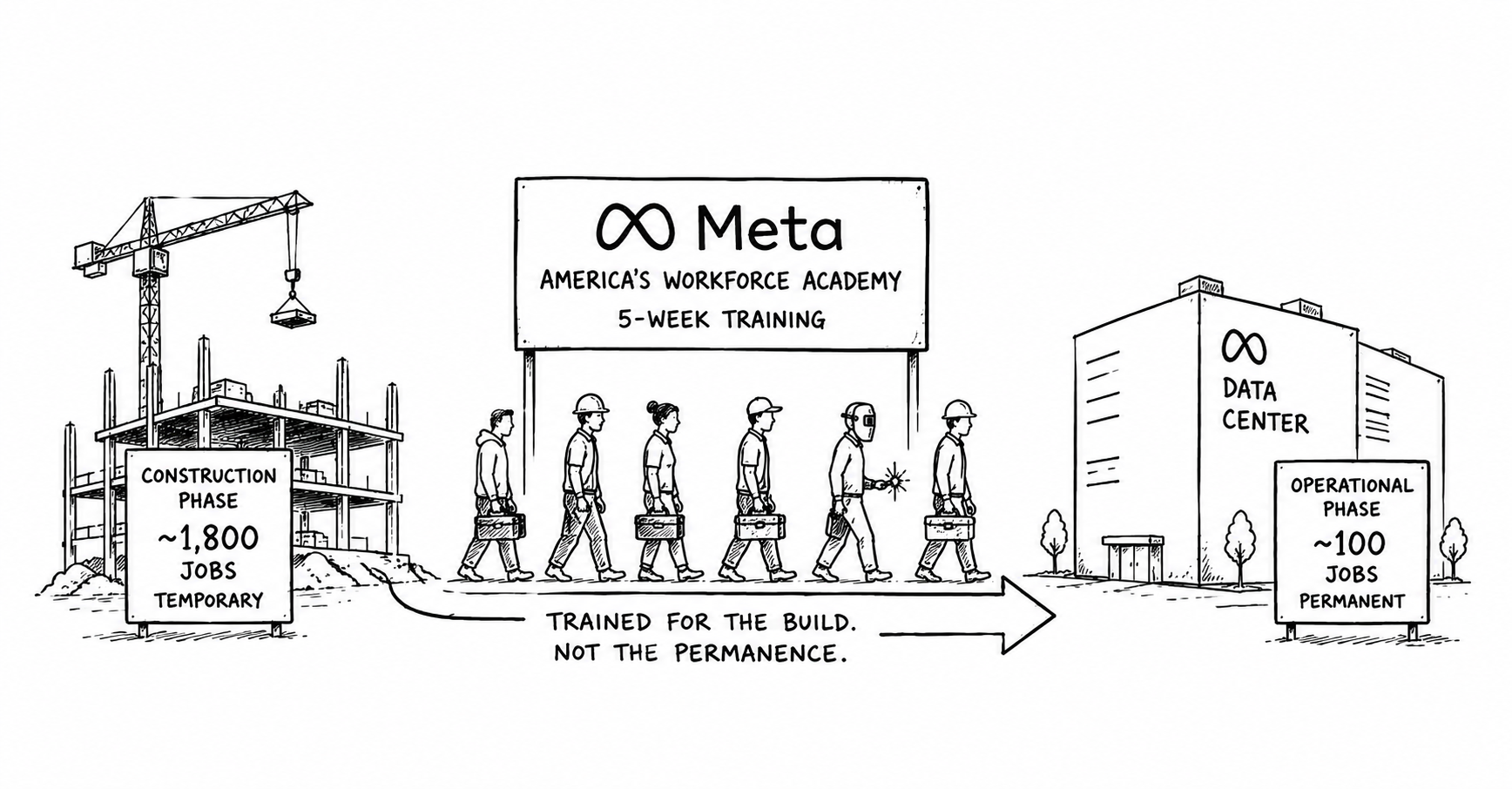
— and the data center construction model answers that question before the program starts.
Meta announced on June 8 the launch of America’s Workforce Academy — a $115 million no-cost training program that teaches skilled trades including electrical work, HVAC installation, welding, plumbing, and fiber-optic technology in a five-week curriculum. Graduates receive an industry-recognized National Center for Construction Education and Research credential and a guaranteed job offer with one of Meta’s general contractors on an active data center construction site. The program pilots in Louisiana, Ohio, Indiana, and Texas — all states where Meta has active data center projects. Meta described it as the largest private-sector commitment to skilled trades training with a job guarantee in U.S. history.
One month before the announcement, Meta laid off 8,000 employees.
The guaranteed job offer is real. The job itself is temporary by design. A Meta data center in Texas where the company broke ground last year is projected to have more than 1,800 workers on site during peak construction but roughly only about 100 jobs once operational, according to Reuters. A similar AI facility in Oklahoma follows the same pattern. The America’s Workforce Academy trains workers for the construction phase — the 1,800-person spike. It does not create the 100 permanent positions. Those exist regardless of whether the academy trains anyone.
A Meta spokesperson declined to say how many jobs will become available through the program. Meta did not confirm whether the roles would include union positions. The credential graduates receive — the NCCER certification — is designed, by Meta’s own description, to travel with the worker across employers and industry sectors. That language is worth reading carefully. It means the certification’s value is premised on the worker needing to find their next employer after the Meta project ends.
The structural argument Meta is making publicly is that the AI boom creates construction demand that exceeds the available skilled trades workforce — and that investing in training closes that gap. McKinsey estimates the global data center buildout could reach $7 trillion by 2030. The construction industry is short an estimated 349,000 workers this year. The demand is real. Meta and CBRE’s predecessor fiber technician program, LevelUp, received 35,000 applications in its first seven days despite having only 1,000 available spots. Workers want access to this training. The demand for the training is not the question.
The question is what the training leads to. Meta is building data centers that require large construction workforces temporarily and small operational workforces permanently. The America’s Workforce Academy addresses the temporary need. Meta president and vice-chairman Dina Powell McCormick framed the program’s purpose directly: “The AI revolution is bringing change but also historic opportunities.” Meta Chief Global Affairs Officer Joel Kaplanput it more plainly on LinkedIn: “The AI race is also a workforce race. America wins both when we invest in our people.”
Neither statement mentioned what happens to those people when the construction site closes.
The America’s Workforce Academy is not a cynical program. The training is free, the credential is portable, and the construction jobs it leads to are real and pay union-competitive wages for the duration of the project. For workers locked out of the trades by cost of training or credential barriers, it is a genuine on-ramp.
But Meta laid off 8,000 knowledge workers last month while simultaneously announcing a program to train construction workers for data center projects. Those projects create large temporary construction workforces and far fewer permanent operational positions. The program is framed as workforce investment. It is also a workforce supply solution — training workers for the labor Meta‘s infrastructure expansion requires, on the timeline that expansion requires it, for the duration that expansion needs them.
The credential travels with the worker when the project ends. The job guarantee is for the project, not the permanence. The AI boom is driving a data center buildout that McKinsey estimates could hit $7 trillion globally by 2030. The workers trained to build that infrastructure will need to find their next site when each one is complete. Meta has invested $115 million to ensure there are enough of them. It has not committed to what comes after.
— SSC News Desk | Social Storytellers Collective
Get SSC analysis delivered to your inbox every day. Subscribe free on Beehiiv: socialstorytellerscollective.beehiiv.com