
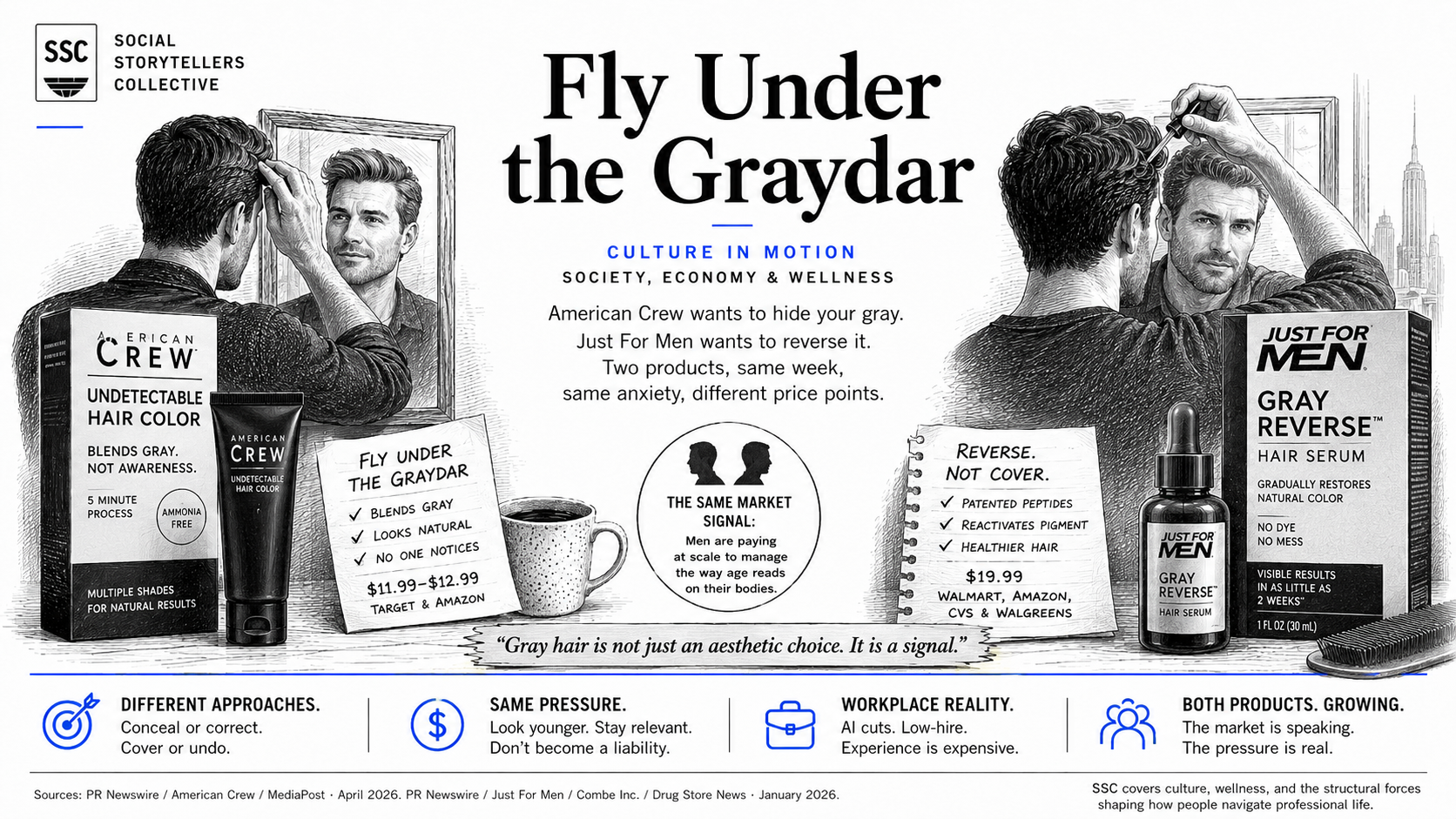
American Crew launched a campaign in April 2026 called Fly Under the Graydar — a product line and marketing push built around a simple, honest insight: men don’t mind coloring their hair. They mind it being obvious. The Undetectable Hair Color formula blends gray hair with a man’s natural color in five minutes, costs between $11.99 and $12.99 at Target and Amazon, and is ammonia-free. Nine out of ten men in testing said no one could tell they had colored their hair. Johnny Kazlausky, Global Marketing Manager of American Crew, put it plainly: “That tension has held the category back for years. So instead of focusing on coverage, we flipped the idea entirely.”
Just For Men went further. In January 2026, the #1 men’s hair and beard color brand launched Gray Reverse™ — a $19.99 daily hair serum that uses patented peptide technology to reactivate the hair’s natural pigmentation process, gradually reversing gray rather than covering it. No dye. No mess. Results visible in as little as two weeks, with best results in three to four months. Available at Walmart, Amazon, CVS, and Walgreens. To mark the launch, Just For Men surveyed 2,000 Gen Z and Millennial men: 68% said they care more about their appearance today than five years ago. Nearly 60% said they are concerned about signs of aging including gray hair. 70% said they plan to use outside help to slow age-related changes. Gray hair ranked as the third top aging concern for men. The average man finds his first gray at 29.
Two products. Two approaches. The same market signal — men are paying, at scale, to manage the way age reads on their bodies.
The campaign is funny. A playful concept, observational humor, a cultural wink about spotting bad dye jobs. The serum is clinical. Peptide technology, pigmentation reactivation, keratin and antioxidants for scalp health. Different registers. Same underlying pressure.
Men are managing their gray in a job market that has spent the last two years making age feel like a liability. The same week these products are in the conversation, Gartner reported that 80% of companies piloting AI had cut workers — disproportionately mid-career and senior employees whose institutional knowledge was expensive to retain once the AI could replicate portions of it. Professional and business services shed 8,000 jobs in April alone per ADP. The Federal Reserve described the current labor environment as “low-hire, low-fire” — companies holding onto workers reluctantly while pulling back sharply on new hiring. The workers most exposed to that reluctance are the ones whose compensation, benefits, and tenure make them the most expensive line on the org chart.
Gray hair, in that environment, is not just an aesthetic choice. It is a signal. And signals in a labor market running on “performance culture” vocabulary get read quickly.
American Crew and Just For Men are not making political arguments. They are making grooming products. But the cultural insight underneath both campaigns is the same one running through every workplace story SSC has covered this week: the pressure to appear younger, faster, more optimizable, less expensive — to not look like someone who has been doing this long enough to cost what experience actually costs.
American Crew at $12.99 hides it. Just For Men at $19.99 reverses it. The market is now offering men two different relationships with the same anxiety — conceal or correct, cover or undo, fly under the radar or make it disappear entirely. That both products are growing simultaneously tells you how large the market pressure actually is.
The products are under $20. The problem they are solving costs considerably more than that.
SSC covers culture, wellness, and the structural forces shaping how people navigate professional life.