
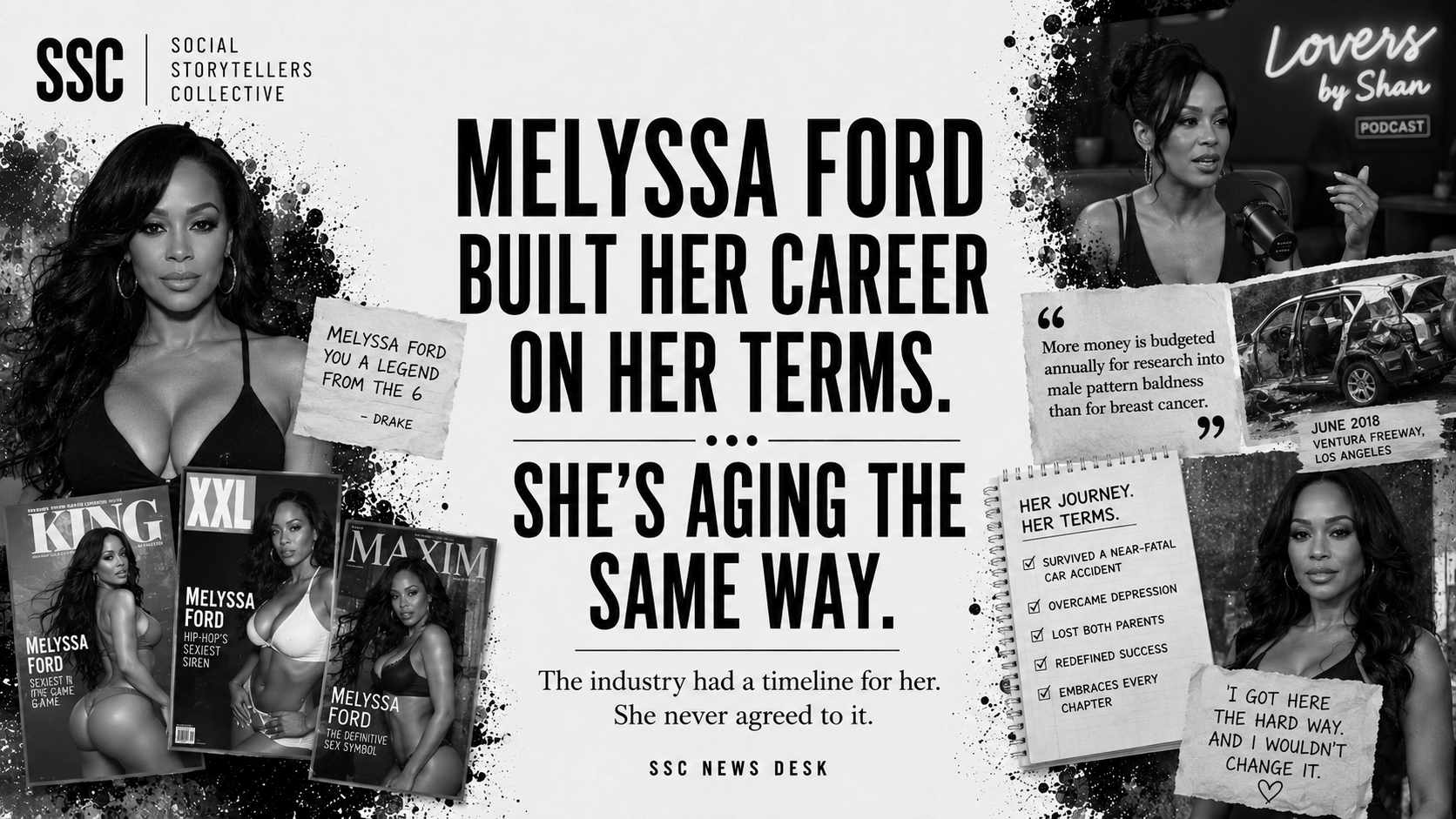
There is a particular kind of pressure the entertainment industry applies to women that it does not apply to men. It arrives quietly at first — in casting calls that specify age ranges, in the shift from leading roles to supporting ones, in the cultural shorthand that treats a woman’s thirties as a transition period and her forties as an endpoint. It is rarely spoken aloud because it doesn’t have to be. The industry built the architecture around it long before any individual woman arrived to navigate it.
Melyssa Ford has been navigating it for nearly three decades — and she is now doing it on her own terms. Born in Toronto to an Afro-Barbadian father and a Russian-Norwegian mother, Ford was discovered in 1997 by music video director Little X while bartending at a nightclub. What followed was one of the most recognizable careers of the hip-hop video era. From 1999 to roughly 2004, she appeared in videos for Jay-Z, Usher, Mystikal, R. Kelly, Lil Jon, Ludacris, and dozens of others — gracing the pages of King, XXL, and Maxim along the way. She was nicknamed Jessica Rabbit. She was revered, objectified, celebrated, and reduced — often in the same breath — for her looks and her curves. Drake would later immortalize her in a verse: “Melyssa Ford, you a legend from the 6.” The industry that made her visible also made clear that visibility was the transaction. Youth and beauty were the currency. The assumption was that when those faded, so would she.
Ford is turning 50 this year. She got here the hard way.
In June 2018, a tractor-trailer clipped the back of her Jeep Wrangler on the Ventura Freeway in Los Angeles. The vehicle flipped three times and landed upside down. The driver fled the scene. Ford suffered a skull fracture, a concussion, bleeding on the brain, and a 10-inch open wound that had to be surgically closed with staples and stitches. She has no memory of the crash. Her representative said at the time that God and her seatbelt saved her life. What followed the physical recovery was its own battle — she documented publicly that the accident deepened a depression she had been managing for years. Then she lost her mother, Barbara Ford. Then her father. She has described herself in interviews as an adult orphan — a person who has buried both parents and must navigate the rest of life without that specific kind of anchor. Few people understand what that weight actually feels like until they carry it.
What those experiences did, collectively, was reorder her sense of what matters. Ford has spoken openly about the perspective shift that comes from surviving something that should have killed you, and then grieving the people who were supposed to outlast the version of yourself that nearly didn’t make it. She embraces getting older with an intentionality that reads as radical against the backdrop of an industry that treats aging in women as a problem to be managed. Sometimes she dyes the grays out of her hair. Sometimes she doesn’t. What she values is having the choice — which is a quieter but more precise kind of freedom than the industry ever offered her when she was younger and more conventionally useful to it.
In a recent appearance on the Lovers by Shan YouTube podcast, she gave an interview that moved well beyond the expected conversation about beauty and longevity. She talked about aging with clarity and without apology. She pushed back on the idea that a woman’s value is contingent on whether she married or had children by a certain age — a timeline the culture enforces quietly but consistently. And she named the economics directly: more money is budgeted annually for research into male pattern baldness than for breast cancer. That is not a talking point. It is a funding reality — and it says something precise about whose concerns the system was designed to prioritize.
The math on that funding gap is not subtle. The National Institutes of Health allocates resources in ways that have consistently underweighted conditions affecting women — particularly Black women, for whom breast cancer mortality rates are significantly higher than for white women despite lower incidence rates. The money follows the assumed patient. And the assumed patient, for most of modern medical research history, has been male. Melyssa Ford naming that in a podcast conversation about aging and self-worth is not a detour from the subject. It is the subject. The same system that underfunds research into diseases that disproportionately kill women is the system that tells women their social value expires on a schedule.
That schedule is enforced through a specific set of cultural markers. Marriage. Children. The right timeline. A woman who reaches her late thirties without checking those boxes is not simply living differently — she is, according to a deeply embedded cultural script, failing. The entertainment industry has been particularly aggressive in transmitting that message. Female celebrities are routinely asked about their relationship status and reproductive choices in interviews where their male counterparts are asked about their work. The personal becomes the primary story. The work becomes the backdrop.
What Ford is doing — and what a growing number of women in entertainment are doing alongside her — is refusing the frame entirely. Not negotiating its terms. Not explaining why their choices are valid. Refusing to accept the premise that their value was ever contingent on the choices the frame was designed to evaluate. That is a different posture than the one the industry is accustomed to managing. It does not fit neatly into a redemption narrative or a makeover story or a comeback arc. It is simply a woman in full, saying the terms are hers.
The entertainment industry has always been more comfortable with women who age apologetically — who acknowledge the difficulty, credit good genetics or discipline, and express gratitude for continued relevance. Ford is not performing gratitude for an audience that was prepared to move on without her. She is making an argument. Aging on your own terms is not a consolation prize for women who didn’t win the game the industry designed. It is a recognition that the game was designed badly — and that the women who understood that earliest are the ones now building something outside it.
The conversation Melyssa Ford had on Lovers by Shan is part of a larger one happening across platforms, in podcasts and comment sections and group chats, among women who grew up watching the industry erase the women who came before them and decided they were not going to participate in their own erasure. It is not a trend. It is a reckoning — and it is arriving on its own timeline, not the one anyone else scheduled.