
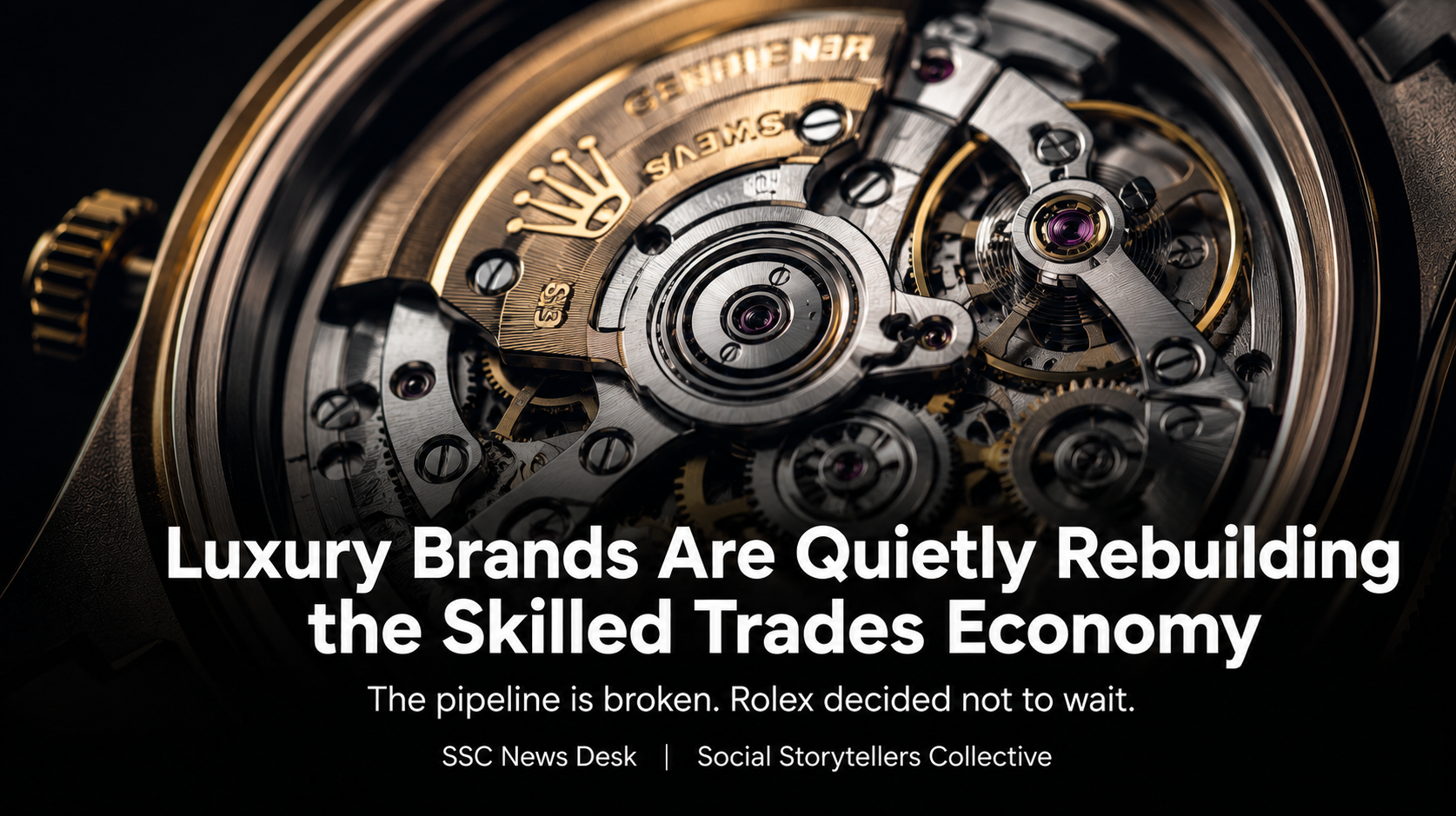
For years, the American labor conversation has been dominated by software engineering, finance, consulting, and the broader white-collar knowledge economy. College became the default prescription for stability, while skilled precision trades were culturally framed as secondary pathways rather than elite technical disciplines. Now even some of the world’s most prestigious luxury companies are confronting the consequences of that imbalance. Rolex launching a tuition-free watchmaking school in Texas is not simply a workforce initiative — it is evidence that entire industries are beginning to rebuild talent systems outside the traditional university pipeline.
The program addresses a severe shortage of certified watchmakers in the United States, where fewer than 2,000 reportedly remain in active practice nationwide. That number matters because luxury watches are not mass-market electronics designed for disposability. Mechanical watches require maintenance, restoration, calibration, and repair performed by highly specialized technicians trained in microscopic precision systems. As demand for luxury watches surged globally over the last decade, the labor infrastructure required to sustain that market failed to scale alongside it. Rolex is not opening this school because watchmaking suddenly became trendy — it is opening it because luxury capitalism still depends on human craftsmanship, and the pipeline producing that craftsmanship has weakened dramatically. That creates a paradox inside the modern economy: highly digitized industries increasingly rely on rare forms of analog expertise that fewer workers are being trained to perform.
What makes this particularly interesting is where the school is located. Texas has become a national testing ground for alternative workforce pathways outside the traditional coastal credential economy. The state’s rapid growth, lower operating costs, manufacturing expansion, and technical labor demand have made it fertile ground for apprenticeship-style education models tied directly to employment outcomes. Programs like this reflect a broader employer realization that waiting for universities alone to solve workforce shortages is no longer viable — a pressure point that intensifies as federal education infrastructure continues fragmenting in ways that make the credential system look stable while quietly losing function.
The compensation figure attached to the story — career paths reportedly reaching around $95,000 annually — also challenges longstanding assumptions about what constitutes high-value work. Watchmaking sits at the intersection of engineering, artistry, luxury retail, mechanics, and restoration science. Yet many Americans still associate prestige almost exclusively with managerial or digital labor. That disconnect is beginning to fracture as specialized trades become harder to automate and increasingly scarce. In an economy saturated with generalized degrees, rarity itself becomes economic leverage.
There is also a structural dimension to Rolex investing in education infrastructure directly. Luxury brands traditionally protect exclusivity through scarcity of product. Increasingly, they may also need to protect scarcity of labor. The craftsmanship associated with high-end watches cannot be scaled through software — it requires years of tactile repetition, technical discipline, and institutional knowledge transfer. By funding schools directly, brands gain greater control over the quality and continuity of their workforce ecosystem.
The Rolex school ultimately says less about watches than it does about where structural power in labor is shifting. Some of the most stable future careers may not emerge from broad institutional pathways at all, but from highly targeted training ecosystems built directly around industries facing talent shortages. The companies benefiting most from those skills have decided they can no longer wait for the educational system to produce workers on its own — and that decision is quietly redrawing who gets access to economic stability, and on whose terms.