
On April 11, Dance Theatre of Harlem held its annual Vision Gala at New York City Center and the Ziegfeld Ballroom, honoring Ford Foundation President Darren Walker with the Arthur Mitchell Vision Award. A live fundraising appeal during the evening generated an additional $160,000, bringing the total raised to $1,386,047 in support of the company’s mission to expand access to ballet and nurture diverse talent. The room exceeded its goal. The context surrounding it, however, makes the number harder to celebrate cleanly.
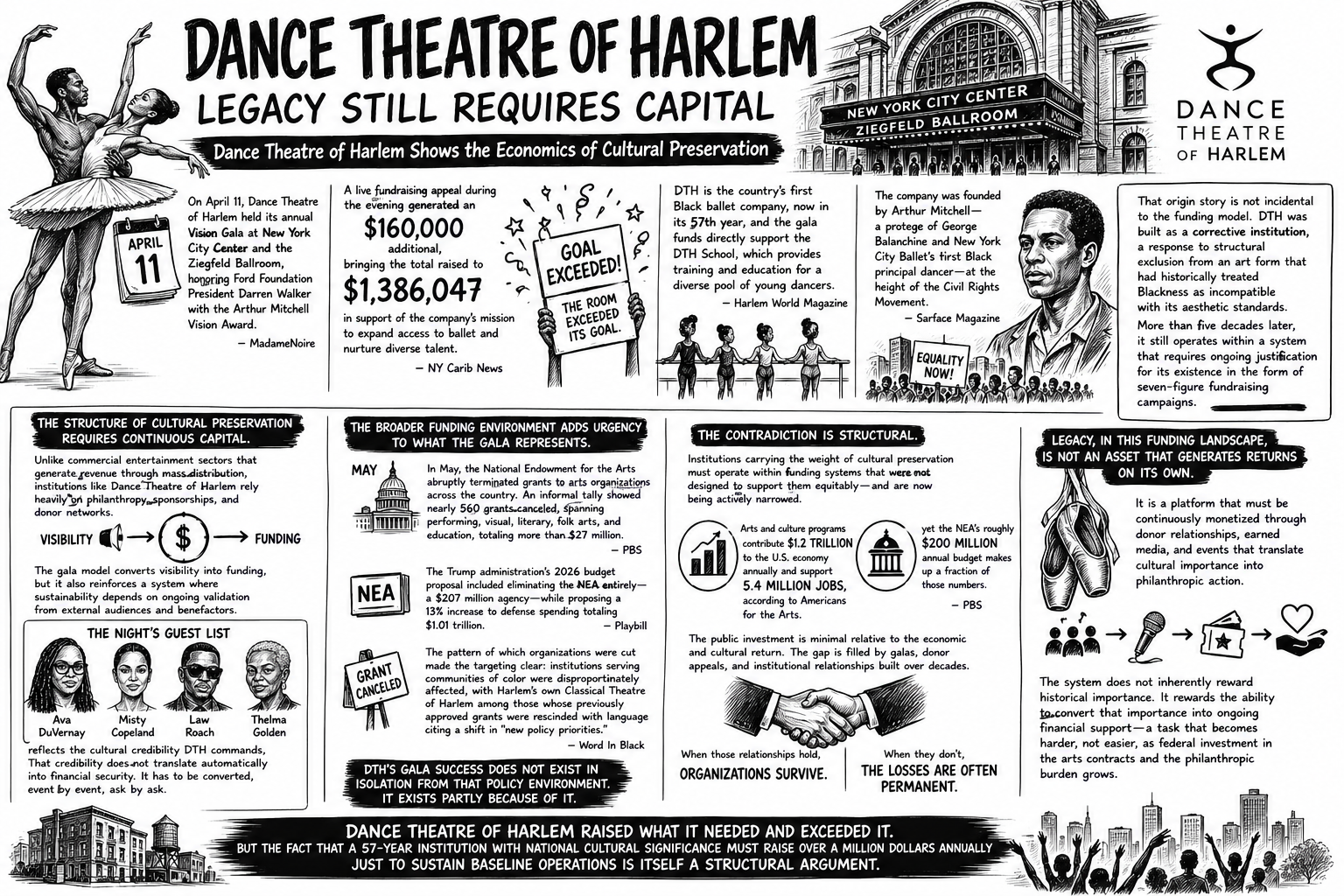
DTH is the country’s first Black ballet company, now in its 57th year, and the gala funds directly support the DTH School, which provides training and education for a diverse pool of young dancers. The company was founded by Arthur Mitchell — a protege of George Balanchine and New York City Ballet’s first Black principal dancer — at the height of the Civil Rights Movement. That origin story is not incidental to the funding model. DTH was built as a corrective institution, a response to structural exclusion from an art form that had historically treated Blackness as incompatible with its aesthetic standards. More than five decades later, it still operates within a system that requires ongoing justification for its existence in the form of seven-figure fundraising campaigns.
The structure of cultural preservation requires continuous capital. Unlike commercial entertainment sectors that generate revenue through mass distribution, institutions like Dance Theatre of Harlem rely heavily on philanthropy, sponsorships, and donor networks. The gala model converts visibility into funding, but it also reinforces a system where sustainability depends on ongoing validation from external audiences and benefactors. The night’s guest list — Ava DuVernay, Misty Copeland, Law Roach, Thelma Golden — reflects the cultural credibility DTH commands. That credibility does not translate automatically into financial security. It has to be converted, event by event, ask by ask.
The broader funding environment adds urgency to what the gala represents. In May, the National Endowment for the Arts abruptly terminated grants to arts organizations across the country. An informal tally showed nearly 560 grants canceled, spanning performing, visual, literary, folk arts, and education, totaling more than $27 million. The Trump administration’s 2026 budget proposal included eliminating the NEA entirely — a $207 million agency — while proposing a 13 percent increase to defense spending totaling $1.01 trillion. The pattern of which organizations were cut made the targeting clear: institutions serving communities of color were disproportionately affected, with Harlem’s own Classical Theatre of Harlem among those whose previously approved grants were rescinded with language citing a shift in “new policy priorities.” DTH’s gala success does not exist in isolation from that policy environment. It exists partly because of it.
The contradiction is structural. Institutions carrying the weight of cultural preservation must operate within funding systems that were not designed to support them equitably — and are now being actively narrowed. Arts and culture programs contribute $1.2 trillion to the U.S. economy annually and support 5.4 million jobs, according to Americans for the Arts, yet the NEA’s roughly $200 million annual budget makes up a fraction of those numbers. The public investment is minimal relative to the economic and cultural return. The gap is filled by galas, donor appeals, and institutional relationships built over decades. When those relationships hold, organizations survive. When they don’t, the losses are often permanent.
Dance Theatre of Harlem raised what it needed and exceeded it. But the fact that a 57-year institution with national cultural significance must raise over a million dollars annually just to sustain baseline operations is itself a structural argument. Legacy, in this funding landscape, is not an asset that generates returns on its own. It is a platform that must be continuously monetized through donor relationships, earned media, and events that translate cultural importance into philanthropic action. The system does not inherently reward historical importance. It rewards the ability to convert that importance into ongoing financial support — a task that becomes harder, not easier, as federal investment in the arts contracts and the philanthropic burden grows.