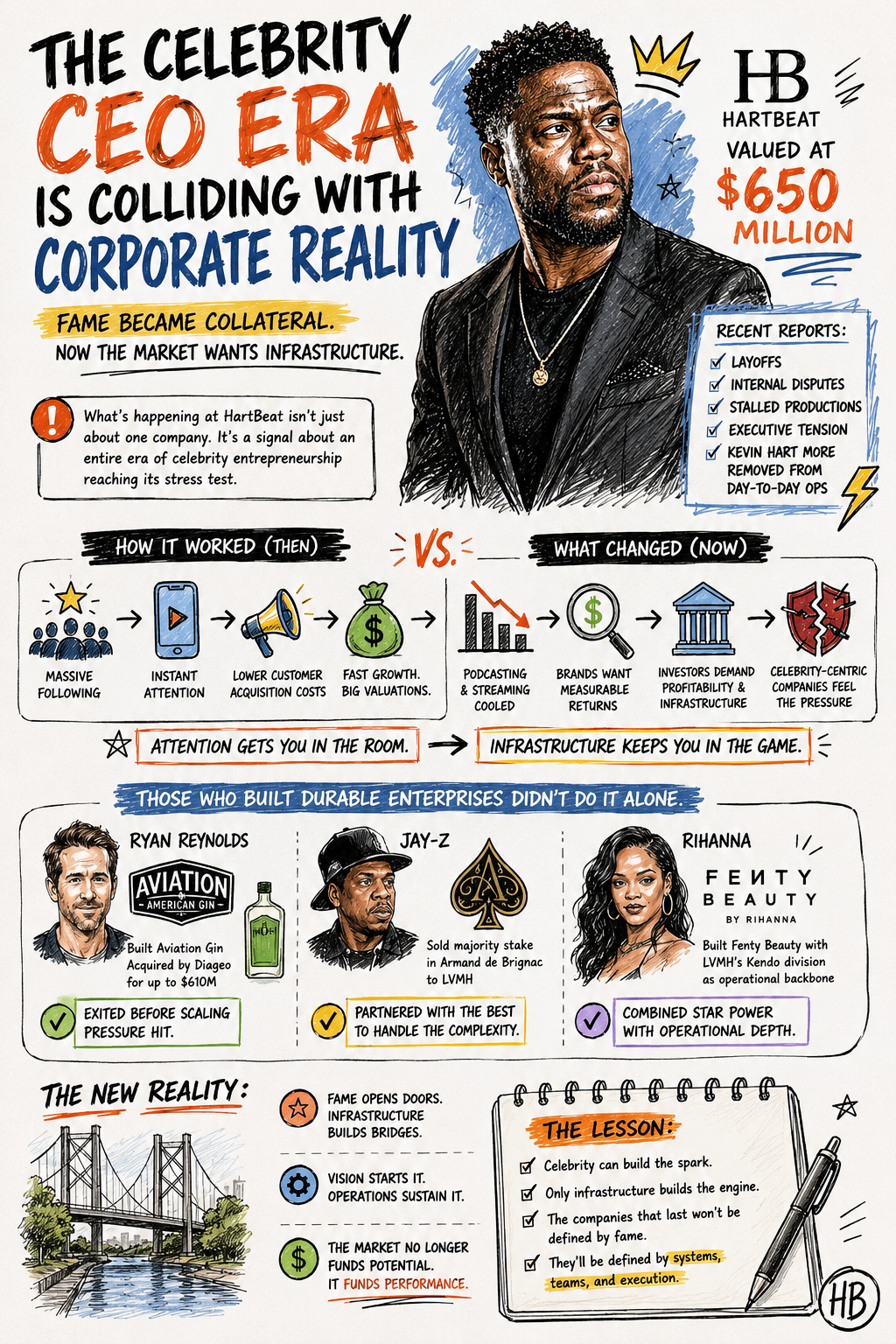
Kevin Hart built a company valued at $650 million on the premise that visibility could become infrastructure.
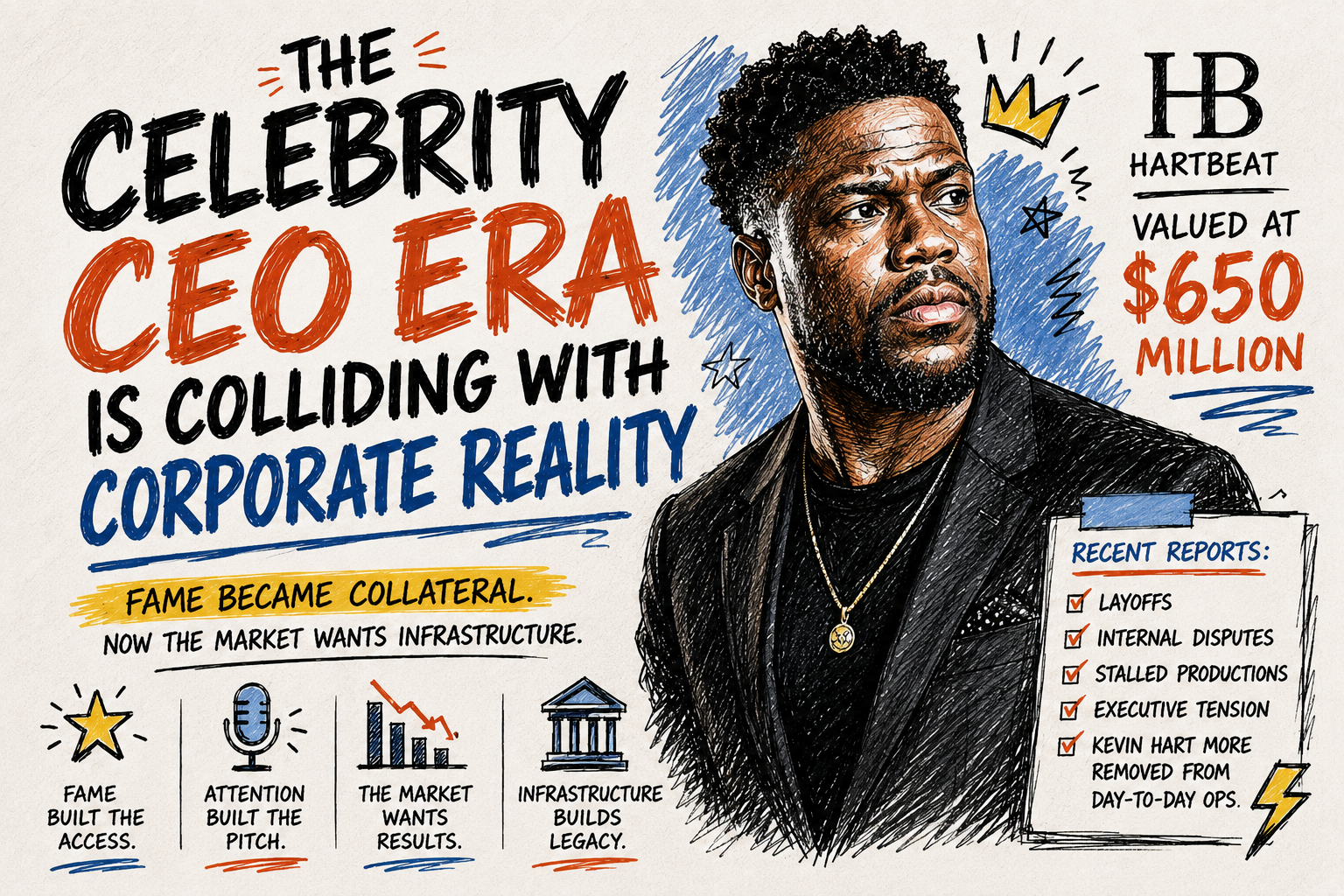
The TMZ reporting this week suggests the distance between those two things is wider than the valuation implied.
The allegations surrounding HartBeat — layoffs, internal disputes, stalled productions, executive tension, and Hart himself becoming increasingly removed from day-to-day operations as film commitments expanded — matter less as a story about one company than as a signal about an entire era of celebrity entrepreneurship reaching its stress test.
For more than a decade, Hollywood and venture capital aggressively funded celebrity-led companies because celebrity attention lowered customer acquisition costs instantly. A comedian with 100 million followers could theoretically launch a podcast network faster than a traditional studio could build one organically. A rapper could move product faster than a legacy advertiser. A creator could become a media company overnight. Fame itself became collateral. The pitch was simple and it worked — until the environment that made it work began to change.
Podcasting has cooled from its peak-era valuation frenzy. Streaming companies are spending more cautiously. Brands are demanding measurable returns instead of cultural excitement alone. Investors increasingly want profitability rather than ecosystem potential. In that environment, companies built heavily around a singular personality become vulnerable when the central figure cannot physically anchor every division at once. Attention and operational durability are not the same thing. The market is now exposing the distance between them.
The pattern is visible across the celebrity business landscape simultaneously. Ryan Reynolds built Aviation Gin into a brand Diageo acquired for up to $610 million — but the exit came before the scaling pressure arrived. Jay-Z sold a majority stake in Armand de Brignac to LVMH, effectively transferring operational complexity to one of the world’s most capable luxury management infrastructures. Rihanna’s Fenty Beauty, widely cited as the gold standard of celebrity brand building, succeeded in part because LVMH’s Kendo division provided the operational backbone that allowed the brand to function independently of Rihanna’s day-to-day involvement. The celebrities who built durable enterprises largely did so by attaching their visibility to institutions with management depth — not by attempting to build that depth themselves from scratch.
HartBeat attempted something more ambitious and more fragile: a full entertainment company, built around a single personality, scaling across film, television, podcasting, and live entertainment simultaneously. Whether the specific allegations in the TMZ reporting prove accurate in every detail, the structural vulnerability they describe is real and not unique to Hart.
The cultural significance here extends beyond one company or one entertainer. Black celebrity entrepreneurship has often carried an additional layer of symbolic weight because ownership itself has historically been limited. When Black entertainers build large-scale companies, the public frequently treats those ventures not just as businesses but as representation victories. That emotional investment is real and it is earned — the history behind it is real. But it can make structural criticism feel personal even when the issues are operational. Representation does not eliminate the pressures of scaling media businesses inside a cooling entertainment economy. A company can be both a meaningful ownership milestone and a business navigating genuine operational challenges. Both things can be true simultaneously.
The deeper question the HartBeat story raises is not whether Kevin Hart is a good businessman. It is whether the celebrity entrepreneur model — as it was practiced in its peak era — was ever as scalable as the valuations suggested. The companies being funded were not just buying celebrity product lines. They were betting that charisma could substitute for institutional infrastructure. In some cases, at the right scale, at the right moment, it could. In others, it was a valuation built on attention that the underlying operations could not sustain once the attention moved on.
Celebrity culture is moving from an era where visibility itself could sustain valuation into an era where infrastructure, management discipline, and operational coherence matter more than virality. The entertainers who built durable enterprises understood this early and structured accordingly. The ones who didn’t are now learning it in public.
The companies that survive this next phase will be the ones capable of functioning even when the star is absent from the room.