
Africa is rewriting its partnership terms. Europe is finally showing up differently.

For most of the Africa-France summit’s history, the meeting has taken place in Francophone Africa — in countries whose relationship with France was shaped by colonial ties, linguistic inheritance, and the particular economic dependencies that French West Africa has been navigating, renegotiating, and in some cases rejecting for decades.
Today, that history changed.
The Africa Forward Summit opened in Nairobi, Kenya — the first time the summit has been hosted by a non-Francophone African nation. The choice is not incidental. Kenya’s President William Ruto has been among the most vocal African leaders in pushing for a recalibrated relationship between the continent and its traditional Western partners — one based on investment and mutual benefit rather than aid dependency and diplomatic deference.
The agreements signed today reflect that recalibration in concrete terms. Kenya and France signed 11 bilateral agreements covering transport, infrastructure, trade, energy, digital technology, health, and education. Among the most significant: the rehabilitation of the KSh12.5 billion Nairobi Commuter Rail system — a direct investment in urban mobility for millions of working Nairobi residents — and the establishment of a joint venture to develop and finance logistics and port infrastructure valued at approximately KSh104 billion (roughly $700 million USD).
Why Nairobi matters beyond the symbolism
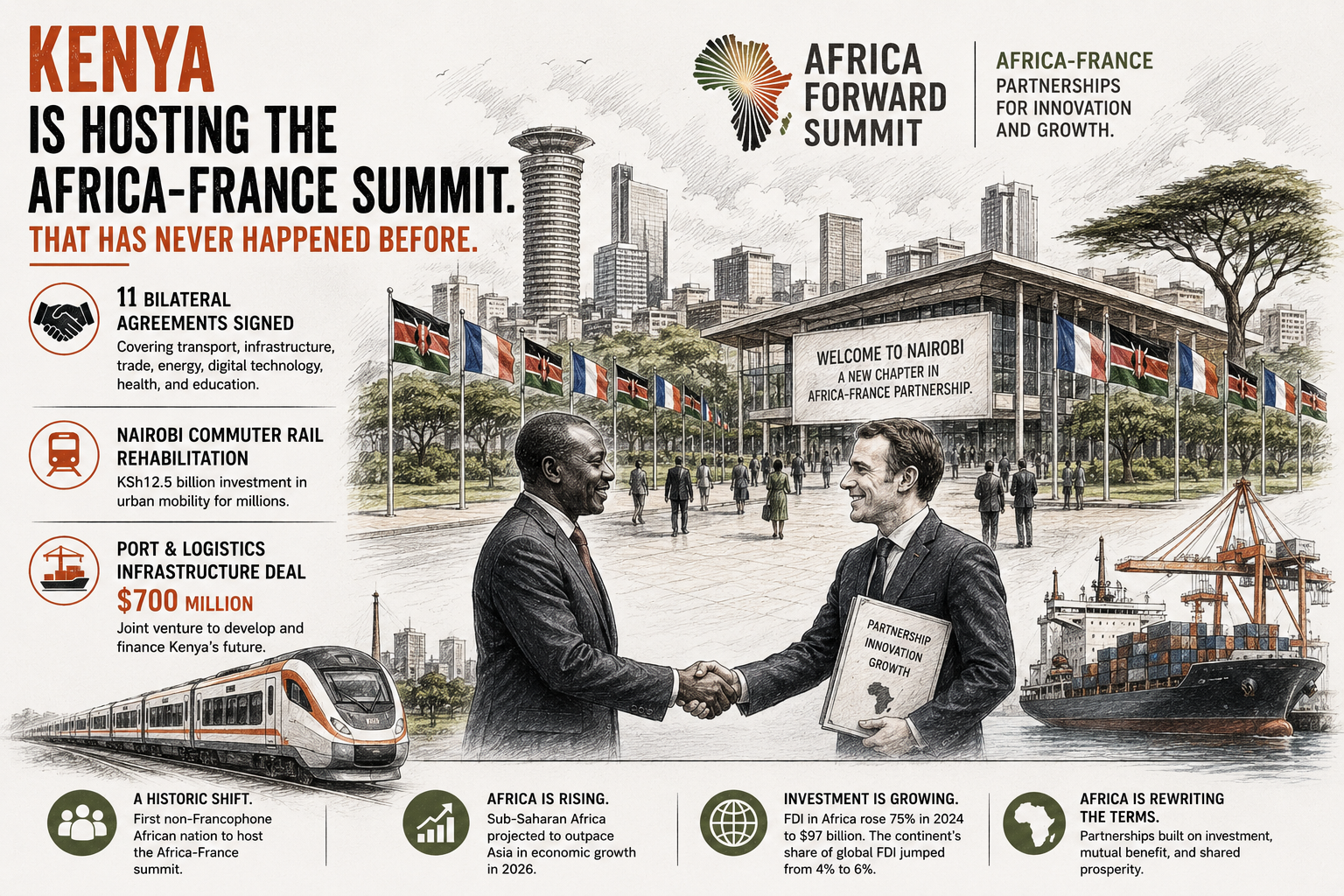
The Nairobi Commuter Rail is not a vanity project. It is a functional urban transit system serving one of Africa’s most congested major cities — a city of 5.5 million people whose growth has outpaced its infrastructure for decades. Modernizing it is not a diplomatic gesture. It is a quality-of-life investment for working residents who currently spend hours in traffic navigating a city that has not had reliable public transit at scale.
That framing — investment in the daily lives of working people rather than in the showcase infrastructure projects that tend to dominate African development headlines — is part of what makes the Kenya-France partnership notable. The summit’s theme, “Africa-France Partnerships for Innovation and Growth,” signals a deliberate pivot from the aid-and-security framework that has historically defined France’s engagement with the continent toward something that looks more like the commercial partnerships Africa’s fastest-growing economies have been building with China, the UAE, India, and Japan over the last decade.
France is not the first mover here. It is a late arrival to a continent that has been diversifying its partnerships for years precisely because the traditional Western engagement model was not delivering at the speed or scale the moment required. Continental frameworks such as Agenda 2063 and the African Continental Free Trade Area are shifting from vision to implementation, and the countries positioning themselves as partners in that implementation — rather than observers of it — are the ones that will shape the next chapter of African economic development.