
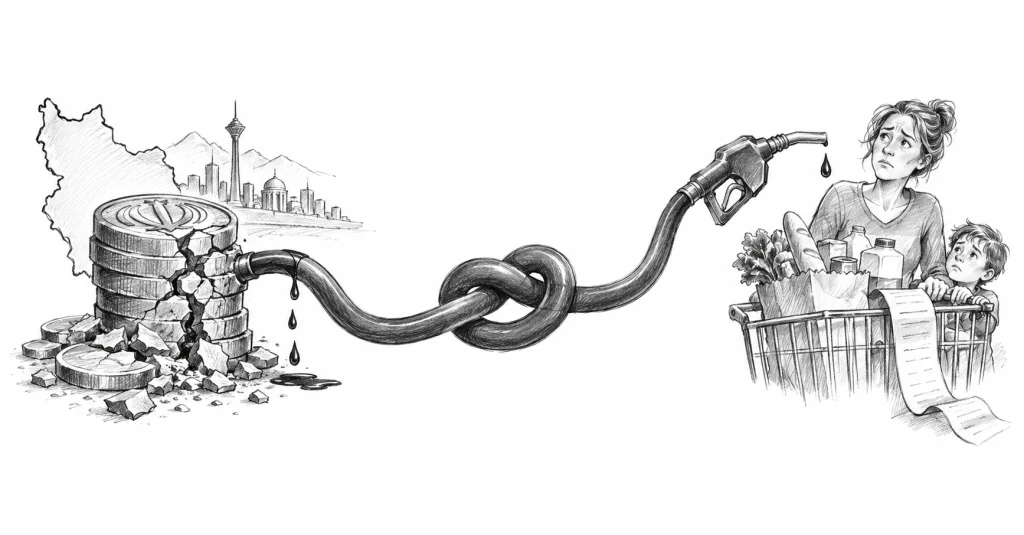
The war strategy assumes economic pressure will force Tehran to the table first. Consumer confidence suggests American households are running out of patience too.
Two economic stories broke on the same day this week, and they are really one story. In Tehran, the rial fell to a new record low, with more than 2.5 million needed to buy a single U.S. dollar as the war with the United States enters its eighth month, according to NewsNation. In Washington, the Conference Board reported that American consumer confidence dropped 6.7 points in September to 81.9, with views of current conditions falling to 109.3 and expectations sliding to 63.6. The Associated Press tied the decline directly to elevated prices, stagnant wages and the ongoing Iran war. One headline describes an adversary under pressure. The other describes who else is feeling it.
The logic of the current strategy is straightforward, and it deserves to be taken seriously. Iran was already weakened by years of sanctions, and a U.S. blockade on its oil, along with new wartime sanctions, has deepened the damage. Government data there shows rising inflation and elevated unemployment. If that pressure pushes Tehran to accept a deal, the payoff could be significant, and Washington State University economist Chris Clarke told NewsNation that ending the conflict and reopening Gulf trade could deliver real benefits to energy-dependent economies. Mediators from Qatar and Pakistan are already shuttling messages between the two sides, according to the AP. Economic leverage is working, supporters would argue, and patience is the price of a better settlement.
The problem is the assumption buried inside that argument: that the pressure only flows one way. Clarke himself noted that Iran’s economy, at roughly $300 billion to $400 billion, is “basically the size of a small U.S. state,” and that a recession there would have little direct effect on the United States because the two countries have almost no economic ties. That sounds reassuring until you follow the rest of his explanation. The damage to Americans doesn’t come from Iran’s economy. It comes from the conflict itself, through the global oil price, through diesel costs that raise the price of moving everything by truck and train, and ultimately through what shows up at the pump and the grocery store. Iran’s collapse is contained. The war’s costs are not.
The Conference Board data shows exactly where those costs are landing. Consumers named rising prices and fuel costs as their top worries, and their view of current business conditions turned negative for the first time since September 2024. Average 12-month inflation expectations climbed to 6.1 percent. That matters because expectations shape behavior: households that expect prices to keep rising pull back on spending, push harder for raises they may not get, and lose confidence in the future faster than any single data point can capture. The AP noted that Americans have now lived through five years of elevated inflation. A war-driven energy shock doesn’t arrive on a clean slate. It lands on top of that fatigue.
It also lands unevenly. A fuel-price spike is a rounding error for a household with savings and a short commute. For the delivery driver, the rural family that drives 40 miles to work, the small trucking company or the independent restaurant owner watching supplier invoices climb, it is the difference between a manageable month and a missed payment. The same week these numbers came out, federal data showed job openings falling to roughly one for every unemployed worker, so the people most exposed to rising costs also have less room to find better-paying work. The strategy is asking the households with the least cushion to absorb the most for the longest.
That is the part of the debate Washington is not having out loud. When policymakers discuss economic pressure on Iran, they talk about leverage, currency collapse and negotiating position. They rarely describe the domestic side of the ledger as part of the same calculation, even though it is. Every month the conflict continues is a month in which American consumers are effectively funding the pressure campaign through their energy bills, without anyone asking whether they consented to that cost or how long they can sustain it. With the midterm elections a little more than a month away, the AP noted, that frustration is already becoming a political risk.
None of this means pressure has no role, or that a bad deal is better than no deal. It means the costs of the strategy should be counted honestly and in full. If the administration believes economic pressure will end this war on better terms, it should say how long it expects that to take, what it expects Americans to pay in the meantime, and what it is doing to shield the households least able to carry the burden. A pressure campaign that only measures the other side’s pain is not a strategy. It is a bet, and ordinary Americans are the ones placing it.
Iran’s rial tells us the pressure is real. The consumer confidence index tells us it isn’t only landing in Tehran. The question is no longer whether economic pressure works. It is which economy runs out of patience first, and whether the people paying for that contest ever get a say in how long it lasts.
Sources: The Associated Press via ABC News, “Americans growing more pessimistic about the economy as prices for gas, other items remain elevated,” by Matt Ott, September 29, 2026; The Conference Board, “US Consumer Confidence Fell in September,” September 29, 2026; NewsNation, “What happens if Iran’s economy collapses?,” by Don Davis, September 29, 2026; The Associated Press reporting on U.S.–Iran mediation efforts.