

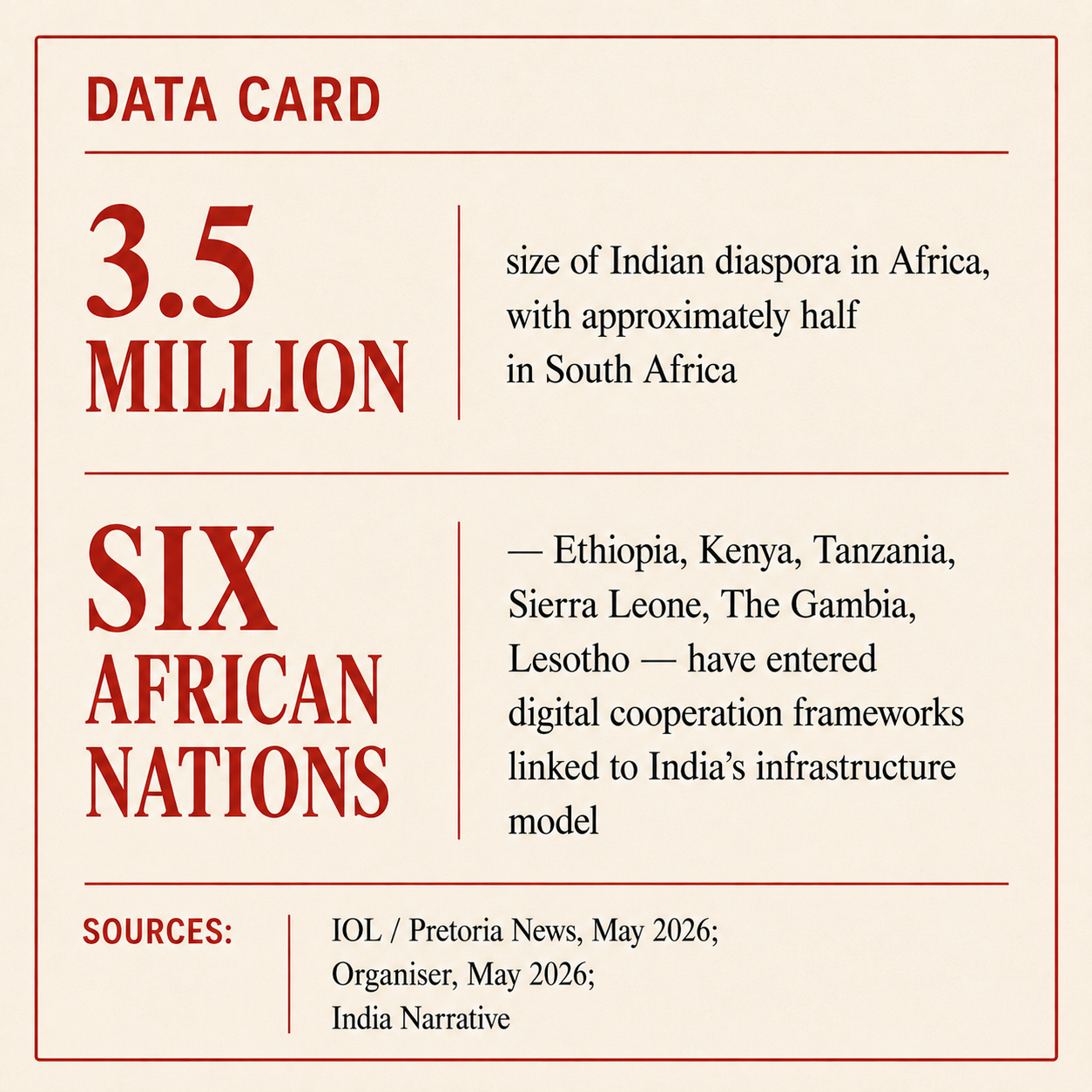
The fourth India-Africa Forum Summit wrapped May 31 in New Delhi, producing a framework for cooperation across digital public infrastructure, fintech, telemedicine, and e-governance. Countries including Ethiopia, Kenya, Tanzania, Sierra Leone, and Lesotho entered agreements linked to India’s digital identity and payments models — systems that have reshaped how India’s 1.4 billion people access finance, welfare, and government services. The summit’s framing was deliberately South-South: India and Africa as co-architects of a new global technology layer, outside Western platform capture and outside the China infrastructure model that has drawn criticism across the continent. Africa has an Indian diaspora of approximately 3.5 million people, with roughly half in South Africa. The people-to-people infrastructure is real.
What the summit did not fully resolve is who controls the data. India’s digital public infrastructure is effective and scalable. It is also a centralized identity system with significant surveillance capacity. Exporting that model to African nations with varying levels of democratic accountability and civil society strength is not inherently a partnership of equals — it depends on the governance structures built around the technology, the contractual terms of data sovereignty, and whether localization is real or rhetorical. The summit announced a “People-to-People Partnership 2.0” framework for 2026–2036. What it means in practice will be determined by implementation, not by the theme. Reporting by IOL, Organiser, and India Narrative tracked the summit’s close.