
Internal records reviewed by The Guardian show growing concern among local officials that residents are struggling to distinguish between federal immigration agents and local law enforcement. Reports from multiple states describe masked officers, unmarked vehicles, and overlapping enforcement tactics that make it unclear who is conducting operations. Officials warn that the confusion is discouraging residents from engaging with police, even in routine situations.
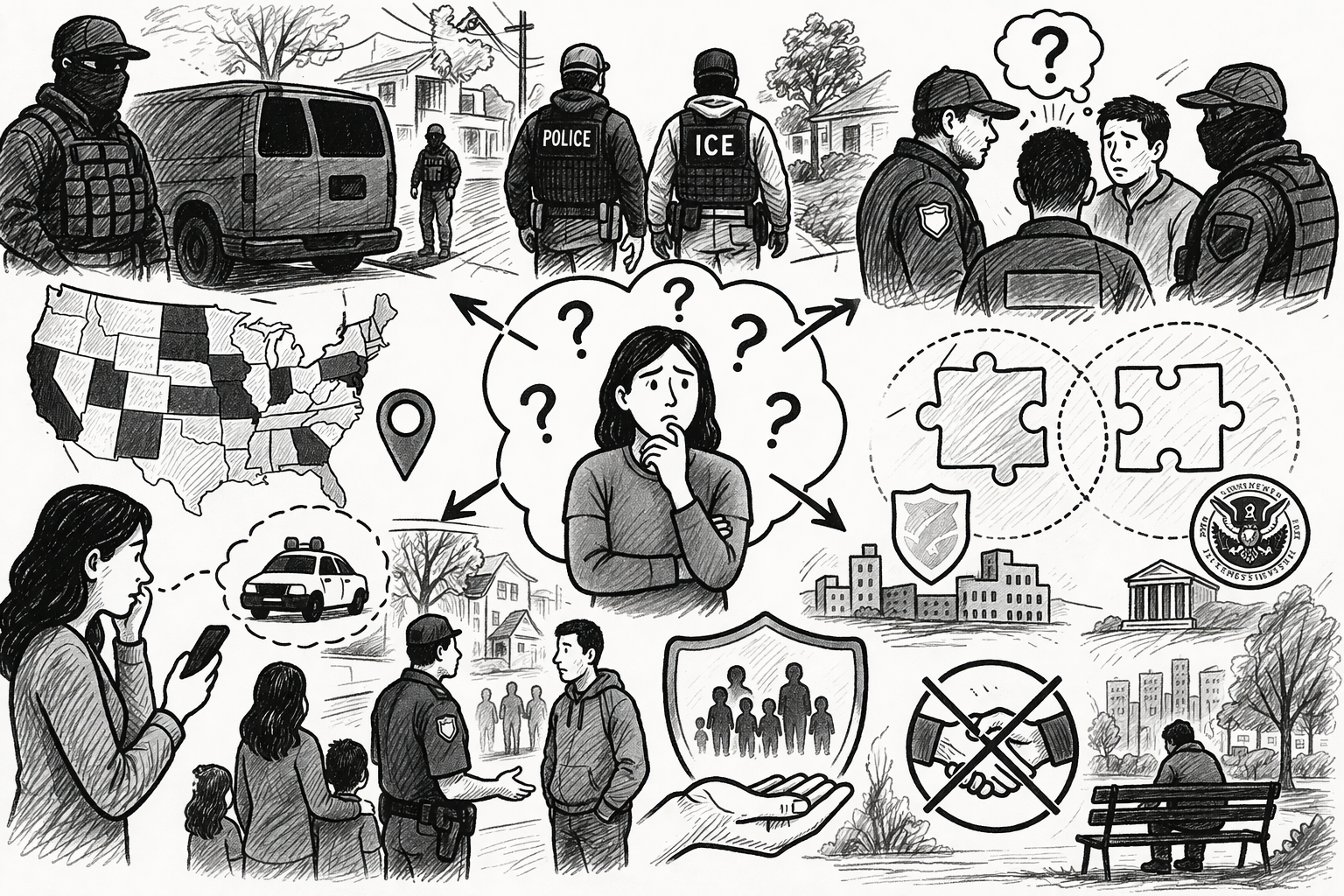
The issue emerges as immigration enforcement expands beyond the border into interior communities, where federal and local jurisdictions increasingly intersect. In at least seven states, officials have documented instances where residents avoided contacting law enforcement out of concern that any interaction could involve immigration consequences. That hesitation affects not just undocumented individuals, but broader communities navigating uncertainty about authority and risk.
What is being disrupted is not only perception but function. Policing depends on a baseline level of trust — that residents understand who officers are and what authority they carry. When that clarity breaks down, cooperation declines. Reporting of crimes, participation in investigations, and everyday interactions all become more limited, reducing the effectiveness of public safety systems.
This overlap reflects a broader shift in how enforcement operates. Immigration policy is no longer confined to clearly defined federal spaces. It is appearing within local environments, using tactics that resemble traditional policing while carrying different implications. The result is a blending of roles that were once more distinct, creating ambiguity at the point of contact.
The consequences extend beyond immigrant communities. When residents begin to associate any law enforcement presence with potential immigration action, the deterrent effect spreads. People who might otherwise engage with police withdraw, altering how communities interact with institutions meant to serve them.
The deeper pattern is one of system convergence without coordination. As enforcement expands, boundaries blur, but the frameworks governing those systems do not fully adjust. The result is a loss of clarity that weakens trust, making it harder for institutions to function as intended even as their presence becomes more visible.