
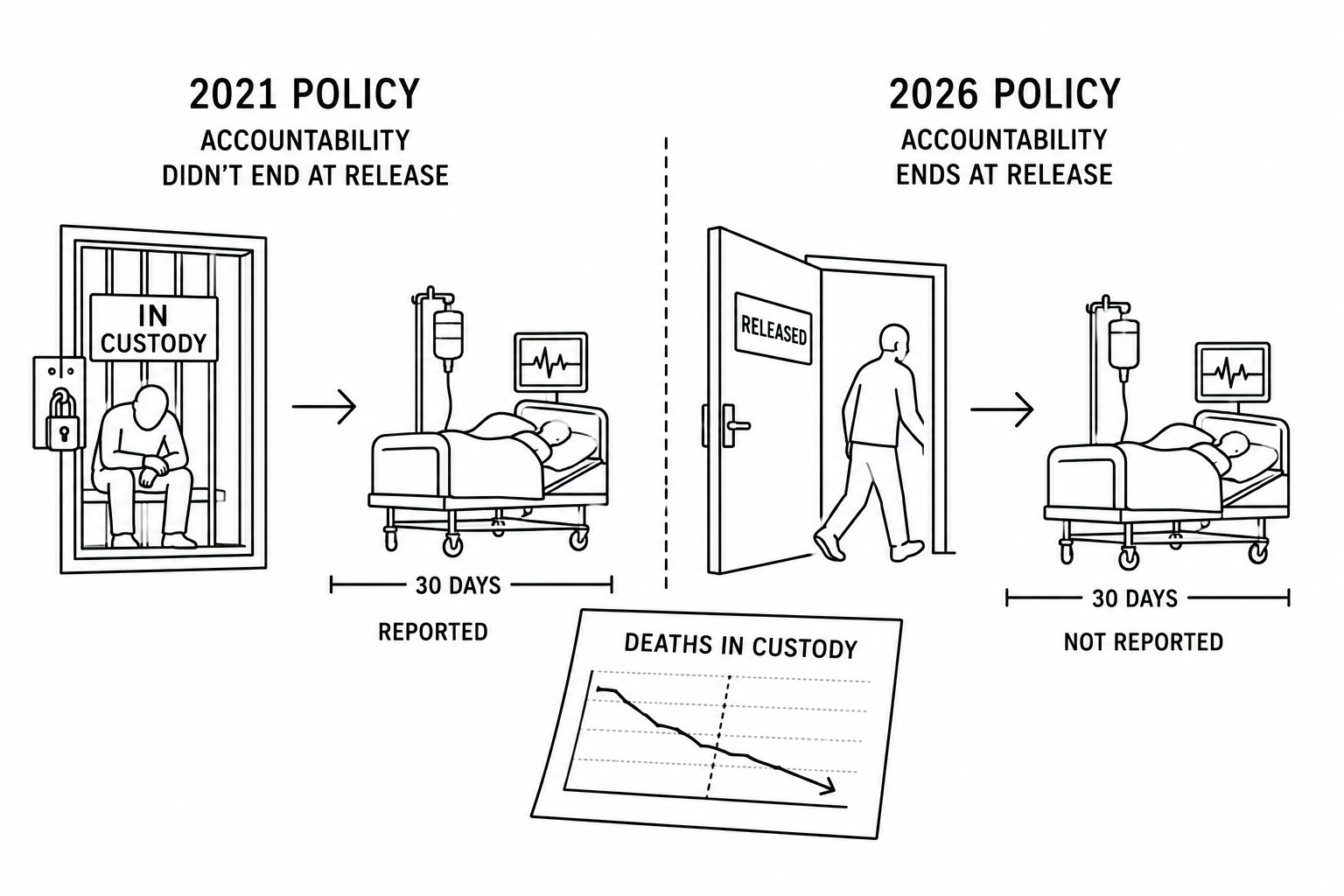
Immigration and Customs Enforcement will no longer publicly report the deaths of detainees who die within 30 days of release from custody, according to Associated Press reporter Michael Biesecker. Acting ICE director David Venturella confirmed the change in a memo sent to agency employees on June 4, 2026, stating the agency is “eliminating its requirement to report deaths that occur within 30 days of people being released from its custody.” The change takes effect immediately. It rescinds a policy adopted in 2021 specifically to prevent ICE from avoiding accountability by releasing critically ill detainees just before death — a practice documented in cases where detainees who were brain-dead or suffering from active infection were discharged and died shortly after. At least 18 detainees have died since January 1, 2026 — a pace on track to surpass 32 deaths recorded in 2025, which was itself the deadliest year for ICE detainees since 2004.
The 2021 policy existed because the mechanism it addressed was documented and deliberate. Detainees who deteriorated inside detention facilities were sometimes transferred to hospitals or released rather than treated in custody — meaning their deaths occurred outside the official count. The 30-day reporting window was designed to close that gap. Dr. Sanjay Basu, a University of California-San Francisco epidemiologist who has analyzed more than 270 ICE custody deaths, named the consequence directly: the policy change will “make the mortality statistics appear lower without any actual improvement in care.” He added: “The period immediately following release is when deaths attributable to inadequate care during confinement become apparent.”
The DHS response to the change was explicit. A spokesperson stated: “Under this updated policy, when an individual is no longer in ICE custody then ICE will no longer be responsible for monitoring or reviewing deaths that may occur.” DHS called the change “common sense.” That framing — responsibility ending at the moment of physical release rather than at the conclusion of care — is the structural argument the piece is built around. The event of release and the event of death are being administratively separated. Whether the conditions producing the death originated in custody is no longer the agency’s official concern.
This dynamic has a parallel in the ICE detention coverage SSC documented in the Friday Forward this week — the Albanian man who pulled out his own tooth after months of untreated dental pain, the Romanian man who had a stroke on a video call with his daughter after a facility repeatedly failed to administer his post-cardiac surgery medications. Those cases were documented under the existing reporting standard. Under the new standard, deaths in similar circumstances that occur within 30 days of release will no longer appear in ICE’s public accounting — regardless of whether the conditions that produced them developed entirely in custody.
The mechanism at work is not unique to immigration enforcement. Institutions shape public understanding through definitions, classifications, and reporting standards. Unemployment figures depend on how workers are categorized. Crime rates depend on how offenses are recorded. Housing shortages depend on how available units are measured. Administrative definitions are not technical choices in isolation — they determine what information enters public debate and what disappears from it. When ICE changes what counts as a death in custody, it changes what the public can measure about the consequences of detention.
Congress has legally required ICE to report in-custody deaths publicly since the DHS Appropriations Bill of 2018. That obligation covers deaths in custody. The 30-day post-release rule extended accountability beyond the moment of discharge. Eliminating the post-release window does not violate the letter of the congressional mandate — it narrows the category the mandate was designed to capture. The law requires reporting. The agency has redefined the population to which the law applies.
Modern governance relies on metrics to establish accountability. As agencies revise what they count, report, and publish, debates over transparency become debates over power. Institutions do not simply administer policy — they also define the public record by which that policy will ultimately be judged. The ICE reporting change is not a bureaucratic update. It is a decision about what the record will show.