
Part of The Access Shift — examining how access is being quietly reshaped across American life.
Houston did not need a formal simulation to understand what the World Cup will demand of it. March provided one — unplanned, uncontrolled, and more instructive for both of those qualities.
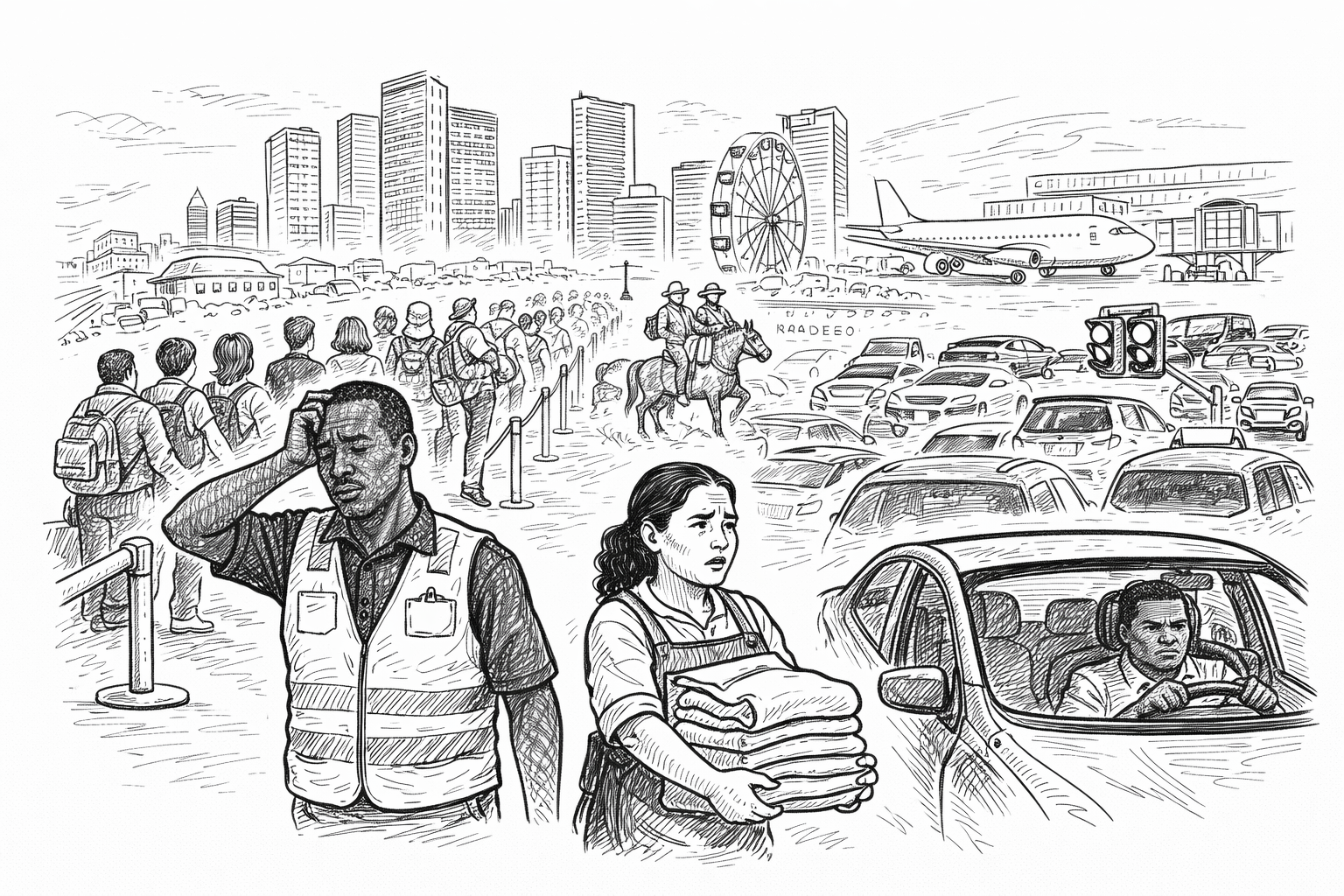
Between the Houston Livestock Show and Rodeo, spring break travel, major sporting events, and a surge in convention activity, the city experienced what can only be described as an organic stress test. Airport lines stretched into hours. Ride-share wait times surged to the point where travelers were making alternate arrangements mid-journey. Staffing gaps that are manageable under normal volume became visible and consequential when that volume spiked simultaneously across multiple systems. The city did not fail. But the places where it bent were hard to miss for anyone who was paying attention — and the World Cup, which arrives this summer with a scale that dwarfs anything March produced, will apply pressure to those same places with considerably less forgiveness.
The numbers frame the challenge but do not capture it fully. The rodeo alone draws more than 2.5 million visitors annually, making it one of the largest events of its kind in the world. George Bush Intercontinental Airport handles over 45 million passengers a year. But those figures assume distribution across time — the rodeo over weeks, the airport’s volume spread across seasons and daily rhythms. What March revealed is what happens when those flows collide inside a compressed window, when the city’s hospitality, transportation, and service infrastructure are all running near capacity at the same moment. The stress test was not about whether the infrastructure exists. It was about whether it holds when everything is asked of it simultaneously.
What also became visible in March, though it received less attention in the coverage of lines and wait times, is who absorbs the friction when systems strain. The ride-share surge that inconveniences a convention attendee is the same surge that extends a shift for the driver who cannot log off. The staffing gaps at airport concessions and hotel lobbies are not abstract operational metrics — they are the working conditions of the people, disproportionately Black and Latino in Houston’s hospitality economy, who are doing the physical labor of making the city’s tourism ambitions legible to the world. When the system is under pressure, that pressure does not distribute itself evenly. It concentrates at the points where labor is least compensated, least protected, and most exposed to the direct experience of volume without the resources to manage it.
City officials have acknowledged that some of the most critical variables sit outside local control. TSA staffing, federal immigration processing, airline coordination, and ground transportation infrastructure all operate within systems Houston cannot direct. Yet those systems will determine how the city is experienced by the tens of thousands of international visitors arriving for the World Cup — and more importantly, how the workers sustaining that experience are supported or left to absorb whatever those systems fail to provide. As SSC has documented in its World Cup coverage, the public spending commitments are locked in, the security infrastructure is being built, and the surveillance systems being installed for the tournament are intended to remain long after it ends. What is less settled is whether the communities doing the work of hosting will be positioned to benefit from what they are being asked to sustain.
The World Cup has been framed consistently as an opportunity — for visibility, for economic momentum, for Houston to demonstrate to a global audience what the fourth-largest city in the United States is capable of hosting. What March suggests is that it is also an exposure. Not of whether Houston can host — the city has the venues, the hotels, the airport capacity, and the cultural infrastructure to manage a tournament of this scale. The exposure is more specific than that. It is of how tightly Houston’s success depends on systems it does not control, workers it has not fully invested in, and an infrastructure that bent visibly under a month that was not designed to break it. The World Cup will not be as forgiving as March was. The question is whether the people who make Houston run will be any better resourced to meet it when it arrives.