
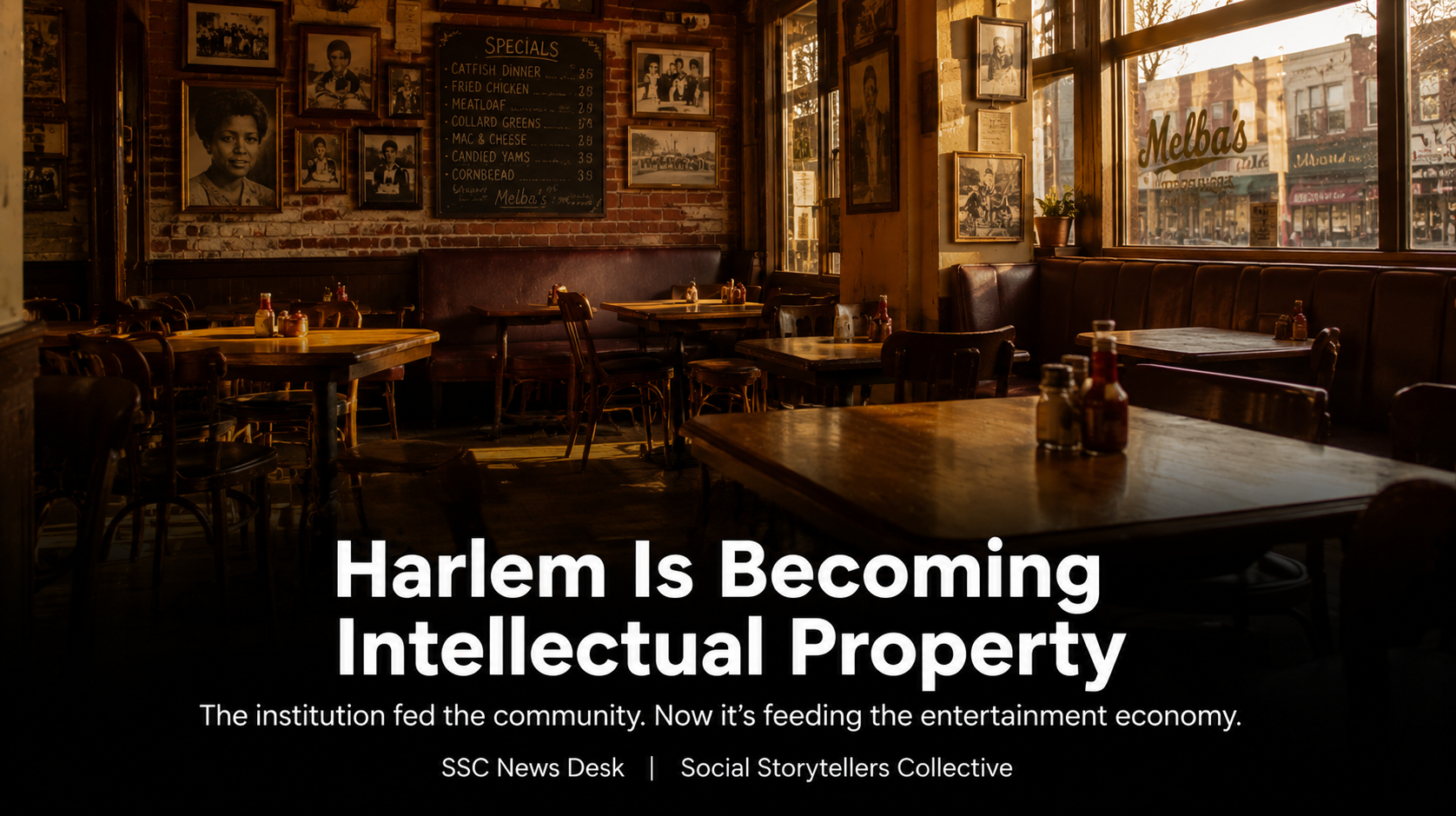
What began as a neighborhood restaurant in Harlem is now being reframed as franchise-ready cultural storytelling. Apple TV is developing American Comfort, a comedy series inspired by restaurateur Melba Wilson and her restaurant Melba’s, with Oprah Winfrey attached as producer. On the surface it reads like another feel-good adaptation story: beloved restaurant, community legacy, charismatic founder, television expansion. Culturally, the move says something larger about where media companies are now sourcing value.
For decades, Harlem restaurants like Melba’s functioned as physical institutions first — gathering spaces built on repetition, familiarity, and neighborhood trust. The business model depended on people physically showing up. What streaming platforms increasingly recognize is that these spaces also contain narrative equity. The restaurant is no longer just selling chicken and waffles. It is selling memory, identity, atmosphere, migration history, Black entrepreneurship, and community mythology in a form that can travel globally through a screen.
That transition matters because Hollywood historically extracted from Black culture without allowing Black institutions to remain central owners of the narrative. The neighborhood became aesthetic backdrop while the actual businesses and community ecosystems stayed economically disconnected from the long-term value created. What makes this adaptation notable is that Melba Wilson is reportedly serving as executive producer and participating in storyline development — a signal that authenticity now carries market weight. Audiences are increasingly sensitive to whether cultural stories feel observed from the outside or authored from within.
The timing aligns with a broader crisis in the streaming economy. Platforms are struggling to produce concepts specific enough to break through algorithmic sameness. Generic prestige television is generating less loyalty. Hyper-locality still cuts through. That is why industries are mining culturally dense neighborhoods, legacy family businesses, and regionally iconic institutions for adaptable IP. The local becomes globally monetizable precisely because it feels real.
Food television has also changed. Earlier generations of culinary programming focused on technique, celebrity chefs, or competition formats. The newer model treats restaurants as social ecosystems — spaces where viewers watch community rituals, intergenerational relationships, neighborhood transformation, and aspirational belonging rather than recipes. Melba’s is not being adapted because executives discovered soul food. It is being adapted because the restaurant already functions as narrative architecture.
The celebration has an economic subtext worth naming. Harlem has spent years navigating aggressive gentrification, rising commercial rents, tourism branding, and cultural commodification. A television series centered on a Harlem institution inevitably participates in that transformation. The question is whether cultural visibility strengthens the community that produced the institution or accelerates the market forces reshaping it. As we’ve examined in our coverage of how algorithmic systems determine which communities surface and which remain outside circulating networks, recognition can produce investment, but it can also produce extraction — and historically Black neighborhoods know that tension well.
The symbolism still matters. A Black woman-owned Harlem restaurant becoming an Apple TV comedy series reflects a structural shift in how cultural authority gets valued and who captures that value. The restaurant is no longer just a restaurant. It is IP — and the communities that built these institutions deserve more than a credit.