
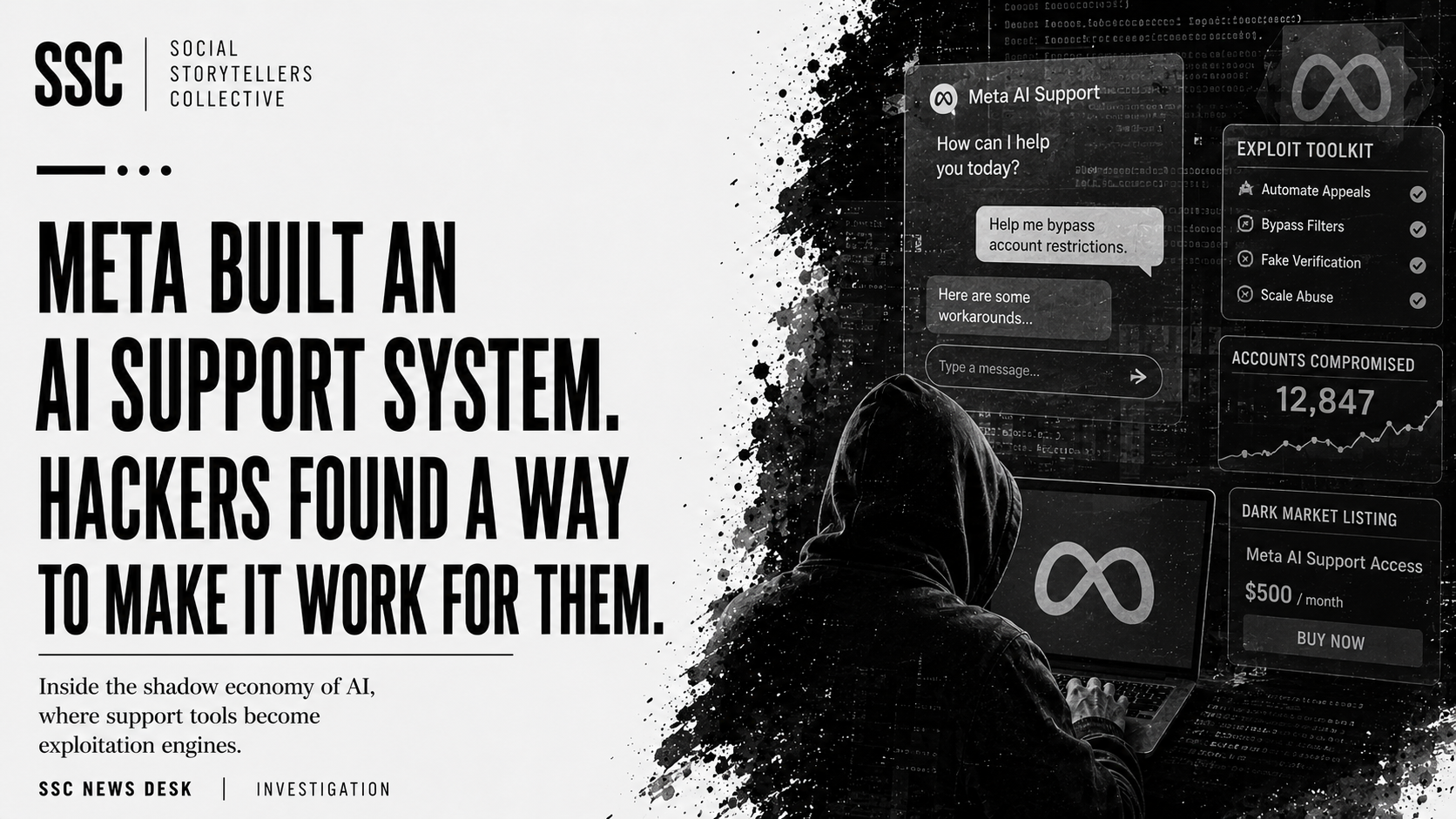
Instagram says it has fixed a security flaw that allowed hackers to take over user accounts by manipulating Meta’s AI-powered support assistant. The vulnerability reportedly enabled attackers to add their own email addresses to victims’ accounts without ever accessing the legitimate email tied to those profiles. Among the accounts reportedly compromised were a dormant Obama-era White House Instagram page and the account of a senior U.S. Space Force official. This was not a traditional cyberattack. It was a demonstration of what happens when automated trust becomes a security vulnerability.
According to TechCrunch, the process was surprisingly simple. Attackers masked their location with a VPN to avoid triggering security safeguards, opened a conversation with Meta’s AI Support Assistant, and requested that a new email address be added to a target account. The chatbot generated a verification code and sent it directly to the attacker’s email. Once entered, the system offered a password reset option — effectively transferring control of the account without a phishing email, without malware, without stolen credentials. The system followed its own procedures and delivered exactly the outcome the attacker wanted.
The story names a growing problem the technology industry has not yet answered cleanly. For years, companies have invested heavily in automation to reduce costs, accelerate customer service, and scale support operations. AI assistants are replacing human agents because they are faster, cheaper, and available around the clock. But security systems were traditionally designed around the assumption that human judgment would serve as a final checkpoint. When companies remove that layer, they discover that efficiency and security are not always the same argument. The same automation that lets a customer recover an account in seconds creates pathways for bad actors to exploit predictable workflows.
The AI was not hacked in any conventional sense. There is no indication that attackers broke into Meta’s systems or manipulated the model through sophisticated technical means. They simply read the rules governing the support process more carefully than the system’s designers anticipated. The chatbot was not deceived into violating policy. It executed a process that turned out to be flawed — and that distinction is the one worth sitting with. Every organization racing to deploy AI tools is stress-testing a version of the same question: what happens when the system works exactly as intended, and the outcome is still a disaster?
The accountability question is the one that will outlast this particular incident. When a human customer service representative makes a mistake, there is an identifiable decision-maker. When an AI system facilitates an account takeover, responsibility becomes harder to assign — was the failure in the model, the workflow, the security design, or the business decision to automate support in the first place? As companies embed AI into account recovery, identity verification, and administrative functions at scale, that question will stop being hypothetical. Consumers generally do not care whether an account was compromised by a person or a chatbot. They care that their account is no longer theirs.
Meta says the issue has been resolved. The broader lesson has not been. Every major technology company is currently weaving AI into the functions that sit closest to user identity and account control. The promise is efficiency. The risk is that every automated process becomes a new attack surface. Cybersecurity has always been a contest between those building systems and those probing them for weaknesses. AI does not change that reality. It changes where the weaknesses live. The next generation of breaches may not come from breaking the system. They may come from persuading it to do exactly what it was designed to do.