
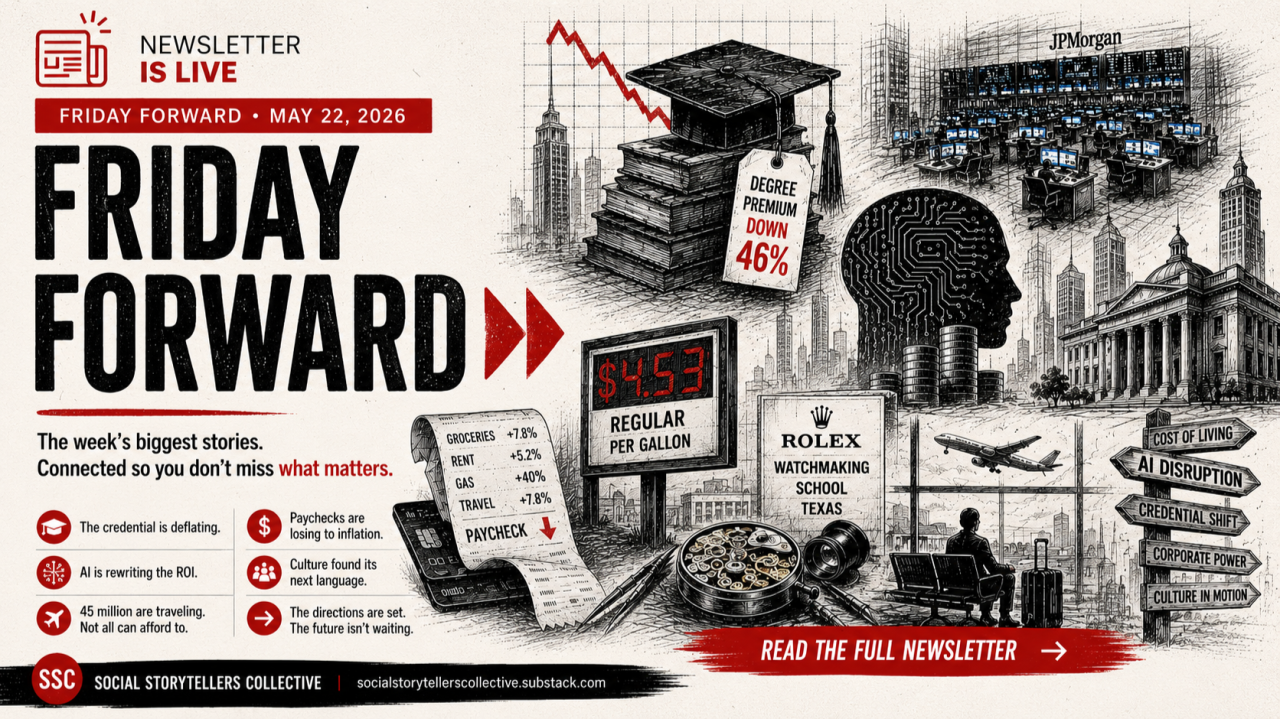
Read the Room – Friday, May 22, 2026
From deflating credentials to AI payouts to SNAP cuts — this week, the systems Americans were promised are being revised without them in the room.
May 22, 2026 | Social Storytellers Collective
What a week.
Not in a breathless way. In the way where you sit down Friday morning and realize that everything published between Monday and now was actually the same story told from a dozen different angles. The systems Americans were told would deliver mobility — the degree, the paycheck, the platform, the safety net, the brand promise — are being repriced, restructured, or quietly retired. The people setting those terms are moving faster than anyone can audit, challenge, or negotiate. And the people absorbing the disruption are doing so, largely, alone.
That was the week. Here’s how it actually went.
The Credential Is Deflating
We ran something different this week — a four-part series examining the economics of the American degree from every angle the argument demands. Read them together. The argument they make is the argument the week required.
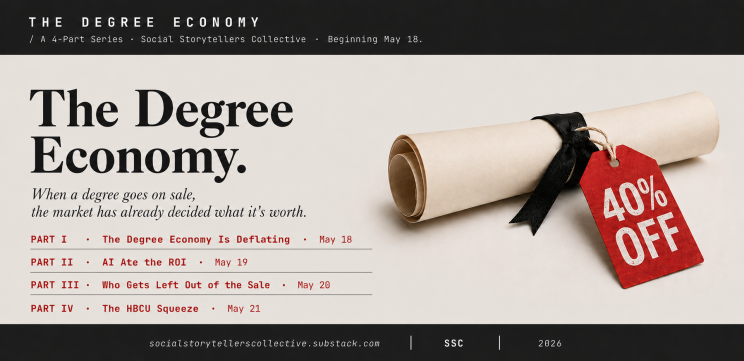
It starts where the feeling starts. In The Credential Is Deflating, SSC documents how the degree still costs what it always cost — tuition up, debt up, time invested unchanged — while the premium it returns has been cut nearly in half over the past decade. That gap between what the credential demands at the front end and what it delivers at the back is not a market correction. It is a structural repricing that the institutions selling the credential have no financial incentive to announce.
AI Ate the ROI follows the money to where it’s disappearing. The jobs a bachelor’s degree was designed to unlock — the analyst roles, the coordinator positions, the entry-level professional work that was supposed to be the first rung — are the jobs being automated first. This is no longer a distant warning. Jamie Dimon said it out loud on Bloomberg Television from Shanghai this week: JPMorgan, America’s largest bank with roughly 320,000 employees, will hire more AI specialists and fewer bankers going forward. Standard Chartered announced 8,000 support roles eliminated by the end of the decade. Goldman Sachs is constraining headcount. As SSC documented in JPMorgan Is Replacing Bankers With AI. The CEO Said So On Bloomberg. Wall Street Already Knew., the direction is consistent across every major institution. The language varies. The math runs one way.
The pivot companies have positioned as the more equitable alternative is skills-based hiring — and in Who Gets Left Out of the Sale, SSC asks the follow-up question that pitch never answers: whose skills, assessed by whose platform, evaluated by whose algorithm, weighted by whose historical data? The credential wasn’t a perfect system. What’s replacing it isn’t more neutral. It is just less visible.
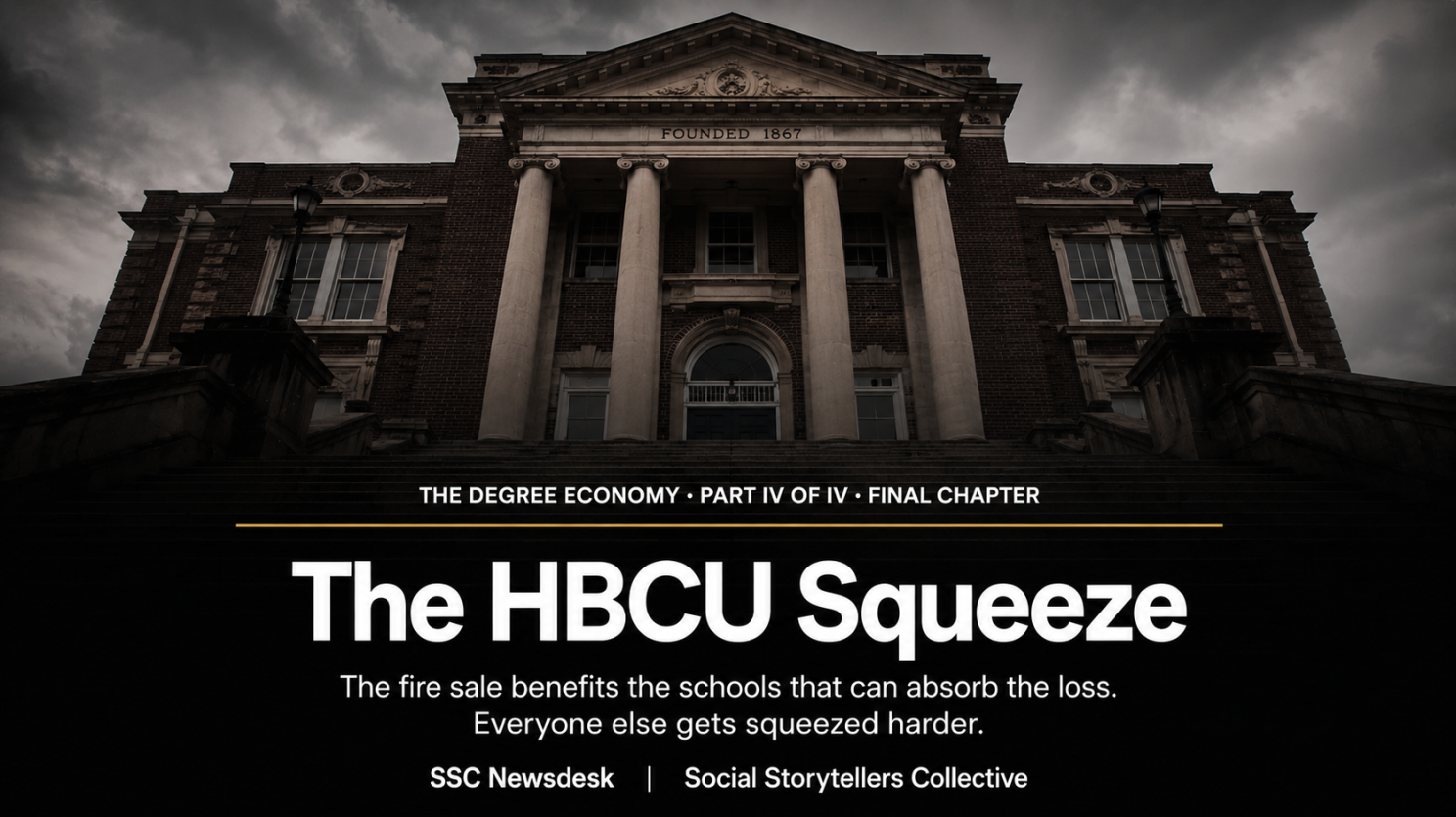
The series closes where it has to close. In The HBCU Squeeze, SSC examines the institutions that built credential pathways for communities that had no other on-ramp — that produced outcomes that outperformed the resources they were given, and are now watching the credential itself be questioned at the same moment their federal funding is under pressure. The margin was never there. The pressure now is substantial.
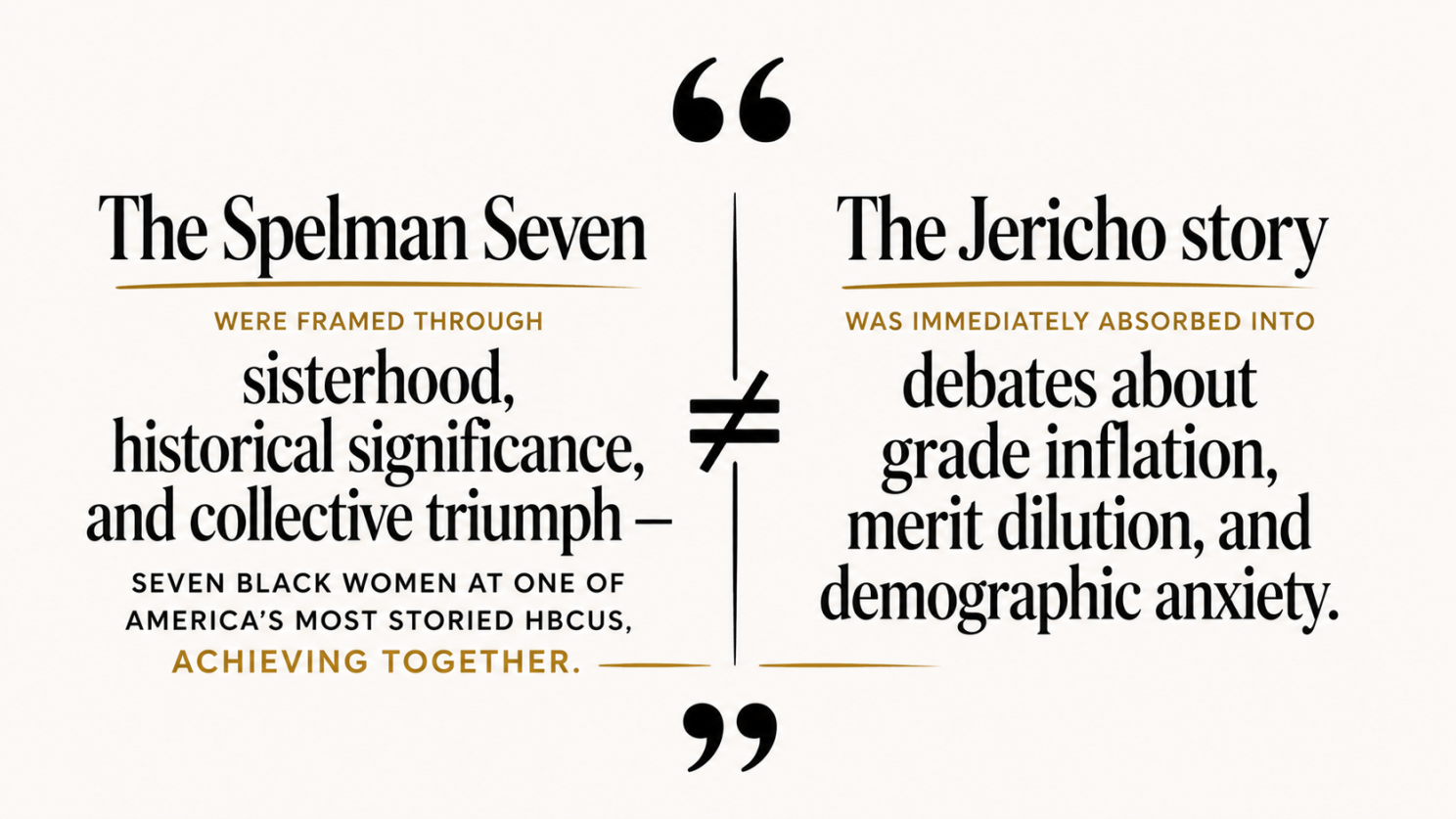
The week gave us a live illustration of what all four parts are tracking. In The Valedictorian Is Becoming a Category, Not a Person, SSC examines two stories that landed in the same week — the “Spelman Seven,” seven Black women graduating together as co-valedictorians at Spelman College, celebrated through the lens of sisterhood and collective triumph; and a Long Island high school producing 21 valedictorians in a single graduating class, immediately absorbed into debates about grade inflation and demographic anxiety before the ceremony was scheduled. The students earned straight A-plusses for four years. The internet decided what that meant. The valedictorian is becoming a category. The question is who gets to inhabit it without their achievement being converted into someone else’s argument.
And in Luxury Brands Are Quietly Rebuilding the Skilled Trades Economy, SSC documents how Rolex opened a tuition-free watchmaking school in Texas — not because watchmaking became trendy, but because fewer than 2,000 certified watchmakers remain in active practice nationwide and the traditional pipeline stopped producing what the market needed. Career paths reportedly reaching $95,000 annually. No degree required. While the credential economy deflates at the top, precision trades are becoming scarcer and more valuable. The companies benefiting from those skills have decided they can no longer wait for the educational system to produce workers on its own.
The Numbers Running the Wrong Direction
The economy delivered a set of numbers this week that require reading together to understand what’s actually happening underneath the headlines.
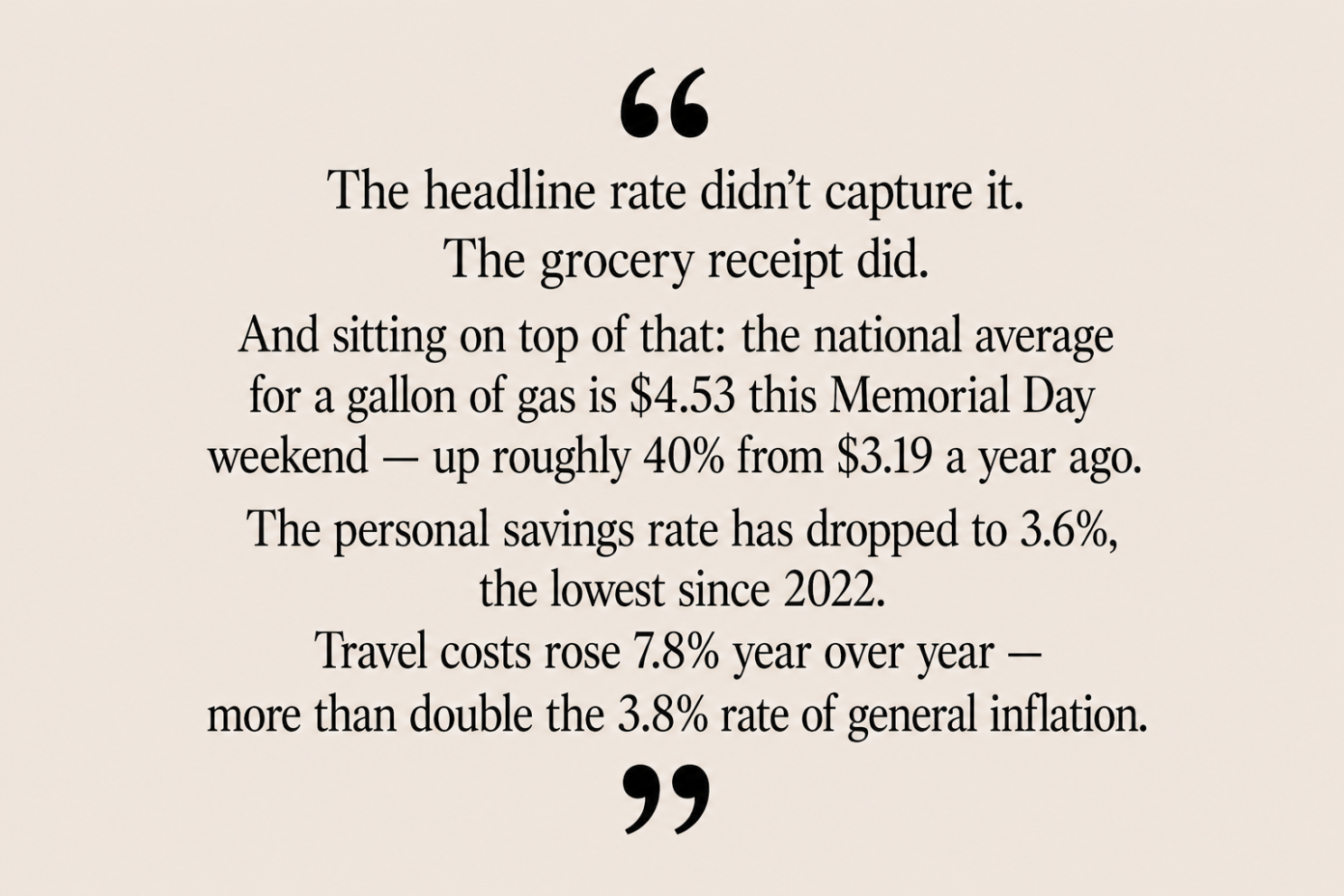
In For the First Time in Three Years, Your Paycheck Is Losing to Inflation, SSC examines how the gap opened — not because wages collapsed, but because prices held while wage growth decelerated. The headline rate didn’t capture it. The grocery receipt did. And sitting on top of that: the national average for a gallon of gas is $4.53 this Memorial Day weekend — up roughly 40% from $3.19 a year ago. The personal savings rate has dropped to 3.6%, the lowest since 2022. Travel costs rose 7.8% year over year — more than double the 3.8% rate of general inflation.
In 45 Million People Are Traveling This Weekend. Not All of Them Can Afford To., SSC reports that 45 million Americans are on the move this weekend — a record by AAA’s count — while nearly 40% of households earning $66,000 or less have no summer travel plans at all. Zero. And in 53 Million People Are Flying This Summer. Not All of Them Can Afford To., SSC tracks how United Airlines is projecting a record 53 million passengers between June and August — a number that looks different once you understand that United already cut capacity by approximately 5% in March, shed its cheapest fare classes, and watched last-minute Caribbean fares rise 74% after jet fuel spiked to $4.78 a gallon following the Iran strikes. The record is being set by one America. The other is watching the highway signs from where they are.
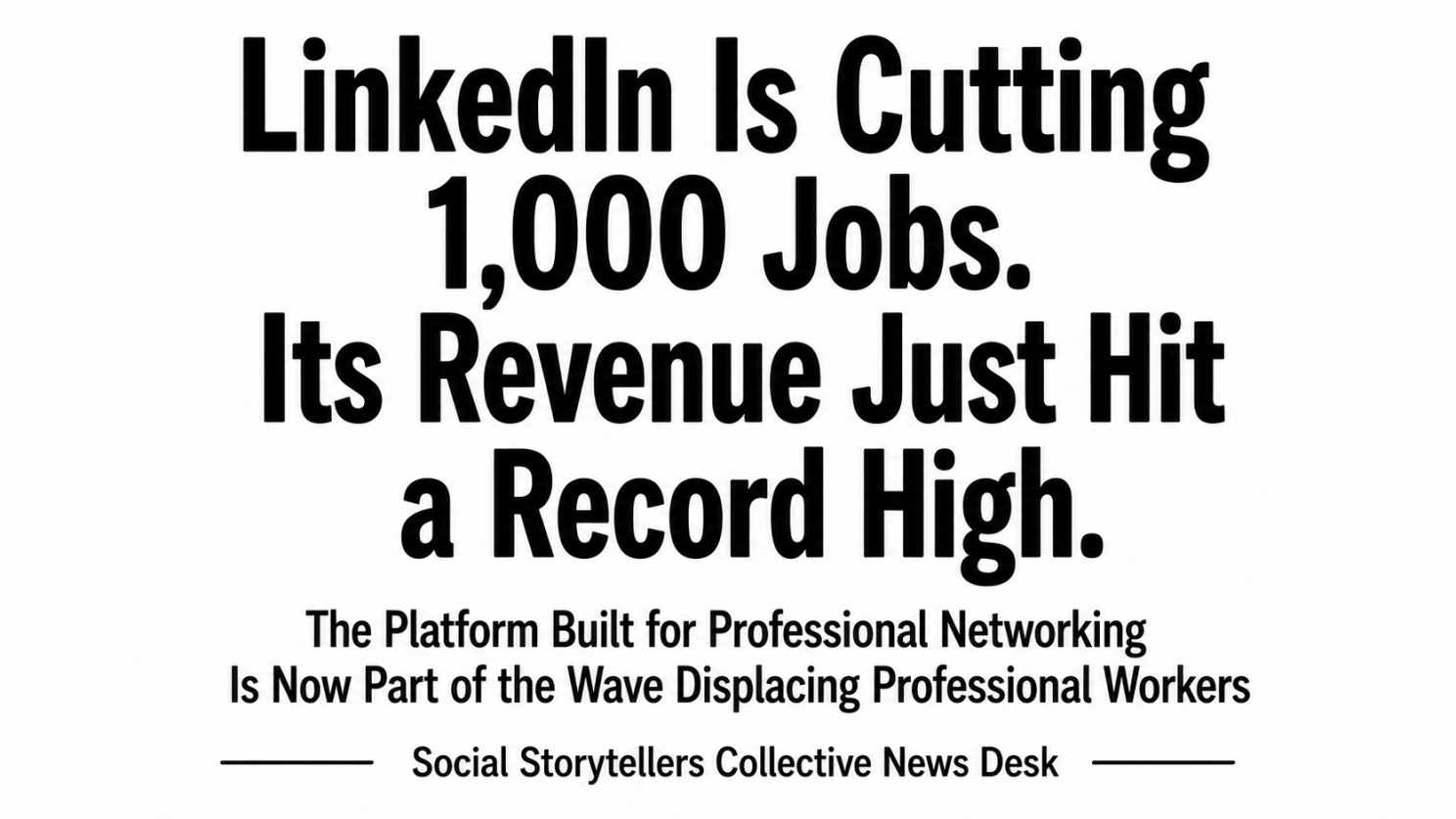
The layoff stories arrived with the same architecture they’ve been arriving with all year. LinkedIn Is Cutting 1,000 Jobs. Its Revenue Just Hit a Record High. — LinkedIn cut approximately 5% of its global workforce the same week Microsoft reported the platform crossed record revenue. In Walmart Is Not Calling It a Layoff. It Is a Layoff., Walmart — $680 billion in annual revenue — told roughly 1,000 corporate employees to relocate to Bentonville, Arkansas or Sunnyvale, California — or exit. SSC named the mechanism clearly: relocation requirements are not logistical asks. They are filtering tools. The people who cannot move exit voluntarily. The company reduces headcount without the paperwork. The people who leave are the ones the requirement was designed to remove.
Who Owns What You Built
The AI and platform stories this week converged on the same argument from multiple directions: the terms of what you own, what you built, and what you can access are being rewritten — without your input.
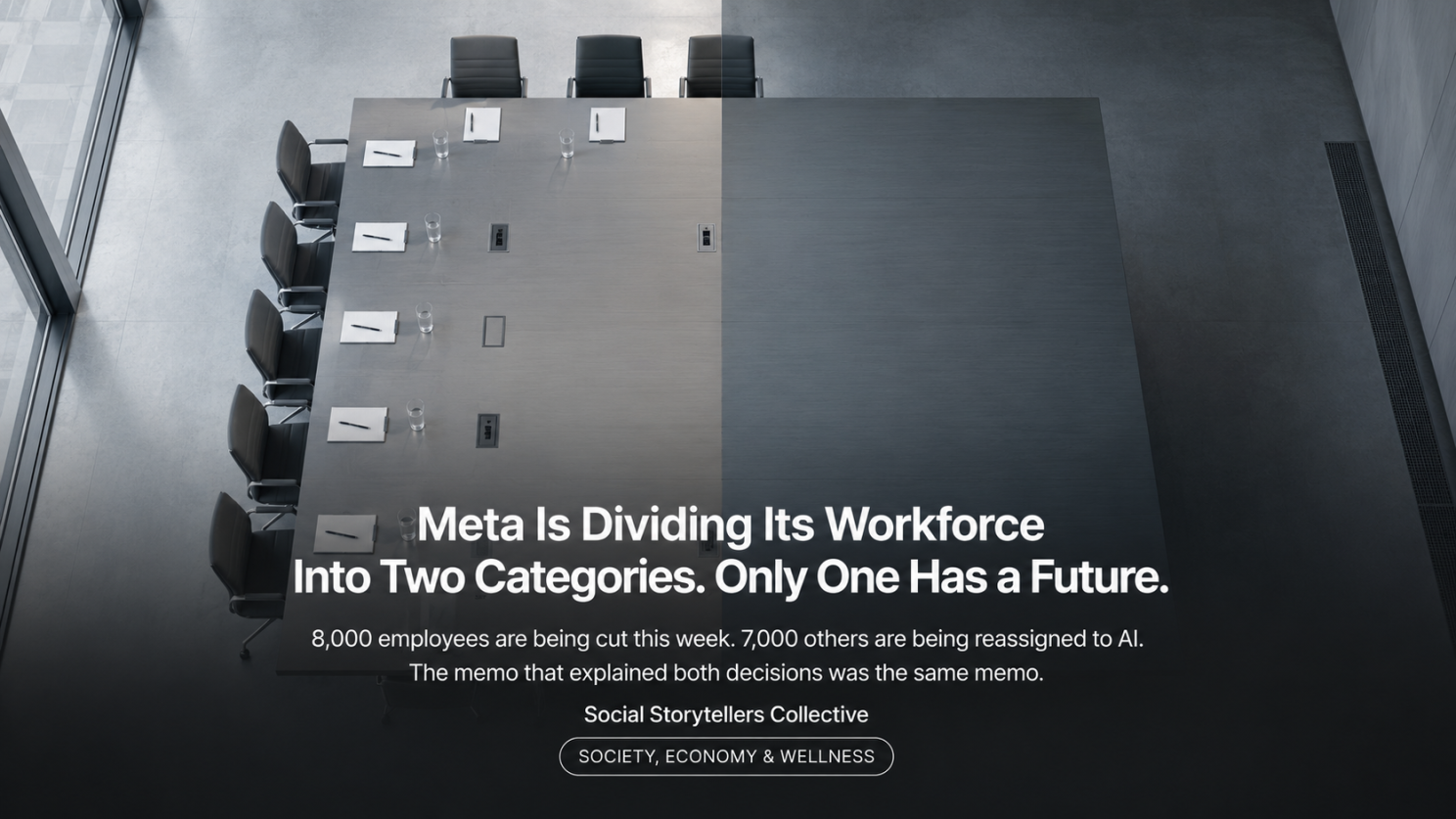
In Meta Is Dividing Its Workforce Into Two Categories. Only One Has a Future., SSC documents how Meta cut 8,000 employees — roughly 10% of its workforce — while simultaneously reassigning 7,000 others to AI roles. Both decisions came from the same internal memo. Mark Zuckerberg divided his workforce into the people the AI economy needs and the people it has already decided it doesn’t. The sorting is not random. It follows the contours of existing skill distribution and educational access — which means it follows, with uncomfortable precision, the contours of existing inequality. Who gets reassigned and who gets the 4 a.m. email is not a mystery. It is a decision. And the decision has a shape.
In OpenAI’s $6.6 Billion Insider Payout Reveals Who the AI Economy Is Actually Building Wealth For, SSC documents how during October’s financing round, more than 600 employees and early investors cashed out $6.6 billion— 75 people took the maximum $30 million each — while the public mission remains the democratization of intelligence. The private mechanics are the consolidation of wealth at the precise moment the technology is being used to justify mass displacement across the labor market. The companies cutting workers cite AI efficiency. The people who built the AI are cashing out.

What runs alongside that story is The Blueprint Still Belongs to the Worker. When Atlassian laid off a senior systems engineer named Vasilios Syrakis — nearly eight years building critical backend infrastructure — he uploaded a 38-minute educational video walking the internet through the architecture he helped build. The video went viral. Atlassian owns the product. Syrakis carried the blueprint in his head. In the modern economy, that blueprint can become its own form of capital — if the person holding it decides to make it public before the company decides they’re no longer needed.
Google Doesn’t Want You to Search the Web Anymore extends the same argument across the open internet. At its 2026 Google I/O conference, Google announced it is rebuilding Search into an AI operating layer designed to answer questions directly, perform tasks autonomously, and eventually act on behalf of users without requiring them to navigate the open web at all. Google spent decades training businesses, journalists, and institutions to optimize themselves for discoverability inside Search — and is now redesigning the interface so users may no longer need those destinations at all. When the interface becomes the authority, the question of whose knowledge gets synthesized and whose gets skipped becomes more consequential, not less.
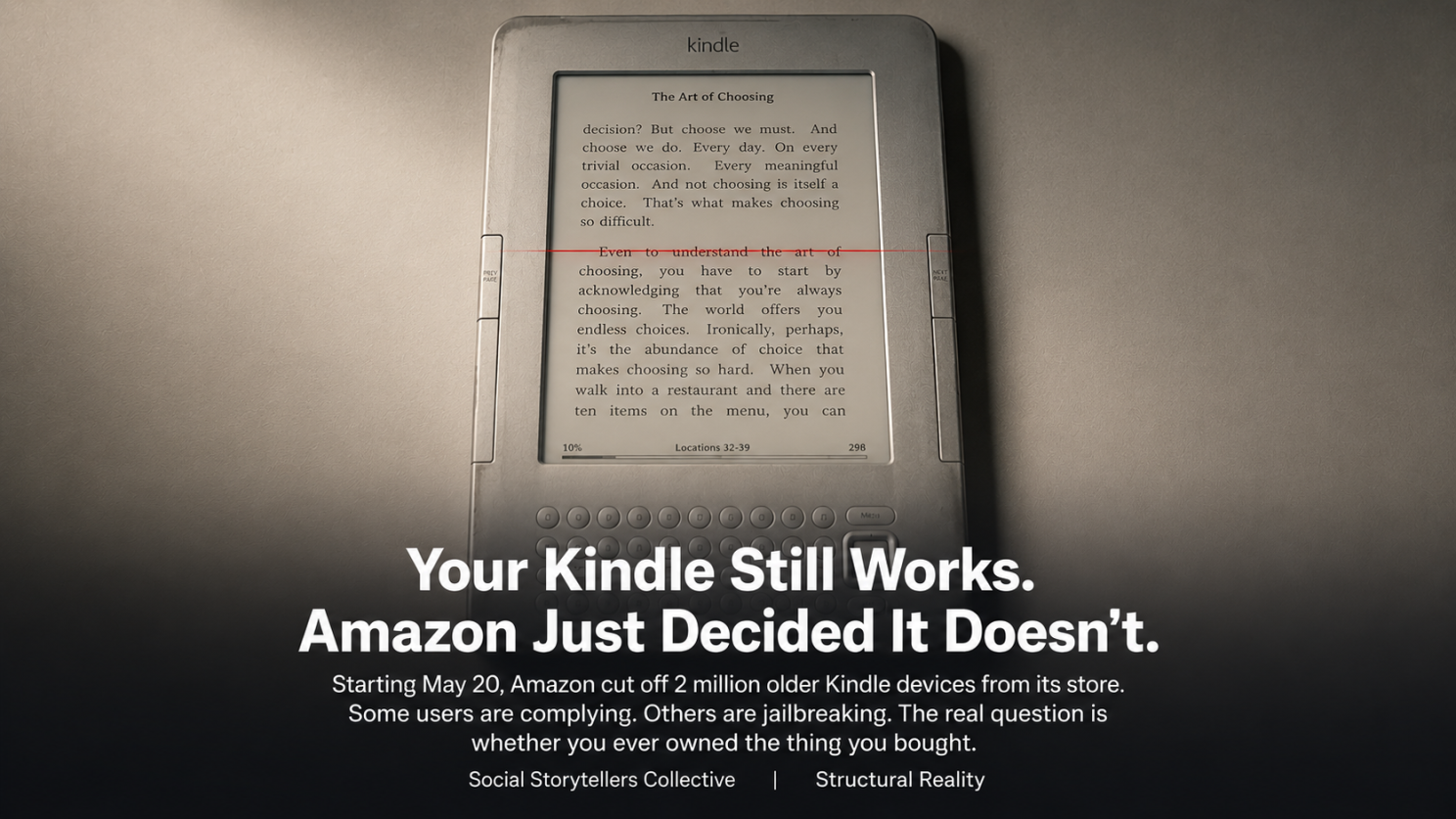
In Your Kindle Still Works. Amazon Just Decided It Doesn’t., Amazon cut off 2 million older Kindle devices from its store on May 20 — not because the hardware failed, but because Amazon controls the ecosystem the hardware depends on to function as advertised. A physical book purchased in 2007 still works in 2026. A Kindle purchased in 2007 has now been administratively disabled. And in The Conversation Is Becoming a Subscription Product, X capped free users at 50 posts per day and 200 replies — a deliberate reorganization of who gets to speak, how often, and at what cost. The platform that spent a decade optimizing for maximum engagement is now optimizing for maximum conversion. The crowd is still there. The free part is ending.
Power Moving Without Permission
The institutional stories this week followed the same architecture: decisions made faster than accountability can travel, landing hardest on the communities least positioned to absorb them.
In 4.3 Million People Have Already Lost Food Assistance. Most of Them Didn’t Know It Was Coming., SSC documents the steepest drop in SNAP participation in nearly three decades. The One Big Beautiful Bill Act included $187 billion in cuts to SNAP over the next decade — new work requirements, tighter eligibility timelines, administrative friction that is removing eligible people faster than the law’s explicit provisions require. The larger provisions haven’t even taken effect yet.
That story belongs next to Restricting Mail Abortion Access Would Hit Black Women First. Medication abortion accounts for 63% of all abortions in the U.S. Black women receive 40% of them. Hispanic women receive 21%. Those groups are also the most likely to be uninsured, living in Southern states with the fewest protections, and dependent on mail access because the in-person clinic infrastructure has been systematically depleted or banned outright. The Supreme Court provisionally allowed mail access to continue in Louisiana v. FDA — but left the legal question unsettled. Mail access was not a convenience for these women. It was the infrastructure.
In The Department of Justice Just Funded Its Own Conflict of Interest, SSC examines how the DOJ announced the “Anti-Weaponization Fund” — $1.776 billion drawn from the federal Judgment Fund — overseen by a five-member commission appointed entirely by Attorney General Todd Blanche, who before this role served as Donald Trump’spersonal defense attorney in the federal cases against him. The fund stops processing claims on December 15, 2028 — one month and five days before the next presidential inauguration. The commission that will decide what counts as weaponization reports to the man who defended the president against the government he now leads. That is not irony. It is the architecture.

The Accreditation Retreat — the ABA voted to repeal Standard 206, the rule requiring law schools to demonstrate meaningful progress on diversity. A committee meeting. No floor debate. The gate stopped swinging both ways. In The Rooney Rule Is 23 Years Old. Florida Just Decided It’s a Civil Rights Violation., a policy designed to ensure Black candidates receive an interview — not a hire, an interview — has been recast in Florida as illegal discrimination. The legal logic inverts the original argument so completely that the inversion itself is the signal. And in They Drew the Map, Then They Erased the People and The Playbook Crossed the Atlantic, SSC documents how redistricting functions as a power allocation tool that operates fastest when the people inside the redrawn lines have the least capacity to redraw them back — and how that logic is now being exported internationally.
In The Stadiums Depend on Black Power. The Politics Often Don’t., the NAACP launched its “Out of Bounds”campaign — calling on Black athletes, families, fans, and consumers to withhold support from flagship public universities in eight states — Tennessee, Louisiana, Alabama, Florida, Mississippi, South Carolina, Texas, and Georgia — whose athletic programs collectively generate billions in annual revenue while relying heavily on Blackathletic labor, even as those same states move to weaken Black voting rights following the Supreme Court’s ruling in Louisiana v. Callais. The stadiums are full. The voter rolls are being thinned. The NAACP is arguing those two facts belong in the same sentence.
The Access Gap Runs Everywhere

In Eli Lilly Just Announced a Weight-Loss Drug That Rivals Bariatric Surgery. The Bigger Question Is Who Actually Gets to Take It., SSC examines retatrutide — Lilly’s TRIUMPH-1 Phase 3 trial delivered an average of 70.3 lbs of weight loss over 80 weeks, with 45.3% of top-dose participants achieving results previously associated only with bariatric surgery. The science is extraordinary. The access infrastructure has not kept pace. Non-Hispanic Black and Hispanic patients receive GLP-1 prescriptions at significantly lower rates than white patients, despite bearing the highest burden of obesity-related illness. More than 22 states report adult obesity rates above 35% — the same states that rank near the bottom for per capita income, where continuous GLP-1 treatment can consume more than 12% of annual household income. The $6 Trillion Wellness Industry Sells Equality. Its Economics Deliver Something Else Entirely.confirms the pattern isn’t unique to pharmaceuticals — it is the operating model of the entire wellness economy.
The Culture Had Notes
In Nike Built a Sneaker Around the Teams That Passed on Kobe. People Are Paying $190 to Pull One at Random., SSC examines the Kobe 4 Protro “Draft Pack” — 14 colorways, one for each franchise that passed on Bryant in 1996, dropping June 26 as a blind box at $190 retail. The mechanic mirrors the draft itself: you don’t get to choose which part of the story you hold. Nike is selling the miss — not as failure, as value. In a week where overlooked talent is everywhere, there is something precise about a sneaker that monetizes the judgment of the people who looked at something transformative and looked away.
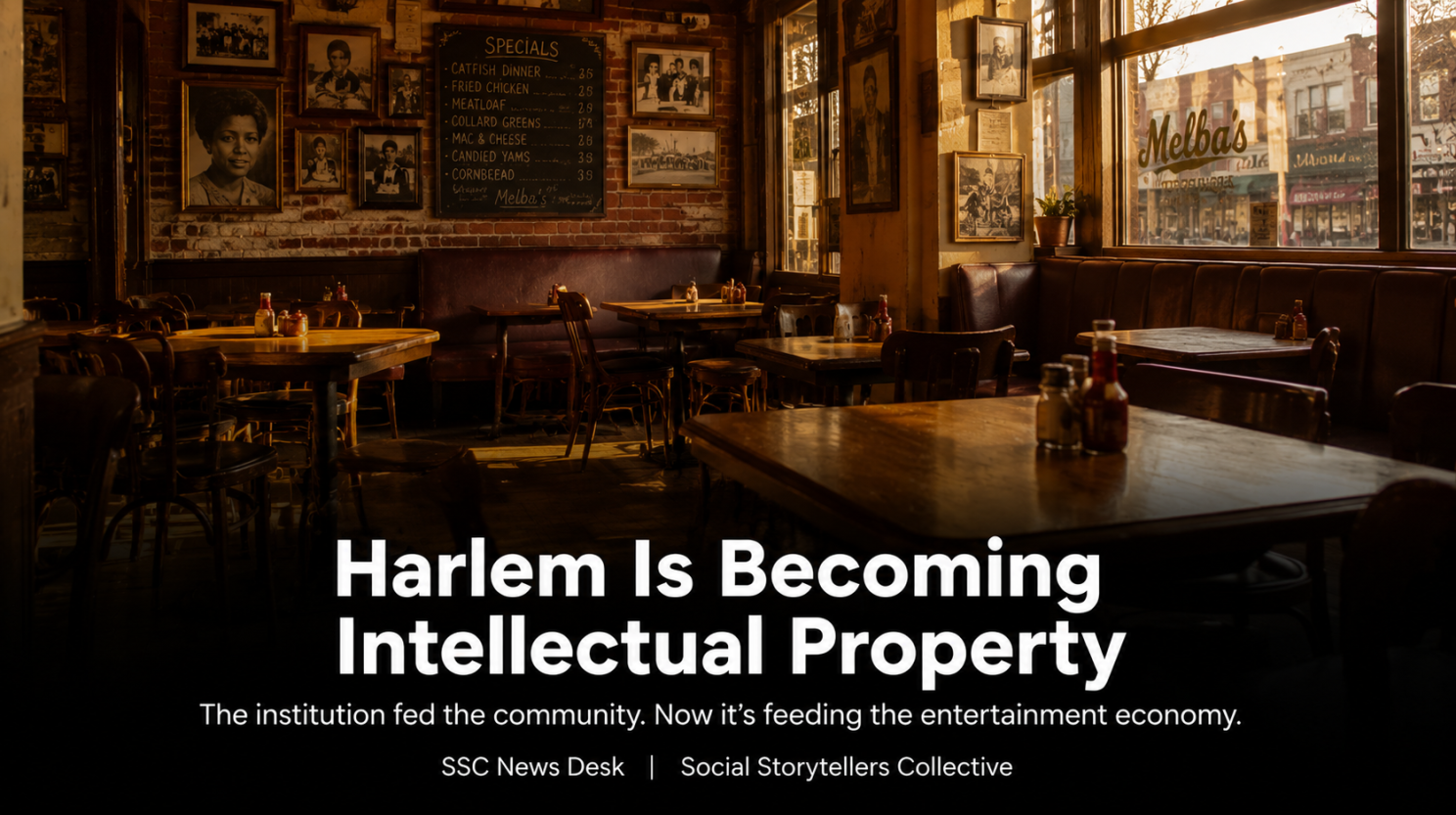
Harlem Is Becoming Intellectual Property examines how Apple TV is developing American Comfort, a comedy series inspired by restaurateur Melba Wilson and her Harlem restaurant Melba’s, with Oprah Winfrey attached as producer. What began as a neighborhood gathering space is now being reframed as franchise-ready cultural storytelling. The question is whether cultural visibility strengthens the community that produced the institution — or accelerates the market forces reshaping it.
In The Night Out Is Becoming a Financial Performance, SSC examines two viral moments from Houston and Atlanta nightlife — a bar post that stopped feeds cold through community fluency and a Monica reference, set against $2,000–$4,000 bottle service sections circulating across Black professional social feeds. The Liv’n Room built belonging through community. The VIP section builds belonging through spending. One is free to participate in. The other has a cover charge that could cover two months of rent. Both are selling the same thing. Only one knows its audience well enough to give it away.
Music Criticism No Longer Feels Neutral — And the Internet Noticed examines who receives generous critical readings, who receives scrutiny, and why the pattern is no longer invisible. The Timeline Wasn’t Ready for Giveon covers what happened when he dropped without announcement into a week that was looking elsewhere. Brandon Crenshaw’s Reaction Is the New Review makes the case that criticism didn’t disappear — it migrated to the face-cam. And Black Mobility Became the Real Debate untangles the week’s most contested conversation — not what was said on the surface, but what the argument underneath was actually about.
In When The Internet Decides What Killed You, SSC examines what happened when Alexx Ekubo — 40 years old, Nollywood actor, privately fighting stage 4 metastatic kidney cancer — went quiet on social media. The speculation that filled the silence reached first for HIV, the way it almost always does when a Black male celebrity disappears from public view and his body changes visibly. He died on May 11, 2026. The same accounts that speculated posted RIP graphics within hours. SSC names what that pattern actually costs — not just for the person being speculated about, but for every person living with HIV privately in the diaspora who watches that speculation and understands exactly what disclosure would cost them. The defense of Ekubo’s dignity cannot be conditional on what the illness turned out to be.
The Brand Stories Are the Economy Stories
Lululemon Tells Its Founder He’s Outdated. He Disagrees. — Chip Wilson is waging a proxy battle to reshape Lululemon’s board, arguing the current leadership lost the thread of what made the brand work. The board’s shareholder letter called his perspectives “outdated” and “misguided.” Neither side has answered the harder question: what is Lululemon for in 2026, and who is it for? A board victory doesn’t resolve the identity crisis. It just assigns one set of people the job of managing it.
The Sustainability Premium Collapsed Before the Brand Did uses Allbirds — once valued near $4 billion, now shrinking — to make a larger argument. The company was built for a consumer who treated purchasing decisions as moral identity statements. What the market is now revealing is that ethical consumption frequently operates like a luxury category: available in full only to those whose budgets were never really in question. Allbirds is not simply closing stores. It is marking the moment when a generation’s consumer optimism met a balance sheet and had to choose.
In He Called HR the Problem. Then He Fired Them. Then He Fired Everyone Else., Bolt CEO Ryan Breslow — speaking at the Fortune Workplace Innovation Summit in Atlanta — described eliminating his entire HR department as an act of courage. The company once reached an $11 billion valuation. It is now down to roughly 100 employees, described by Breslow as “much more junior, who work a lot harder, who have better energy.” The word “entitlement” is doing significant work in his account of what he had to battle. It is the word CEOs use when employees expect the terms of their employment to be honored.
Also This Week
In Getting Accepted Is Becoming Its Own American Competition, SSC examines what the college admissions process has become — not a selection system but a performance economy with its own consultants, coaches, and optimized essays. The students who navigate it successfully are not simply more qualified. They are better resourced for the specific competition being run. In A Survey of 1,600 Black Male Voters Found 92% Say Voting Matters — and More Than 1 in 4 Say They Won’t Vote in November, SSC examines the gap between those two numbers directly: it is not apathy. It is a failure of campaigns to speak to people they keep assuming they already understand.
And in The American Dream Is Becoming a Legacy Product, Will Davison names what all the other stories this week were circling — the specific promise of degree, then job, then house, then retirement, then a life that improved on the one your parents had, is still being sold at full price to people who can no longer afford the loss when it doesn’t deliver. The degree series is the evidence. The layoff stories are the evidence. The SNAP cuts are the evidence. Read it. Then send it to someone who has been carrying the weight of a system that stopped working for them and hasn’t yet had the language for what changed.
Friday Closer
Forty-five million people are on the move this Memorial Day weekend. The highway is full. The airport lines stretched past the barriers before 7 a.m. The record is real.
So is the 3.6% savings rate. So is the $4.53 gallon of gas. So are the 4.3 million people who lost food assistance without a press conference. So are the engineers whose blueprints are being extracted before their stock vests. So are the 2 millionpeople holding Kindles that still work but can no longer access a bookstore. So are the women whose healthcare access rests on a legal fight that isn’t settled. And so are the people who are not in the 45 million — because the math on getting somewhere simply did not work out this week.
We built this week’s coverage because the disruption deserves documentation. Not to perform urgency. Not to manufacture outrage. But because what is being restructured right now — who gets access to mobility, food, healthcare, a credential, a platform, a seat at the table — is not a temporary adjustment. It is a decision being made at speed, without the people most affected in the room.
We’ll keep covering it. Monday through Friday, and again here next week.
You are not imagining it. The numbers confirm what you’re feeling.
— Social Storytellers Collective socialstorytellers.substack.com