
Happy Friday — and welcome to May.
This week had no single moment that announced itself as a crisis — but it ended yesterday with a Supreme Court decision that may be the most consequential thing that happened across the entire news cycle. The Court raised the legal bar for challenging congressional maps under the Voting Rights Act — not by eliminating the law but by narrowing the mechanism used to enforce it. The 2026 maps are largely locked. The framework governing 2028 is not what it was. That shift will not announce itself as collapse. It will show up as a series of incremental adjustments that collectively reshape who is represented and how — and by the time it is fully visible, the window for contesting it will have already closed.
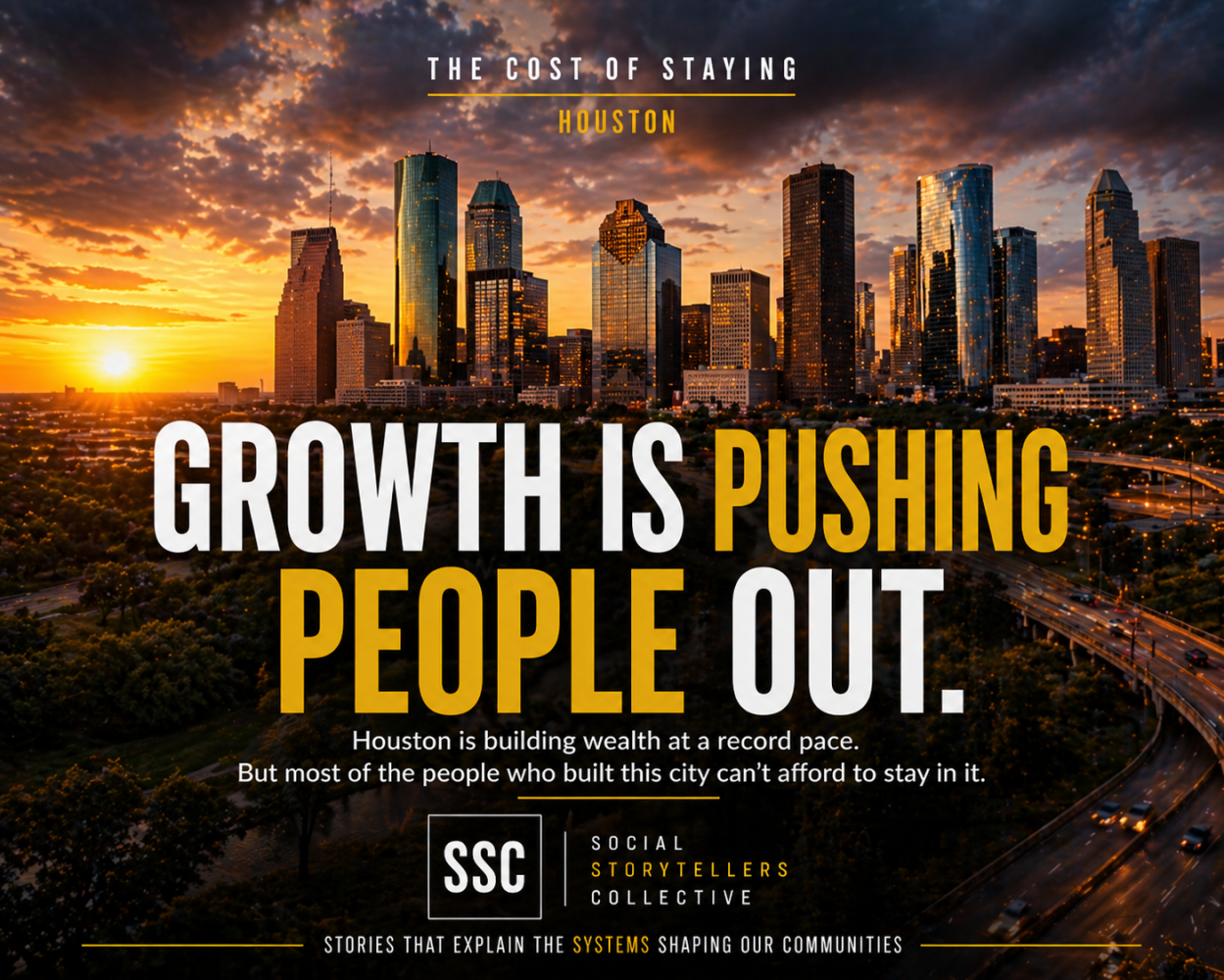
This week also marks the launch of City Signals, SSC’s new series on what cities reveal about who they’re built for. The first two installments — one examining who can actually afford to remain in New York and one tracking how Houston’s record population growth is outpacing the systems designed to support it — establish the frame for everything else we tracked this week: demand is not disappearing, but the cost of remaining inside that demand is rising.

New York and Houston are different in scale and character, but aligned in structure. Both continue to attract capital, attention, and migration. Both project growth. And in both, the ability to stay is becoming conditional. Residents leaving New York earned $68 billion more than those moving in. Houston is absorbing 543 new people every day into systems — housing, infrastructure, roads, utilities — that were not built to scale overnight. That same pressure is showing up at the household level, where nearly two-thirds of parents are now financially supporting their adult children , and where essentials are rising simultaneously across categories that cannot be reduced or deferred. The system is not failing. It is becoming more expensive to stand inside it.
That pressure extends into the institutions that define stability. The gap between Harvard’s $53 billion endowment and the graduate workers striking outside its gates — some earning so little they qualify for state food assistance — shows how systems that appear stable rely on labor structures that are far less secure beneath them. The same recalibration is happening in corporate work, where benefits that were framed as a new baseline are being quietly reduced — and workers who built their lives around those conditions are now being told the conditions have changed.
Mobility tells a similar story. Low-cost carriers are approaching Washington for federal support as fuel costs remain elevated, even as they continue to market affordability to price-sensitive travelers. That contradiction sharpens when you read the fine print on unlimited flight passes — where the terms determine who can actually use what is being sold. And in Japan, movement is no longer simply enabled but actively managed, with free domestic flights used as a policy instrument to redistribute where tourists go once they arrive. What looks like expanded access is often controlled access, shaped by systems under pressure to remain viable.
In culture, the backlash to Emma Grede’s visibility advice revealed something specific: Black audiences are generating reach that travels far beyond the communities producing it, without always being positioned to benefit from where it goes. The same dynamic shows up in how attractiveness is evaluated by geography — where the standard is always set by the most optimized environment, and the gap between that standard and where most people live is framed as a personal failure rather than a structural one. And in the Ja 4 rollout, Nike is not betting on Morant’s redemption — it is betting on the market’s appetite for the narrative of it .
Power is being redefined in real time. Ukraine, once given days to survive, is now being discussed as a potential leader of the free world — a transformation produced not by stability but by sustained pressure. In the NBA, the shift from representation to leverage is the more important story, as Black athletes and their representatives move from being present in rooms to controlling what happens inside them. And in Los Angeles, a $0.01 price tag on city assets makes visible what has always been true: participation has never been evenly rewarded, even when visibility is high.
Across policy, systems are being reshaped through placement and constraint rather than outright removal. Enforcement geography is being contested at the state level, with Illinois moving to limit where detention operations can exist, while federal courts are blocking attempts to suspend asylum processing at the border entirely. Mexico moving toward universal healthcare — while the U.S. continues negotiating the terms of access — puts the gap between what different systems define as guaranteed into sharp relief. And at the individual level, the ability to pause before reacting is itself becoming a form of control inside environments that are designed to reward immediacy.

The week also surfaced stories about how systems obscure what they are doing by changing what things look like. Internal records show federal immigration agents operating in ways that make them indistinguishable from local police — masked officers, unmarked vehicles, overlapping tactics — and the consequence is already measurable: residents are declining to engage with law enforcement even in routine situations, because they cannot tell who is at the door. That confusion is a feature, not a failure. Laura Loomer called Candace Owens a “nappy headed Black bitch” on X and kept her White House press pass — and the absence of consequence is itself the signal about what the current information environment tolerates and who it protects. The same logic runs through three Truth Social posts in fifteen days, each more racially targeted than the last — a pattern that is not random and not accidental, but a deliberate use of conflict as a currency that the attention economy rewards. And Norway’s move to ban social media access for children under 16 — following Australia, where violations carry fines up to $49.5 million — marks a shift in who is held responsible for what platforms do to young people, moving enforcement from parents onto the companies themselves.

On the technology side, the reshaping is quieter but no less structural. Microsoft is offering buyouts to employees whose age and years of service combine to 70 or more — a program that looks like early retirement but functions as workforce reduction at a scale of up to 8,750 people, roughly 7 percent of its U.S. workforce. Zoom is now verifying that the people in your meeting are actually human — a partnership with World that treats what was once an assumption as a vulnerability requiring active confirmation. And Uber is moving into home pickup returns, folding what was once a minor consumer inconvenience into the same on-demand infrastructure that already delivers meals and groceries — extending its reach into another layer of everyday life. Each of these moves is incremental. Together they describe a technology sector quietly expanding the surface area of what it controls.
This week did not produce a single dominant story. It revealed asistent pattern. The systems are still functioning, but the cost of participating in them is rising — and that cost is being distributed unevenly across the people inside them. New York and Houston still attract people, but fewer can afford to stay. Work is still available, but stability is harder to sustain. Mobility is still being sold, but the systems behind it are under strain. These are not contradictions. They are signals. The question is no longer just what is happening. It is who the current version of the system is designed to hold.
If this helped sharpen your perspective, share it with someone who should be paying attention. Join us on your laptop or desktop for the full experience — where the archive lives, where the analysis connects, and where each story builds on the last.
More next week.
The Social Storytellers Collective Team