
The detail that stands out is not the scam itself but how ordinary it has become. People are using AI to generate fake images of damaged food, altered receipts, and synthetic medical documents, then submitting them through systems that were never designed to question reality at scale. What once required effort, coordination, or technical skill can now be done in minutes. The barrier to fraud has collapsed — not because people suddenly became more dishonest, but because the tools have made dishonesty frictionless. What is emerging from that collapse is not a spike in traditional fraud but something structurally different: micro-fraud as a normalized consumer tactic, operating at a volume and velocity that the platforms enabling it were not built to detect.
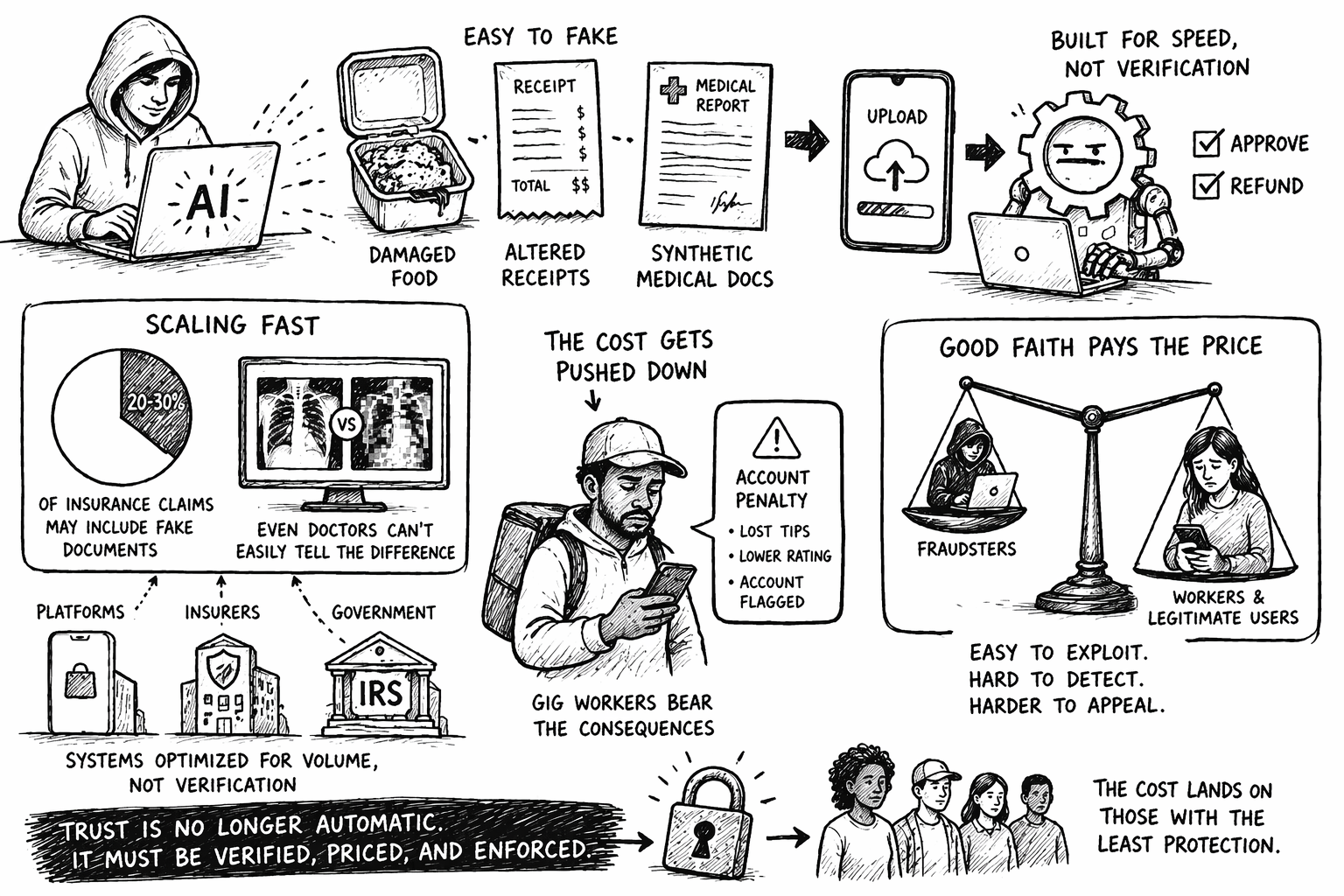
The data reflects how quickly this is scaling. Estimates suggest that 20 to 30 percent of insurance claims may now include some form of manipulated or synthetic documentation. In controlled studies, even trained medical professionals struggle to distinguish real X-rays from AI-generated ones, correctly identifying fakes less than half the time when unaware of their presence. The concern is not just that AI-enabled fraud is increasing — it is that detection is structurally losing ground. Platforms like Uber Eats, insurers, and government agencies like the IRS rely on automated review systems and customer service workflows optimized for speed rather than verification. Those systems create an environment where small, believable claims are easier to approve than to investigate. AI does not simply enable fraud. It aligns precisely with the architecture of platforms already built to process volume over verification — and in that alignment, what looks like a temporary vulnerability is more accurately a permanent inversion, where the systems designed to confirm truth are increasingly unable to do so at the scale truth now needs to be confirmed.
The most immediate cost of that inversion does not land on corporations. It lands on people — specifically, on the workers least positioned to absorb it. When a customer submits a falsified complaint about a food delivery, the refund may be approved automatically, but the cost often gets pushed downstream to gig workers through penalties, lost tips, or account flags that affect their standing on the platform. The system absorbs the fraud by redistributing it to the least protected participant in the chain. That redistribution is not random. Gig and platform workers are disproportionately Black and Brown, working without the employment protections or appeals infrastructure that would allow them to contest account penalties tied to fraudulent claims they had no part in generating. What looks like a harmless workaround at the user level becomes a quiet transfer of risk onto someone else’s labor — and the someone else is consistently the person with the least leverage to push back.
This is where the story shifts from technology to structure. Platforms were designed around an assumption of good faith, reinforced by lightweight verification and customer-first policies. That model worked when fraud required effort. It breaks when fraud becomes easy, scalable, and difficult to detect. Rather than redesigning systems to match the new threat environment, companies often respond by tightening controls in ways that increase friction for legitimate users while still failing to contain sophisticated abuse — a response that effectively penalizes good-faith participants for a problem created by bad-faith ones, and that concentrates that penalty on the workers and users with the fewest alternatives. The fraud is diffuse and hard to prosecute. The response is concentrated and easy to implement. That asymmetry is not incidental. It is the shape of how platform accountability works when the platform is not the one absorbing the loss.
What is unfolding is not a spike but a transition — a redefinition of the relationship between proof and doubt in digital systems. As synthetic evidence becomes indistinguishable from real documentation at scale, trust stops being embedded in the system and starts becoming something that must be actively verified, priced, and enforced. The infrastructure cost of that shift will not be distributed evenly. It will be absorbed by the workers, the legitimate users, and the under-resourced institutions that were already operating closest to the margin — while the platforms that built systems optimized for volume over verification continue to process claims and shift liability downstream. Micro-fraud sounds small. Its structural consequences are not.