
The surveillance authority used to conduct warrantless searches of Black Lives Matter protesters and journalists has lapsed — and the question of whether it returns with or without reform is now live.
Section 702 of the Foreign Intelligence Surveillance Act expired today, April 21. As SSC reported in Congressional Black Caucus Calls for Reform Before FISA Section 702 Reauthorization, the CBC had called for four specific reforms as conditions of any reauthorization — requiring judicial warrants before law enforcement accesses data collected under the program, closing the data broker loophole that allows agencies to purchase data they could not legally collect directly, banning warrantless backdoor searches of Americans’ private communications, and repealing the visa vetting provision that critics argue enables targeting of immigrant communities. As of today’s expiration, those reforms have not been enacted. Congress is now in the position of deciding whether to reauthorize the program as-is, reauthorize it with partial reforms, or allow the lapse to force a more substantive legislative process.
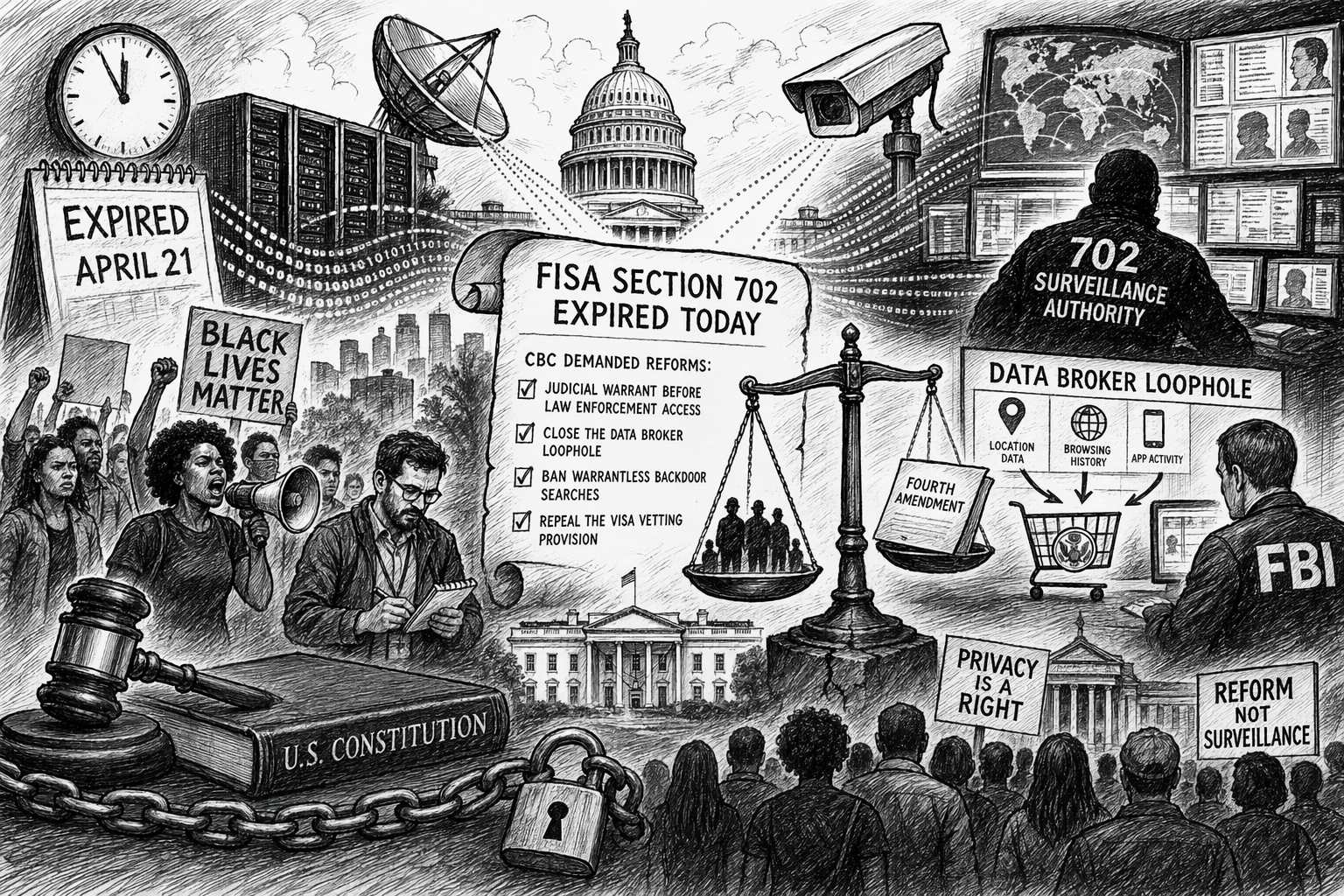
Section 702 was designed as a foreign intelligence collection authority — permitting surveillance of non-U.S. persons located outside the United States. Its practical application has extended significantly beyond that framing. The program collects communications of American citizens whose data is swept up incidentally in foreign intelligence collection, and that incidentally collected data has been accessed without warrant by federal law enforcement in documented cases involving Black Lives Matter protesters, U.S. government officials, journalists, and congressional donors. The FBI conducted tens of thousands of warrantless searches of Section 702 data on U.S. persons in a single year — a figure that produced formal findings from the Foreign Intelligence Surveillance Court and congressional criticism that did not result in statutory reform before today’s expiration. The program has been reauthorized multiple times without the guardrails the CBC demanded. Each reauthorization extended the same legal architecture that produced the documented abuses.
The data broker loophole is the provision that deserves the most specific attention and has received the least. Federal law prohibits the government from collecting certain categories of data on American citizens without legal process — a warrant, a subpoena, or a court order. It does not prohibit the government from purchasing that same data from commercial brokers who collected it through consumer transactions — app location data, browsing history, commercial platform activity — without the legal threshold that direct government collection would require. The loophole effectively allows the government to launder the legal restrictions on domestic surveillance through the commercial data market: buy what you cannot collect, then use what you bought. Closing the loophole would not restrict foreign intelligence collection. It would restrict the government’s ability to use commercial data purchases to circumvent the Fourth Amendment protections that apply to direct collection. That the loophole has survived multiple reauthorization cycles reflects the same dynamic that produces every other accountability gap — the interests served by the architecture are better represented in the legislative process than the communities absorbing its consequences.
The current administration’s enforcement posture is the context that makes today’s expiration specifically urgent rather than abstractly important. A program that authorizes warrantless access to Americans’ communications data, operating without judicial oversight, in an environment where the administration has demonstrated willingness to use federal law enforcement against political opponents, journalists, and immigrant communities, is a materially different risk than the same program in a more constrained political environment. The CBC named this directly before the expiration deadline: the combination of documented past abuses and the current administration’s enforcement posture creates a specific and compounding risk that unreformed reauthorization would extend. Today’s expiration is the accountability moment that statement was designed to create. Whether Congress uses it as one depends on whether the political cost of allowing the lapse exceeds the political cost of reauthorizing without the reforms the most directly affected communities are demanding.