
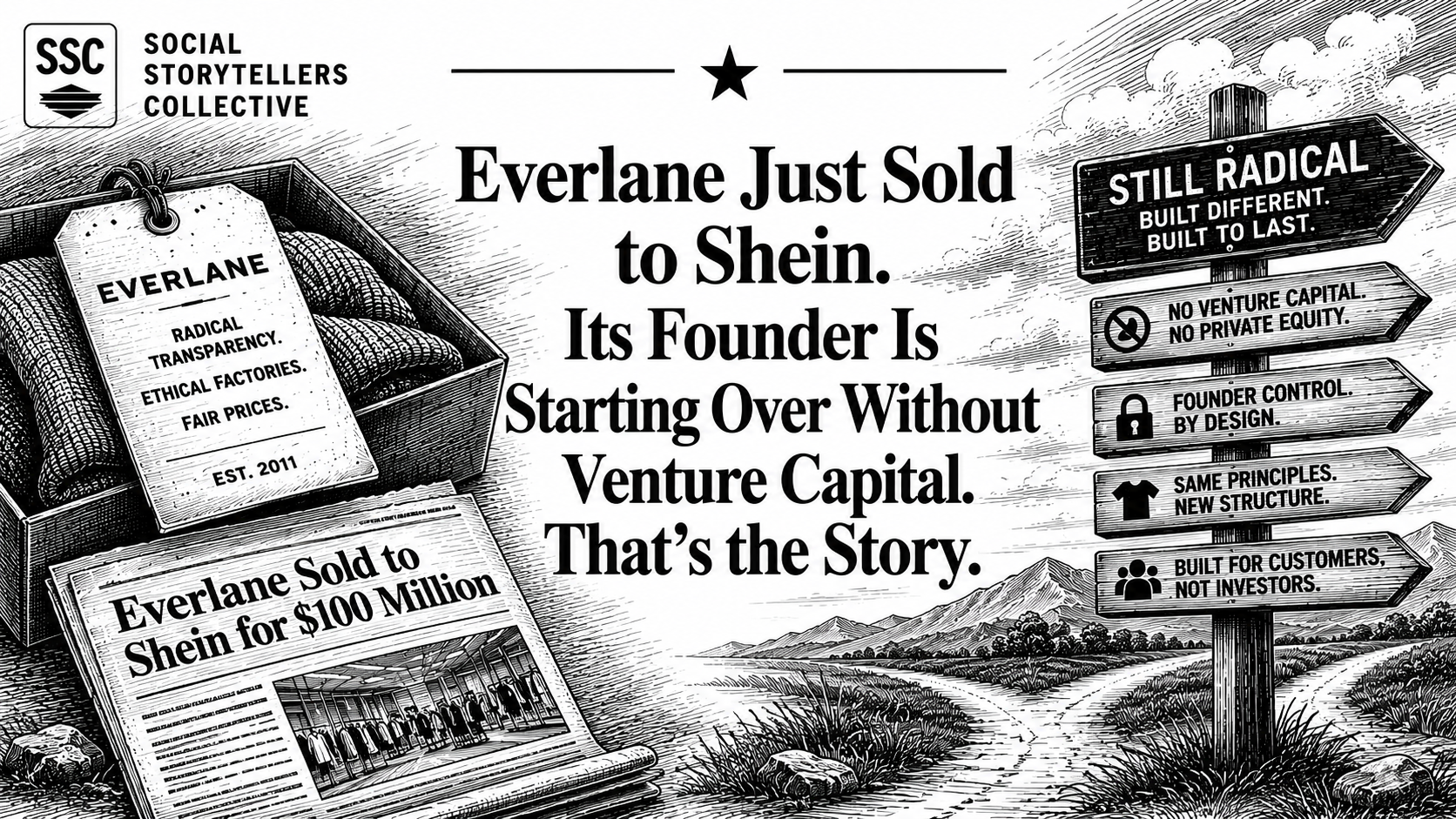
Michael Preysman didn’t know Everlane had been sold to Shein until the news broke publicly. The founder and former CEO of the brand he built around radical transparency, ethical supply chains, and direct-to-consumer pricing discovered the sale the same way everyone else did — through press reports. Current management, backed by the majority shareholder, made the call. Preysman was not in the room. That detail is not incidental to what happened next. Within days he announced Still Radical — a new apparel label built on the same principles as Everlane, with one structural difference: no venture capital, no private equity. The financing model is the founding argument.
The Everlane story is a compressed version of what happens to values-driven consumer brands when institutional capital controls the exit. Everlane launched in 2011 with a specific promise — radical transparency about costs, ethical factories, and pricing that reflected what things actually cost to make rather than what the market would bear. That promise attracted a loyal customer base and significant venture funding. The funding enabled growth. The growth created pressure for returns. The returns required an exit. And the exit — a reported $100 million sale to Shein, one of the world’s largest fast fashion operators — landed as a direct contradiction of everything the brand had spent fourteen years saying it stood for. Preysman described seeing the reaction as hitting him hard. The customers who built their purchasing decisions around Everlane‘s stated values felt the same way.
The Shein acquisition is not just a brand contradiction — it is a structural one. Shein has faced sustained criticism over labor conditions in its supply chain, intellectual property disputes with independent designers, and an environmental footprint that sits at the opposite end of the spectrum from the sourcing transparency Everlane marketed as its core value proposition. SSC examined this contradiction directly in The Ethics Economy Is Collapsing Into Scale — arguing that the reported sale reflected a deeper collapse of the millennial-era belief that consumers would permanently pay more for ethical branding. Inflation reshaped purchasing behavior. White-collar layoffs hit the professional class that was Everlane‘s core customer. Discretionary spending contracted — and when it did, the premium attached to ethical purchasing was among the first things people stopped paying. For the customers who chose Everlane specifically because of where it stood on those issues, the sale didn’t just change ownership. It invalidated the premise of every purchase they had made.
Still Radical is Preysman’s answer to that failure — and the structural choice to exclude venture capital and private equity is the most substantive part of the announcement. VC and PE funding is not inherently incompatible with ethical business practices, but it does create a specific set of incentives around growth timelines, exit multiples, and return expectations that consistently pressure founders to prioritize scale over the principles that made their brands valuable in the first place. Everlane is a case study in exactly that pressure. Still Radical is an attempt to build the same brand without the same structural vulnerability — to create a company where the founder retains enough control that the exit cannot happen without him in the room.
Whether that model holds depends entirely on whether the business can scale without the capital that typically funds scaling. That is the hard version of the question Still Radical will have to answer — not whether its values are sincere, but whether sincerity is financeable without the institutional money that has historically been the only path to the kind of distribution that makes a values-driven brand more than a niche product. Preysman has already built one brand that proved the values could attract customers. The question Still Radical is actually asking is whether those customers are enough to build a business without giving anyone else the power to sell it out from under him.