
The narrative around electric vehicles has shifted. After years of momentum, headlines now point to buyer’s remorse and softening demand, framing the story as consumers reconsidering the technology. That framing does real work — it places the problem with the buyer rather than with the system they were sold entry into. The underlying dynamics tell a different story.
Most EV owners are not rejecting their vehicles. Performance, long-term cost savings, and driving experience remain strong points of satisfaction. The friction is appearing in the infrastructure — charging access, pricing variability, network reliability, and the logistics of ownership for anyone who does not live in the specific type of housing the EV transition was designed around. Public DC fast-charger rates can reach 60 cents per kWh — three to four times what the same energy would cost plugged in at home overnight which directly undermines one of the central economic arguments for EV adoption. That cost gap falls hardest on drivers who cannot charge at home, not because they chose inconvenience, but because the system hasn’t reached them.
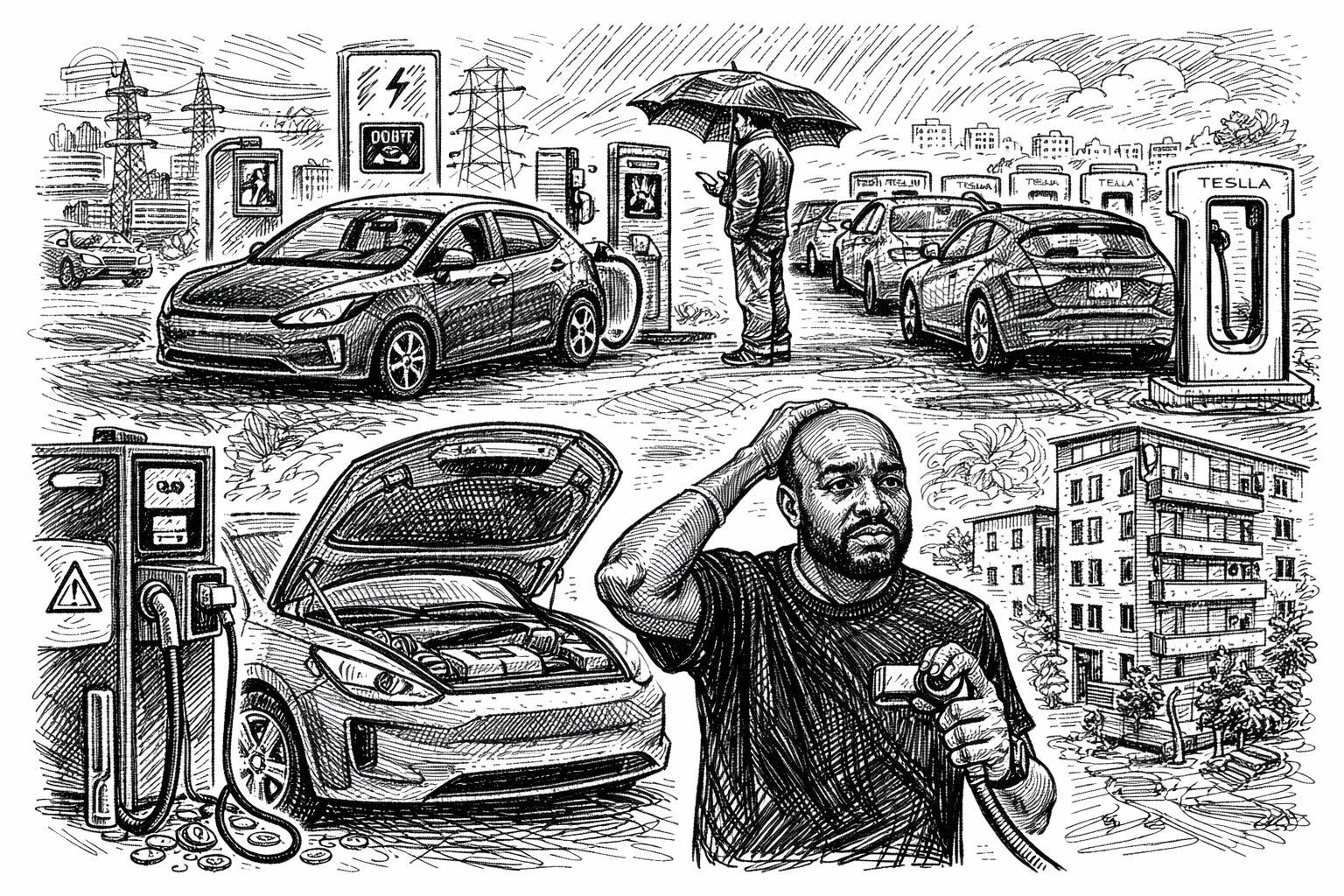
Housing is the variable the EV marketing consistently omits. Only about 5 percent of U.S. multifamily properties currently offer on-site EV charging, meaning that for the roughly one-third of American households living in apartment buildings, public charging is not a backup option — it is the primary one. A UCLA and USC study published in Nature Communications found that disadvantaged communities have 64 percent fewer public EV charging stations per capita than wealthier areas, a gap that rises to 73 percent when accounting specifically for renters in multi-dwelling units. Renters in lower-income communities are being asked to adopt a technology whose supporting infrastructure has been built most densely in the neighborhoods that need it least.
This is not a story about technology failing. It is a story about who the transition was designed for and who is being asked to wait for it to reach them. Federal investment in charging infrastructure has been real, but the distribution of that investment has followed existing patterns of access — concentrating in corridors and communities that already have it. The people framed as hesitant adopters are often people for whom the promise of the EV transition has not yet materialized in any practical form. What gets labeled as regret in the consumer data is frequently the rational response to an infrastructure gap that was not disclosed at the point of sale. We reported on that gap in detail in EV Charging Is Expanding. Access Still Depends on Where You Live. The buyer’s remorse story lets the system off the hook. The infrastructure story is harder to tell — and more honest.