
Part of Structural Reality — examining how systems produce unequal outcomes.
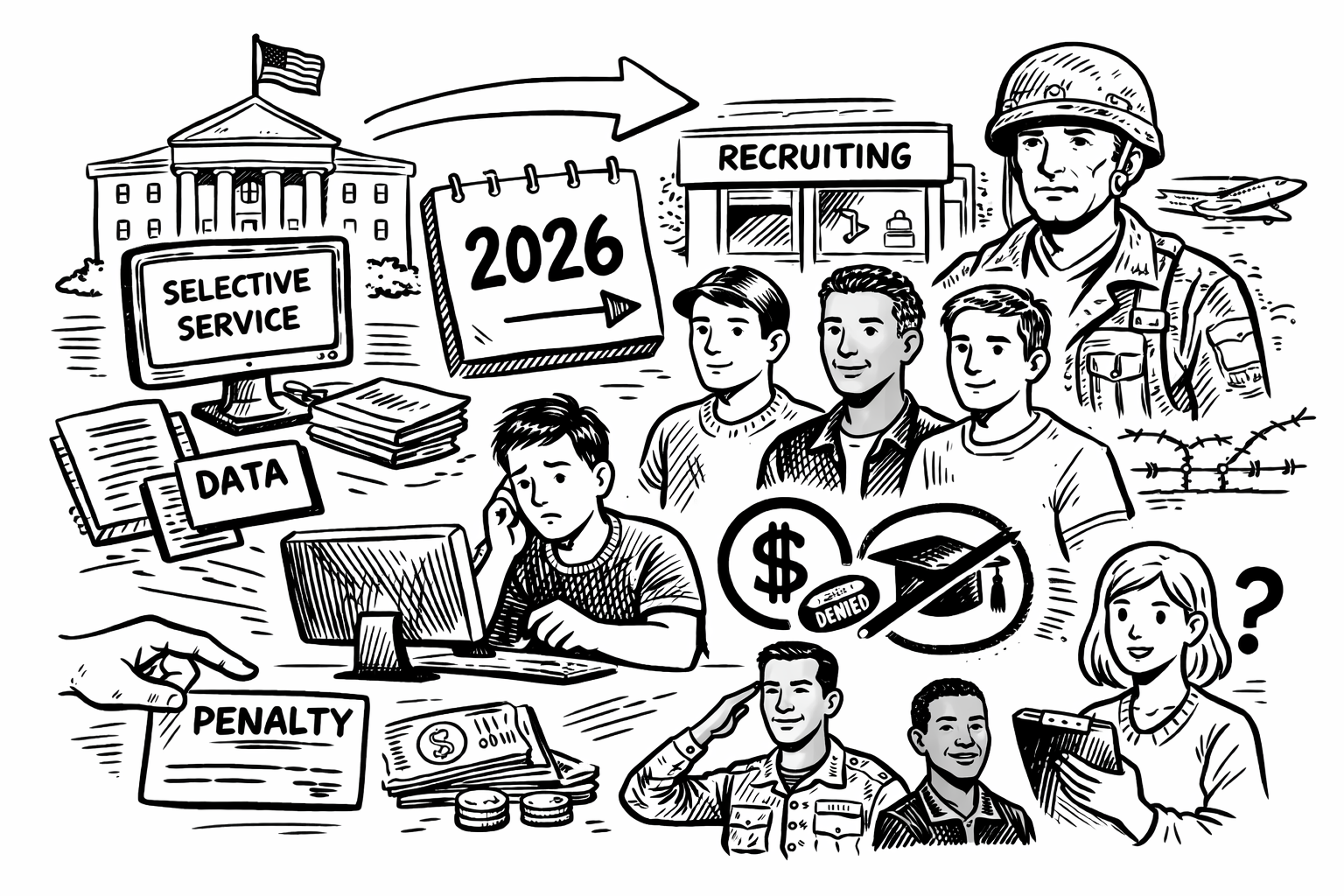
Starting in December 2026, the United States government will begin automatically enrolling eligible men between the ages of 18 and 25 into the Selective Service System using existing federal data — eliminating the self-registration requirement that has governed the process since the draft ended more than five decades ago. The shift is being framed as administrative modernization. It is worth examining as something more than that.
The practical mechanics are straightforward. Rather than requiring young men to actively register, the government will use data already in its possession — Social Security records, tax filings, immigration documentation — to populate the Selective Service rolls automatically. The stated rationale is efficiency: outreach campaigns designed to encourage voluntary registration cost millions annually and still produce incomplete enrollment. Automatic registration solves the compliance problem by removing the human step entirely.
Until December 2026, the current requirement remains in effect. Men between 18 and 25 must still register manually, and failure to do so carries real consequences — potential fines and the loss of access to federal student aid, job training programs, and certain government employment. Those penalties have historically fallen unevenly. Young men who are unaware of the requirement, who are navigating unstable housing, who are incarcerated, or who are undocumented and uncertain about their legal obligations have been disproportionately likely to fall out of compliance — and disproportionately likely to lose access to the federal benefits that might have stabilized their circumstances. Automatic registration removes that specific failure point, which is a genuine improvement in equity of process.
What it also removes is the nominal act of individual choice. Registration was never truly voluntary in the sense that mattered — the penalties for non-compliance were significant enough that the choice was largely coerced. But the requirement to take an active step created at least a formal acknowledgment that something was being asked of a person. Automatic enrollment converts that acknowledgment into a background system function. The young man turning 18 in December 2026 will not decide to register. He will simply be registered, by a government that has determined his data is sufficient to complete the process without him.
The policy does not signal a return to active conscription. The United States has not activated the draft since the Vietnam War, and military service has remained voluntary since 1973. Selective Service registration has continued as a contingency measure — a list that exists so the infrastructure for a draft is theoretically ready if Congress ever authorizes one. That theoretical distance matters, but it should not entirely insulate the policy from scrutiny about what it means to automate the front end of that infrastructure at scale.
The history of who the draft has reached is not evenly distributed. During the Vietnam era, deferment systems that allowed college enrollment or certain occupational classifications to exempt men from service operated in ways that systematically favored white and wealthy Americans, leaving Black men, working-class men, and men without institutional access to navigate the draft at higher rates. Muhammad Ali’s refusal to be inducted, and the movement built around that refusal, was not simply a personal statement — it was a confrontation with a system whose stated universality masked profound structural inequality in application. That history does not make automatic registration in 2026 equivalent to Vietnam-era conscription. It does make it worth asking who the contingency list is being built for and under what conditions it would be activated.
Women remain excluded from Selective Service under current law, though the question has been actively debated in policy and legal circles and has reached federal courts. The exclusion is presented as a settled feature of the system. It is more accurately described as a deferred question — one that the shift to automatic enrollment makes more visible by contrast, since the efficiency argument for automatic registration applies equally to women and yet has not been extended to them.
What looks like reduced friction is also the elimination of a nominal space between a person and a government system that has historically been consequential for some communities and theoretical for others. That is not an argument against streamlining an inequitable compliance burden. It is an argument for being precise about what is being streamlined, for whom the contingency is being maintained, and who will bear the weight if the contingency is ever activated.