
Inside a pop-up in London, customers were told directly: the products were replicas of Lululemon designs, made with a commitment to renewable energy and lower emissions. The project, created by a group called Mumumelon, was not trying to hide the duplication. It was using it as the argument. If one of the most recognizable athleisure brands in the world — a company that generated roughly $11 billion in revenue last year — cannot move faster on sustainability, someone else will demonstrate what that could look like. The intervention was pointed precisely because it did not ask Lululemon to change. It showed, in the form of an imitation storefront, what the brand is choosing not to do at a scale that should make the choice easier, not harder.
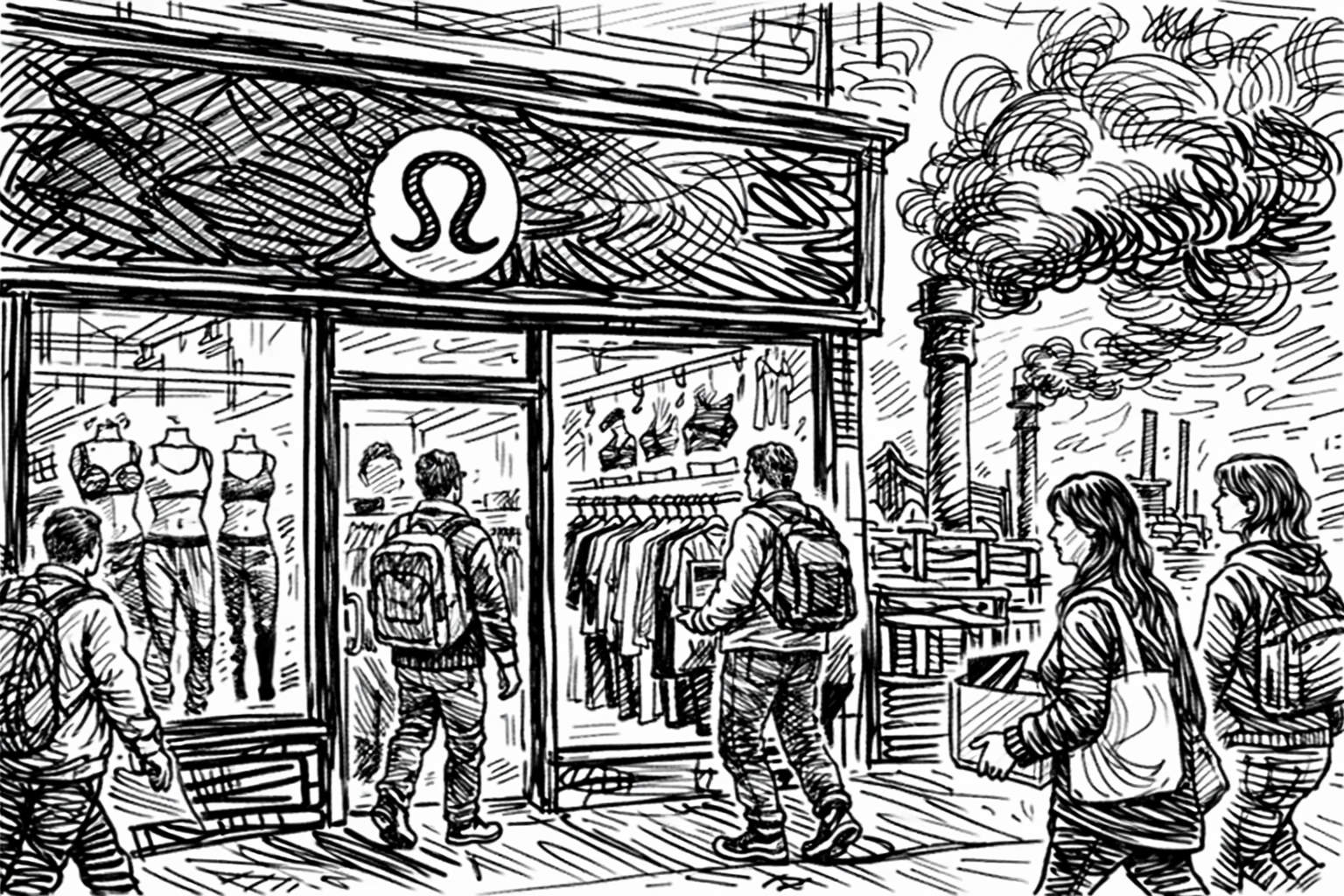
The critique lands at a moment when Lululemon’s environmental commitments are under increasing scrutiny. Despite pledging to transition toward renewable energy, the company is not currently on track to meet its stated targets, including a goal of reaching 25 percent renewable electricity in its supply chain. That gap between commitment and trajectory is not unusual in the corporate sustainability landscape — pledges made at one moment in the economic cycle frequently become targets that get quietly deprioritized when margin pressure increases or when the timeline extends far enough into the future to feel theoretical. What Mumumelon’s intervention does is make the gap visible and tangible in a consumer-facing context, using the brand’s own aesthetic to stage the critique inside the space the brand has built its identity around. The clothes may look identical. The supply chains behind them, by the intervention’s own framing, do not.
What makes this moment structurally interesting is that it collapses two tensions that are usually treated separately. Intellectual property and environmental accountability have rarely occupied the same conversation — dupes are framed as threats to brands, not as leverage over them, and sustainability critiques tend to stay inside policy and advocacy channels rather than entering the retail environment directly. Mumumelon’s pop-up puts both in the same room and asks a question that the fashion and athleisure industries have managed to avoid: if the design can be replicated by a smaller operation committed to lower emissions, what exactly is the $11 billion revenue scale being used for? The answer the intervention implies — that scale is being used to maintain margin rather than accelerate transition — is uncomfortable precisely because it is difficult to refute with the current trajectory data.
The part of this conversation that the sustainability framing most consistently obscures is who actually absorbs the cost of the gap between a brand’s environmental commitments and its production realities. It is not primarily the London consumer who buys a replica in a protest pop-up. It is the garment workers and communities in the supply chain — disproportionately women of color in the Global South — who work in facilities whose energy sources, labor conditions, and environmental footprint are the specific variables that Lululemon’s sustainability targets are supposed to address. When a company with $11 billion in revenue misses a 25 percent renewable electricity target in its supply chain, the people living closest to that supply chain’s environmental impact are the ones absorbing the consequences of the delay. The dupe pop-up centers the consumer as the protagonist of the sustainability story. The structural argument requires centering the supply chain worker instead.
The broader signal the intervention sends is harder for brands to manage than a traditional protest precisely because it operates inside the brand’s own logic. Consumers are no longer just purchasing products. They are interrogating the systems behind them — and when brands fail to align what they sell with how they produce it, the market is beginning to respond in ways that are less about loyalty and more about exposure. What used to be imitation is becoming something closer to accountability, staged in the retail environment where brand identity is most carefully constructed and therefore most vulnerable to the argument that the identity and the production reality are not the same thing.