
Missile threats and escalating regional instability are beginning to test one of Dubai’s most important economic assets: the perception that it exists slightly outside the volatility surrounding it.
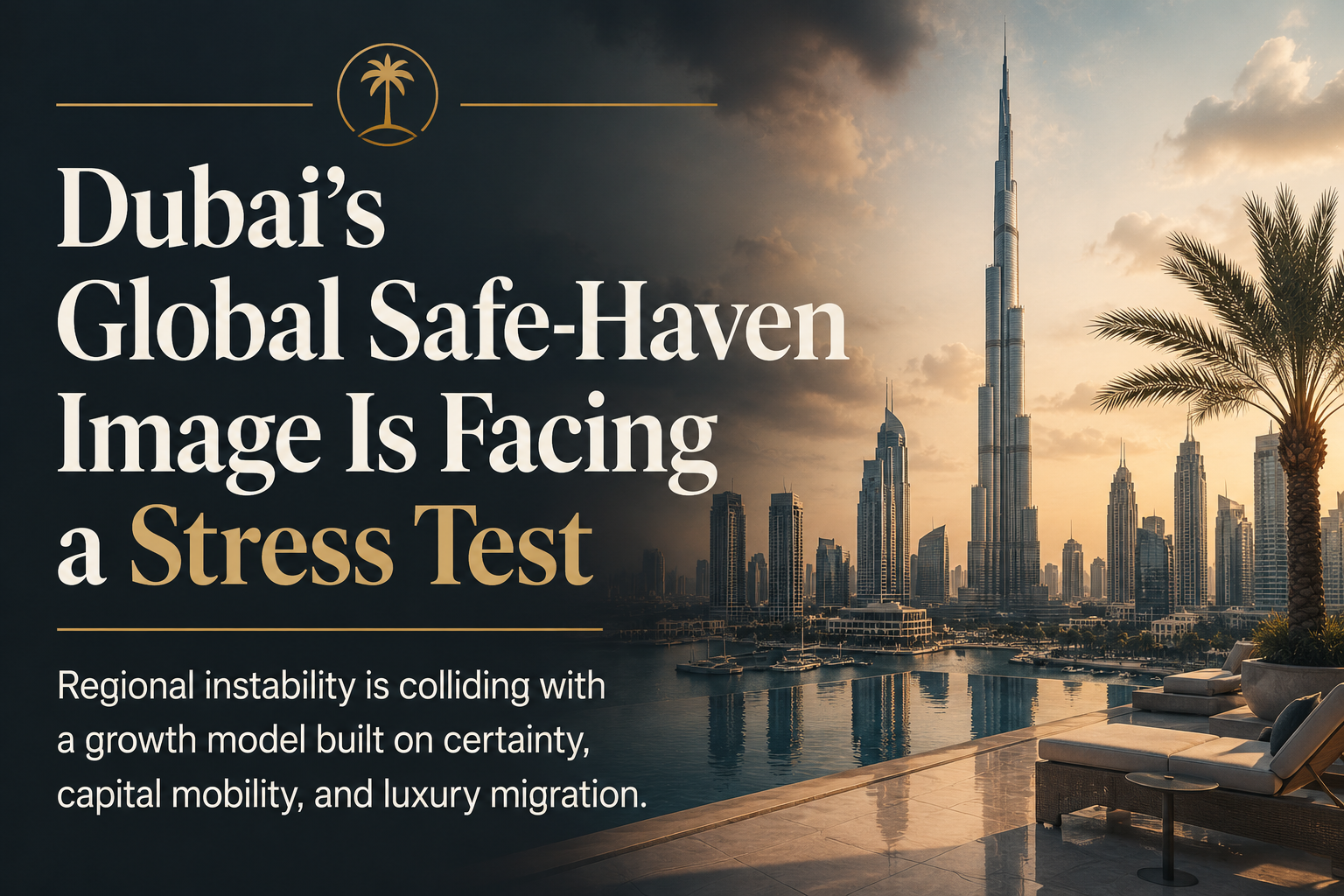
Financial analysts, investors, and regional business leaders increasingly acknowledge that tensions across the Gulf are affecting lending behavior, real estate sentiment, luxury migration patterns, and investor psychology even as Dubai continues projecting confidence publicly. Simultaneously, the United Arab Emirates is expanding commercial engagement with Syria, with bilateral trade reportedly more than doubling in 2025. Together, the developments reveal the balancing act at the center of Dubai’s economic model.
Dubai’s rise over the past two decades depended partly on positioning itself as a stable gateway city where global capital, tourism, luxury consumption, and international labor could converge regardless of broader regional instability. Wealthy migrants from Europe, Russia, Africa, South Asia, and the Middle East increasingly viewed the city as a politically insulated financial hub offering tax advantages, infrastructure expansion, and lifestyle accessibility. Real estate boomed accordingly, helping transform Dubai into one of the world’s most aggressive luxury development markets.
That model relies heavily on perception management. Financial hubs function not only through infrastructure but through confidence. Investors need to believe that banking systems, logistics corridors, airports, and luxury markets will continue operating predictably even during geopolitical turbulence. When regional instability intensifies visibly enough to alter insurance calculations, lending practices, or migration sentiment, the economic effects can spread quickly through sectors tied to real estate, hospitality, aviation, and international finance.
The contradiction is that Dubai’s success simultaneously depends on and exposes global instability. Wealth often flows into the city precisely because surrounding regions appear uncertain, overregulated, politically volatile, or financially restrictive. Capital migration into Dubai accelerated after pandemic disruptions, European energy uncertainty, and geopolitical sanctions altered global wealth patterns. Yet the city cannot fully detach itself from the same regional tensions helping drive capital inward. The closer instability moves geographically, the harder it becomes to preserve the image of separation.
The UAE’s growing commercial relationship with Syria illustrates another layer of strategic positioning. As trade relationships expand and Gulf governments recalibrate regional alliances, economic pragmatism increasingly competes with older diplomatic boundaries. The Gulf states are attempting to balance Western partnerships, regional influence, energy transition planning, and emerging trade opportunities simultaneously. Dubai sits directly inside those overlapping ambitions because its economy depends on remaining useful to multiple geopolitical actors at once.
The implications extend beyond finance. Dubai’s growth has become deeply connected to hospitality, luxury retail, wellness tourism, aviation, and experience-driven consumption economies. The city markets certainty, convenience, aspiration, and access as integrated products. If geopolitical tension begins affecting visitor confidence or investment flows, the effects could ripple through industries built around premium global mobility. Safe-haven branding functions much like luxury branding itself: it requires continuous reinforcement.
Mainstream coverage often isolates Gulf instability from Dubai’s economic narrative, treating the city as though it operates independently from regional political realities. The stronger interpretation is that Dubai represents one of the clearest examples of how modern global cities monetize stability itself. The current stress test matters because it reveals how dependent experience economies have become on maintaining the perception that volatility belongs somewhere else.