
Dallas does not present as a city under strain. The metro added roughly 180,000 residents between 2023 and 2024, sustaining growth rates that outpace most major American cities. Corporate relocations continue. Financial institutions are consolidating operations in the region. Investment follows the business-friendly structure and the expanding labor base. By every metric that drives civic boosterism, Dallas is performing.
The engine and what it runs on
The Dallas-Fort Worth metro is the fifth largest economy in the United States, producing $744 billion in GDP in 2023 — accounting for 3% of the entire US economy. Its engine is diversified: financial services, information technology, healthcare, trade and logistics, and professional services anchor a labor market of nearly 700,000 employed Dallas residents as of January 2026. The unemployment rate sits at 4.0% — below both the Texas state rate and the national rate of 4.3%. The Texas Employment Forecast projects 1.1% job growth across the state in 2026, with Dallas among the leading metros.
The key industries driving that growth skew toward higher-income, higher-credential workers. The sectors where employment has actually declined recently include manufacturing, professional and business services, and leisure and hospitality — industries that historically provided entry points for workers without four-year degrees. The growth engine is running. It is running toward a specific population.
The disparity running alongside the performance
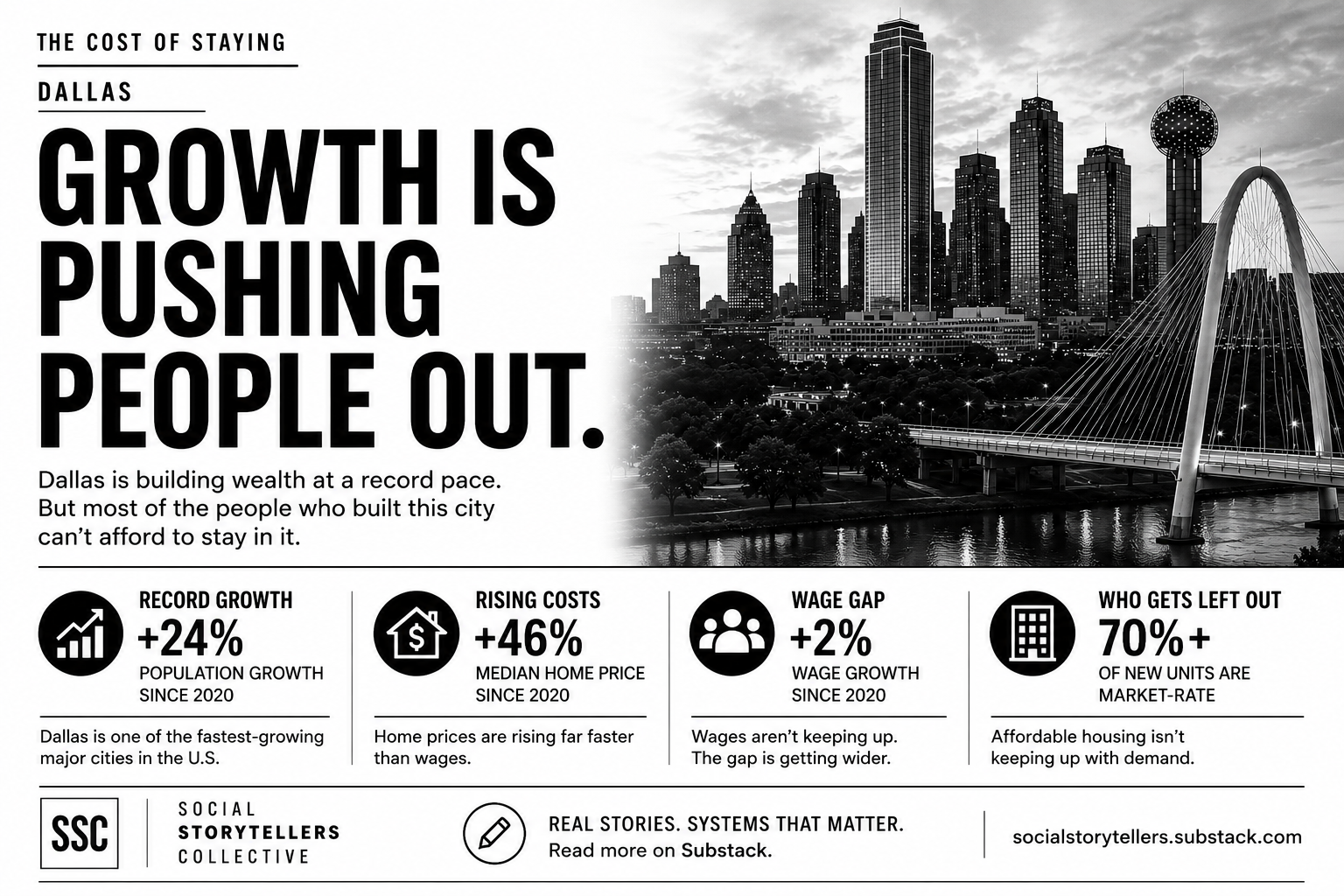
The aggregate numbers describe a metro that is genuinely thriving by the metrics designed to measure growth. What they do not describe is who participates in that growth — and where they can afford to live while participating in it.
Black and Hispanic residents in Dallas County earn less than 60 cents for every dollar white residents bring home. Of the 306 majority lower-income census tracts in the Dallas-Fort Worth area, 83% are predominantly non-white. Meanwhile, 95% of the 108 majority upper-income tracts are predominantly white. The wealth gap is not a historical artifact. It is a current condition running parallel to record corporate relocations and population growth.
The housing data sharpens that parallel. Median home prices have risen sharply over the past decade. Even with a 2.4% price decline in Q1 2025, ownership remains structurally out of reach for roughly half the metro population. Existing home sales fell 11% in January 2026 — and year over year they were down 5% in DFW — a signal that even a softening market has not translated into meaningful accessibility for buyers at the lower end. Texas homeowners are paying 60% more for home insurance in 2024 than they paid in 2019, compounding the affordability gap further for working residents trying to hold onto what they have.
The housing response and its limits
Housing supply has responded to demand — new units have entered the market, and rents have softened in certain segments. That response is genuine. What it hasn’t done is address the structural gap running beneath the surface-level numbers.
The city is short tens of thousands of affordable units for households earning below median income. Low-cost inventory hasn’t just tightened. It has largely ceased to exist as a functioning market category. The system is producing housing. It is producing it for the wrong income bands.
That misalignment isn’t just an affordability problem. It’s a spatial one — and the spatial dimension is where the longer-term consequences live. Growth is concentrating in outer suburbs and exurban corridors while affordability pressure pushes working residents further from the city’s economic core. The result is an expanding commute burden, a weakening connection between where jobs are created and where the people doing that work can afford to live, and a gradual reshaping of who occupies the city’s most opportunity-rich areas.
Dallas is simultaneously growing and sorting — adding people and capital at the top of the system while quietly redistributing who can remain proximate to its benefits.
The corporate relocation story and its downstream effects
The corporate relocation story accelerates this dynamic rather than offsetting it. When a major employer moves regional headquarters to the Dallas metro, the headline is jobs and investment. The less-reported downstream effect is pressure — on housing near employment centers, on infrastructure, on the cost of living for residents who were already stretched.
The city’s business-friendly structure, which drives the growth that defines its national positioning, is also the structure that limits the redistributive mechanisms other cities use to manage that pressure. Low taxes and light regulation attract capital efficiently. They do not produce affordable housing or mitigate displacement on their own. The model has an internal tension it has not yet fully reckoned with.
What Dallas actually reveals
What Dallas reveals at this particular inflection point is not a failure of growth. It is a maturation of its consequences. The city grew fast enough, long enough, that the structural gaps embedded in its model are now large enough to be visible in population behavior — in where people move, in who leaves, in which communities are getting pushed to the exurban periphery while the core absorbs new capital. Those aren’t aberrations. They’re the predictable outputs of a system that optimizes for attraction without a parallel infrastructure for retention.
The signal isn’t that Dallas is slowing. The signal is that the terms of participation in its momentum are narrowing — and the distance between who the growth is working for and who it is working around is becoming harder to explain away with aggregate numbers.
A city this large, this fast-growing, and this economically consequential cannot afford to treat distribution as a secondary concern. The aggregate numbers will keep looking strong. The sorting will keep accelerating. And eventually, the gap between the two becomes the story — not an asterisk to it.
Dallas is part of City Signals, SSC’s ongoing series on what cities reveal about who they’re built for. Read the New York City, Miami, Boston, and Houston installments now at socialstorytellers.substack.com. Future cities in the series include Washington D.C., Los Angeles, Austin, and San Francisco.