Cuba received a shipment of approximately 100,000 metric tons of Russian crude oil — roughly 700,000 barrels — providing short-term relief to an energy system that has been under sustained strain for months. The delivery has reduced blackouts in the immediate term, stabilizing electricity supply across parts of the country. But Cuban officials estimate the country would need close to eight shipments of that size each month to meet national demand, making clear that the current supply is not sufficient to restore system-wide stability.
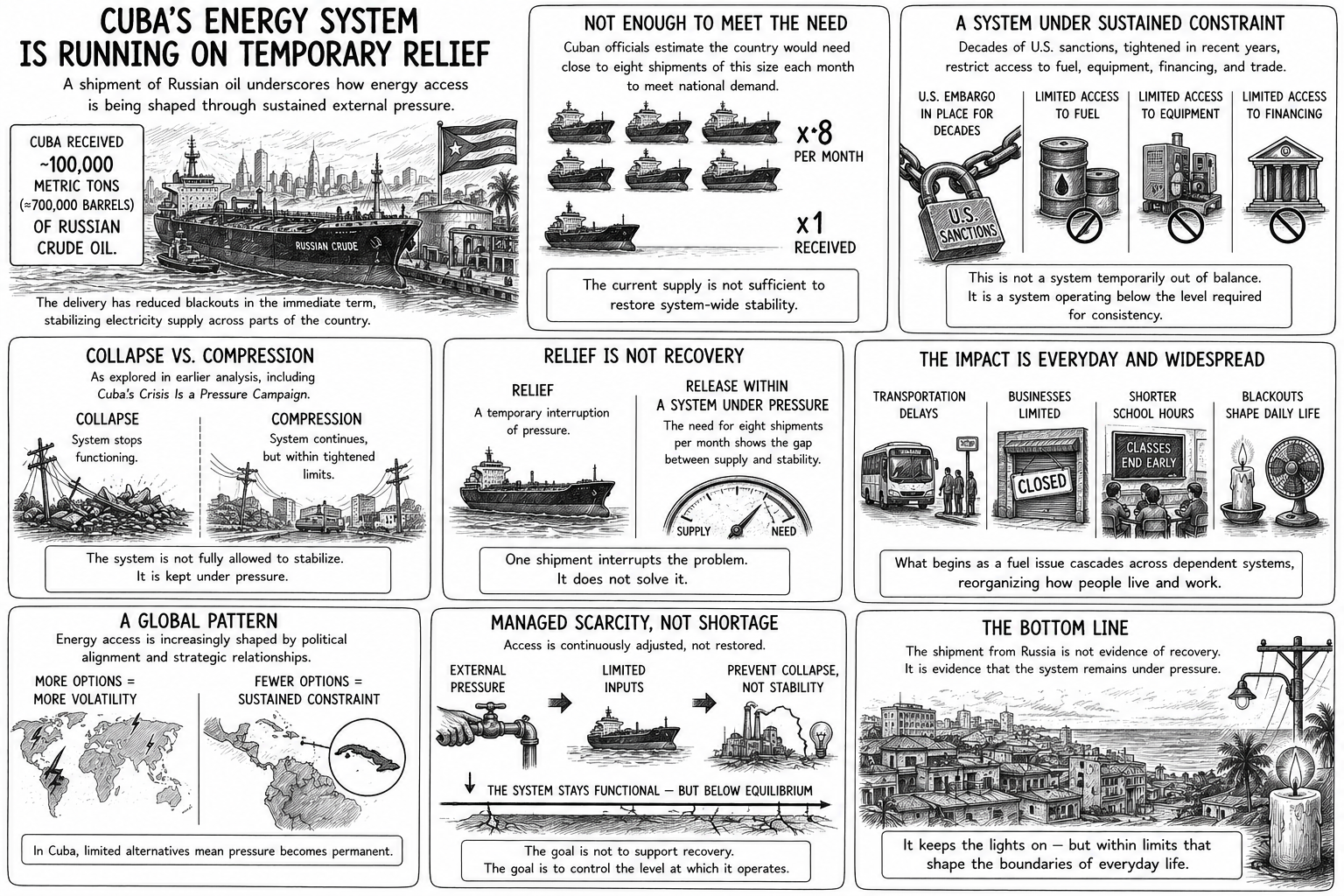
The scale of that gap reflects more than an operational shortfall. Cuba’s energy constraints are unfolding within a broader environment shaped by sanctions, restricted financial access, and limited trade flexibility. The United States embargo, in place for decades and repeatedly tightened in recent years, has constrained access to fuel, equipment, and financing, contributing to shortages that affect transportation, healthcare, and industrial production. This is not a system temporarily out of balance. It is a system operating below the level required for consistency.
That dynamic has been explored more directly in earlier analysis, including Cuba’s Crisis Is a Pressure Campaign, which frames the country’s energy shortages not as isolated breakdowns but as part of a sustained environment of constraint. The key distinction is between collapse and compression. The system continues to function, but only within tightened limits, where access is reduced enough to create instability without triggering total failure.
The recent shipment does not resolve that condition. It interrupts it. And that distinction matters. What appears as relief is better understood as a momentary release within a system that remains under continuous pressure. The need for eight shipments per month compared to one delivery is not a logistical mismatch. It is evidence of a system calibrated to operate below equilibrium, where temporary inputs prevent collapse but do not restore stability.
That pressure becomes visible in everyday life. Energy shortages affect transportation reliability, limit business operations, and reduce the consistency of basic services. Schools shorten hours. Production schedules shift. Households reorganize routines around blackout windows. What begins as a fuel issue cascades across dependent systems, turning infrastructure into a mechanism that shapes how daily life is experienced.
This pattern extends beyond Cuba. Energy access globally is becoming less about market participation and more about geopolitical alignment, where supply is influenced by political relationships and strategic positioning. In regions with more diversified options, that shift introduces volatility. In Cuba, where alternatives are limited, it produces sustained constraint.
The broader shift is toward systems that are not allowed to fully stabilize. What looks like shortage is, in practice, managed scarcity — a condition where access is continuously adjusted rather than restored. The shipment from Russia is not evidence of recovery. It is evidence that the system remains under pressure, operating within limits that define not just energy supply, but the boundaries of everyday life.