
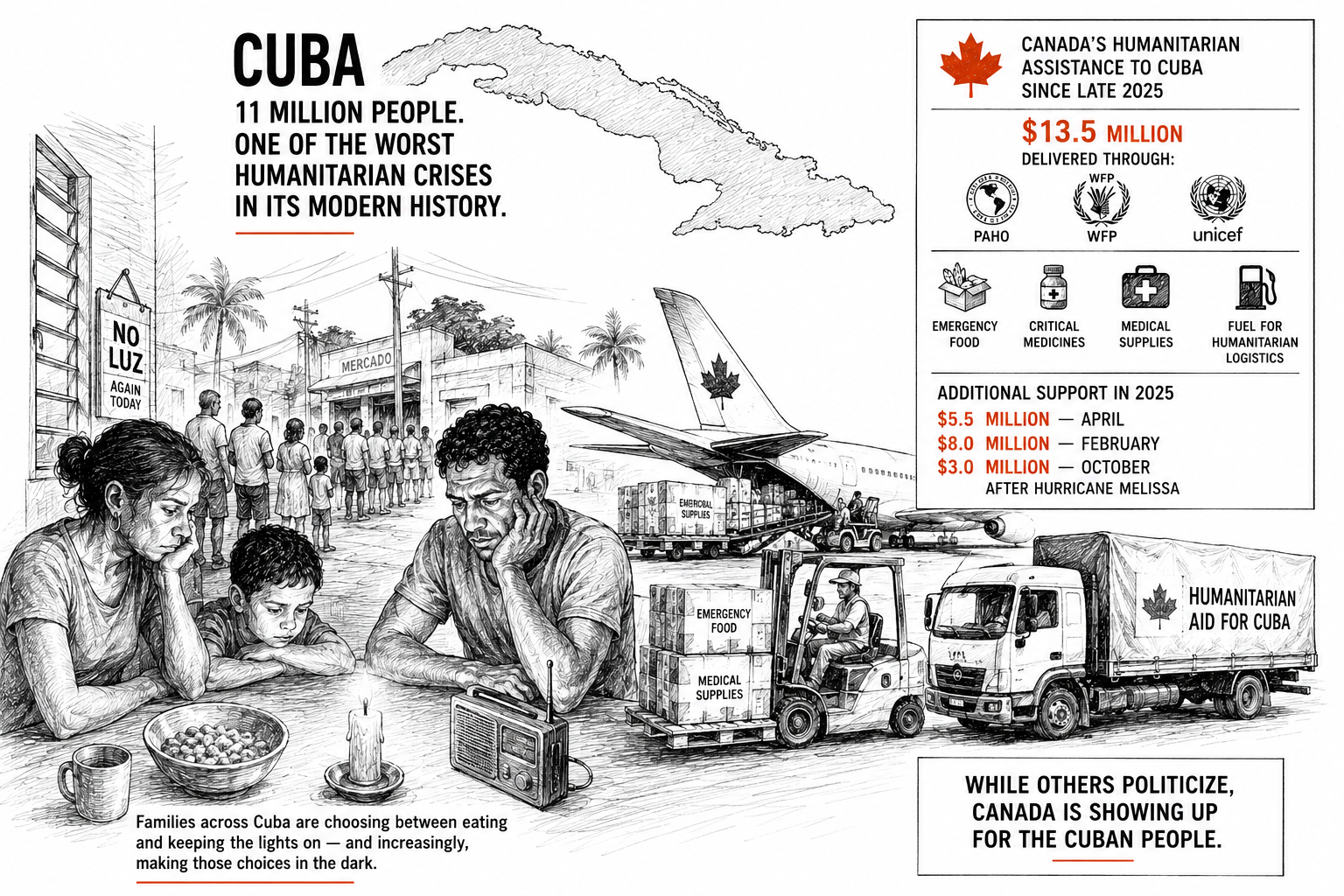
Canada has committed $13.5 million in emergency aid.
Cuba is experiencing one of the most severe humanitarian crises in its modern history. Nationwide power grid failures are producing blackouts that last most of the day across the island. Fuel shortages are cascading into food distribution failures, medicine supply collapses, and healthcare system strain. The 11 million people living through this are not abstractions in a geopolitical argument. They are families making choices between eating and keeping the lights on — and increasingly making those choices in the dark.
Canada has committed $13.5 million in emergency assistance to Cuba since late 2025, delivered through the Pan American Health Organization, the World Food Programme, and UNICEF. The funding covers emergency food, critical medicines, medical supplies, and fuel for humanitarian logistics. Canada provided another $5.5 million in April alone — on top of $8 million in February and $3 million after Hurricane Melissa devastated eastern Cuba in October 2025.
The fact that it is Canada — not the United States, not the European Union, not any of the larger Western economies — doing the most visible humanitarian work on the island tells you almost everything you need to know about how Cuba’s crisis is being framed versus what it actually is.
What is happening on the ground
The crisis is the convergence of multiple compounding failures arriving simultaneously. The US embargo — now over six decades old — has been intensified under the current administration, with a January 2026 executive order imposing tariffs on any country providing oil to Cuba. The order is designed to pressure Cuba’s government by targeting its energy supply chain. The effect on ordinary Cubans is nationwide blackouts and fuel shortages that have paralyzed the economy and disrupted access to every essential service.
Hurricane Melissa compounded an already deteriorating situation. The storm made landfall in eastern Cuba in October 2025, destroying homes and farms across Santiago de Cuba, Granma, Holguín, and Guantánamo provinces. Recovery has been hampered by the same fuel and supply chain shortages that predate the storm.
The Cuban government’s response to the crisis has included measures that have made it materially worse for the people living through it. Cuba’s state-owned telecom monopoly ETECSA raised internet prices significantly in 2025 — at the precise moment when internet access was the primary tool ordinary Cubans could use to communicate distress, organize, access information, and contact family abroad for support. The price hike triggered 46 documented protests — the highest number sparked by a single event in 2025 according to the NGO Justicia 11J. University students issued public statements and called for strikes — an unprecedented development in a country where universities are state-controlled. A journalist was arrested for posting about state security surveillance.
The breaking of silence
What is different about this moment — what makes it worth covering with more specificity than the usual Cuba political framing allows — is that ordinary Cubans are breaking their public silence in ways that are historically unusual. A resident in Centro Habana, speaking on camera, accused state entities of “counter-revolution” after losing electricity, water, and elevator service for an entire city block. Another Cuban, speaking to ABC News, publicly blamed the regime directly for the structural crisis. “The problem here is the government,” they said.
These statements are not typical. Cuba’s political culture has historically suppressed public dissent through surveillance, arrest, and social pressure. The fact that people are saying these things on camera — to international media, without the coded language that dissent usually requires in Cuba — is itself a signal about the severity of what they are living through. When people stop calculating the cost of speaking, the situation has usually already crossed a threshold.
What the framing gets wrong
The mainstream coverage of Cuba tends to collapse into one of two frames: the US embargo as the primary cause of Cuban suffering, or the Cuban government’s failures as the primary cause. Both contain truth. Neither is sufficient on its own.
What gets lost in both frames is the human infrastructure story — the specific, granular reality of what it means to live through a country where the power goes out for most of the day, where medicine is unavailable, where the state raises internet prices during a blackout, and where 359 people from the 2021 protests remain imprisoned with sentences of up to 22 years.
Cuba’s crisis is not a political argument. It is a population of 11 million people absorbing the consequences of decisions made by their own government and by a foreign government that has maintained the world’s longest-running economic embargo against a small Caribbean nation. Both of those things are true simultaneously. The people in the dark did not make either decision.