
While the United States is systematically dismantling the policy infrastructure that supported creative and cultural work — federal arts funding cuts, DEI program elimination, reduced institutional support for underrepresented creative professionals — Dubai has launched a Dhs1 billion creative sector resilience portfolio as part of a deliberate strategy to position itself as the global capital of the creative economy.
That juxtaposition isn’t coincidental. It’s the story.
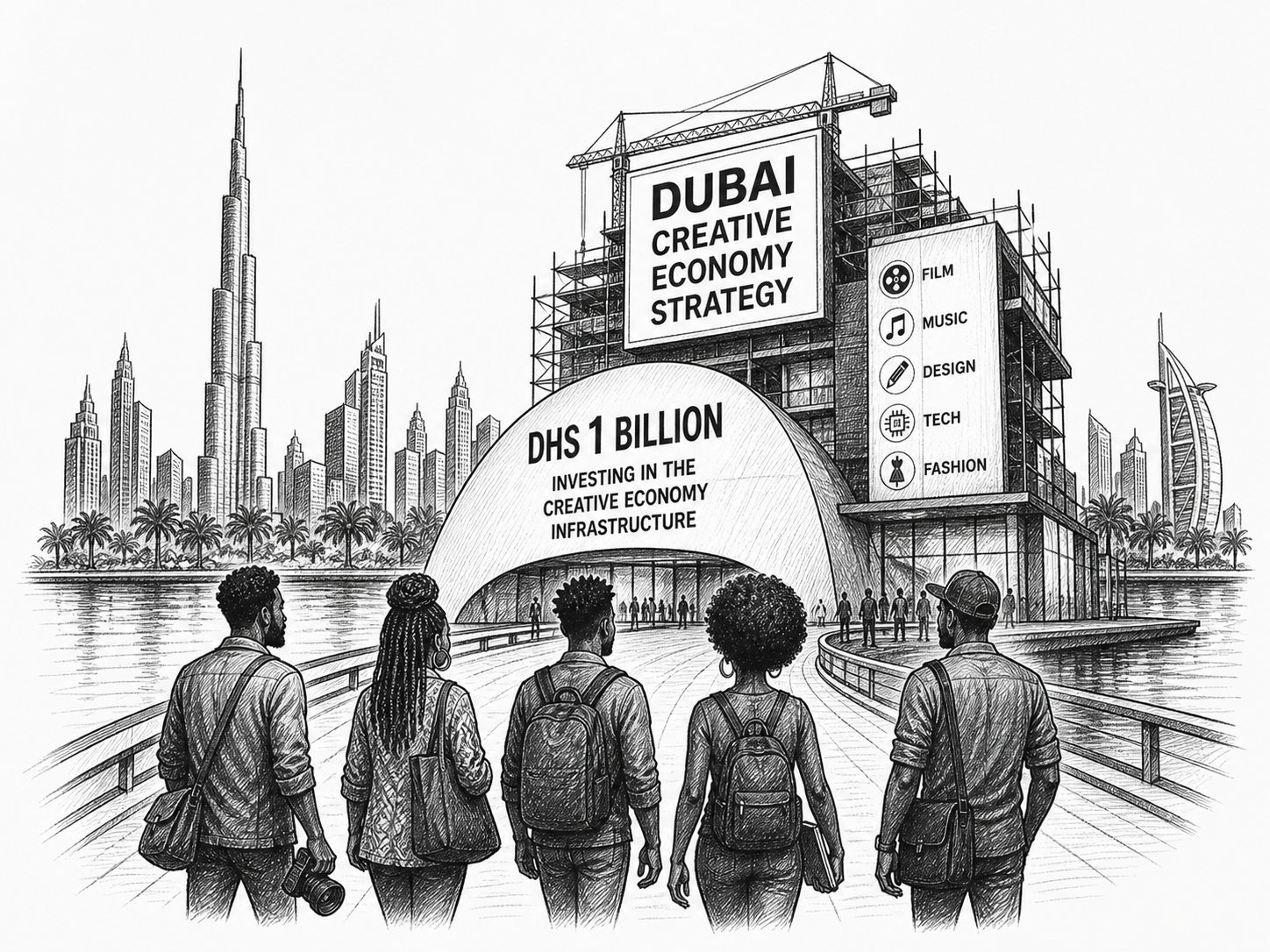
Dubai’s Creative Economy Strategy has been in development for several years, but its current moment is shaped by a global context it didn’t create. The U.S. rollback of diversity and equity infrastructure isn’t just an employment story — it’s a signal to creative professionals, particularly those from underrepresented backgrounds, about where institutional support for their work is likely to exist. When federal grant programs contract, when corporate DEI budgets shrink, when the organizations that provided professional infrastructure for Black and brown creative talent begin pulling back, the question of where to build a career becomes geographic as much as professional. That migration has already been underway — Nigerian creatives, Ghanaian entrepreneurs, Kenyan tech workers, and South African professionals relocating to Dubai in growing numbers, drawn by tax advantages, functioning infrastructure, and an immigration environment that, for holders of professional skills and business capital, offers more stability than the UK or the US currently provides.
Dubai’s pitch is structural. The Creative Economy Strategy explicitly targets global talent — not just regional — by building the legislative and investment environment that makes creative sector work viable at scale. The emirate is forecasting 4.5 percent economic growth in 2026, driven in part by tourism and the cultural and business event infrastructure it has been methodically expanding. Visitor numbers reached 15.7 million between January and October 2025, with the growth concentrated in cultural, medical, and business event categories that signal a specific kind of internationalism — one that treats creative and intellectual work as economic infrastructure rather than cultural amenity.
This matters for SSC’s beat for a specific reason. The communities whose cultural production has historically generated the most commercially valuable creative output in the American context — Black artists, designers, musicians, writers, cultural strategists — are the same communities whose institutional support is being most aggressively contracted right now. The question of who captures the value when Black creative labor moves into a new economic system is never settled by the opportunity alone. In music, that question is about masters and royalties. In the Afrobeats crossover moment SSC documented how the infrastructure capturing the value of African creative production is rarely owned by the communities producing it. Dubai’s creative economy raises the same question at a different scale — and in a different legal framework.
Dubai is not a perfect destination. Labor rights, press freedom, and equity for migrant workers remain serious concerns that complicate any straightforward celebration of its creative economy ambitions. The kafala sponsorship system ties every migrant worker’s legal status to their employer. There is no citizenship pathway regardless of years of residence or contribution. The African professionals arriving are not entering a neutral space — they are entering a hierarchy that was already there before them, finding their place within it rather than shaping it. Alignment at the level of opportunity does not mean alignment at the level of belonging, and that distinction is the one Dubai’s creative economy marketing consistently fails to surface.
The structural dynamic is real regardless: capital is building infrastructure for creative work in the Gulf at precisely the moment American institutions are contracting the infrastructure they had. That’s a power story about who gets to set the terms for where creativity is valued, resourced, and rewarded — and the communities with the most at stake in that question are the ones whose institutional support is disappearing fastest on this side of the Atlantic.