
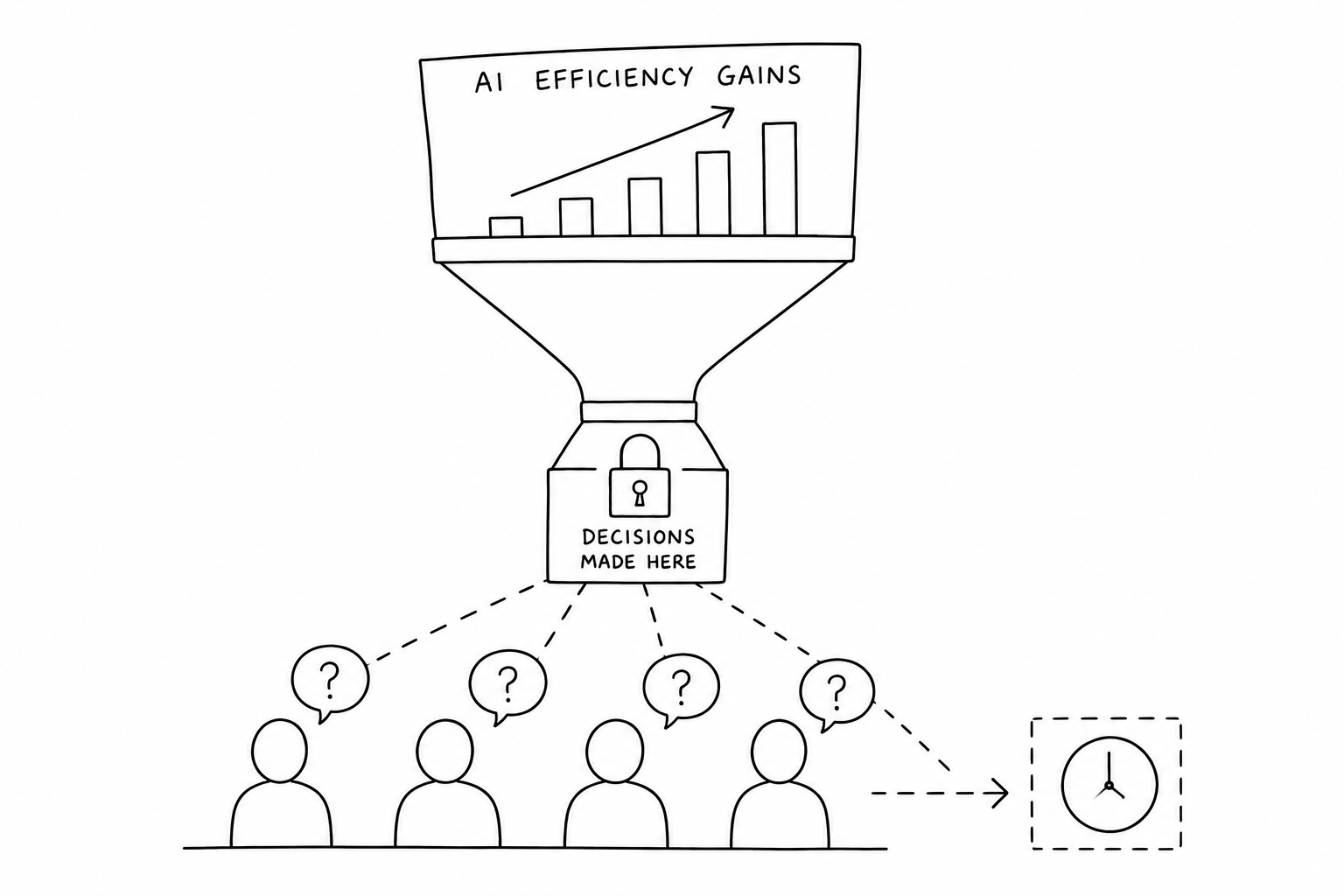
Boston Consulting Group released its fourth annual AI at Work report this week, and the headline number is striking: 74 percent of frontline employees now use AI tools daily or several times a week — up 23 percentage points from 2025. Among regular users, 42 percent report saving the equivalent of a full workday each week. The efficiency gains are real, documented, and widening. What companies are doing with them is a different story.
BCG surveyed nearly 12,000 frontline employees, managers, and leaders across more than a dozen global markets. The structural finding beneath the adoption numbers is this: 66 percent of frontline workers receive limited or no guidance on what to do with the time AI frees up, and more than half report they are not reinvesting that time into more strategic work. The productivity gains exist. The organizational systems to capture them do not.
That gap is not an oversight. It is a design choice — or more precisely, the absence of one. Companies have invested in deploying AI tools. They have not invested in redesigning the work that surrounds those tools. BCG authors Vinciane Beauchene, Sylvain Duranton, David Martin, Vanessa Lyon, and Jeff Walters frame it directly: strategy matters more than tools. Employees who receive clear direction on what to do with AI-generated time consistently outperform those with greater access to AI tools but no strategic guidance. The technology is not the bottleneck. Management is.
The distributional consequences of that management failure do not land evenly. Frontline workers — the 74 percent now integrated into daily AI use — report receiving the least guidance of any group in the organization. Only 36 percent say they have received adequate upskilling. Only 28 percent see a meaningful connection between what leadership says about AI and what the organization actually does. The workers absorbing the operational demands of AI adoption are the last ones being told what it means for their careers, their roles, or their futures.
The agent question accelerates the timeline. 84 percent of respondents have heard of AI agents — tools that act autonomously with minimal human oversight. 30 percent say their organizations have already integrated agents into workflows, more than double the share from 2025. 61 percent of all respondents believe agents could perform at least half of their job within three years. Half of all respondents also say their companies lack clear governance for managing teams that include both people and AI. The technology is moving. The accountability structures are not.
What the BCG report documents, without fully naming, is a familiar pattern in how productivity gains get distributed. When workers save a workday per week through AI efficiency, the question of who captures that value — the worker, through reduced hours or higher pay, or the employer, through higher output expectations at the same cost — is not answered by the technology. It is answered by organizational structure, labor market power, and whether workers have any say in how the redesign happens. The report recommends that companies involve people in shaping the change. It does not explain what happens to the workers at organizations that choose not to.
The efficiency is real. Who it is built for has not been answered — and the window for that answer is closing faster than the adoption curve suggests.