
In the 72 hours between Friday and Monday, rebel groups in Colombia’s southwestern region staged 26 attacks using explosives and drones, according to the country’s defense ministry. The deadliest was a blast on the Pan-American Highway near a tunnel between Cali and Popayán in Cajibio, Cauca on Saturday, which killed 21 people — a death toll that rose over the following 48 hours as victims succumbed to injuries. Colombia heads to a presidential election in May in which crime and security rank among the top voter concerns. The timing of the escalation is not coincidental. The scale of it — 26 attacks in three days — is a statement about capability and intent that the incoming government is being asked to read before it takes office.
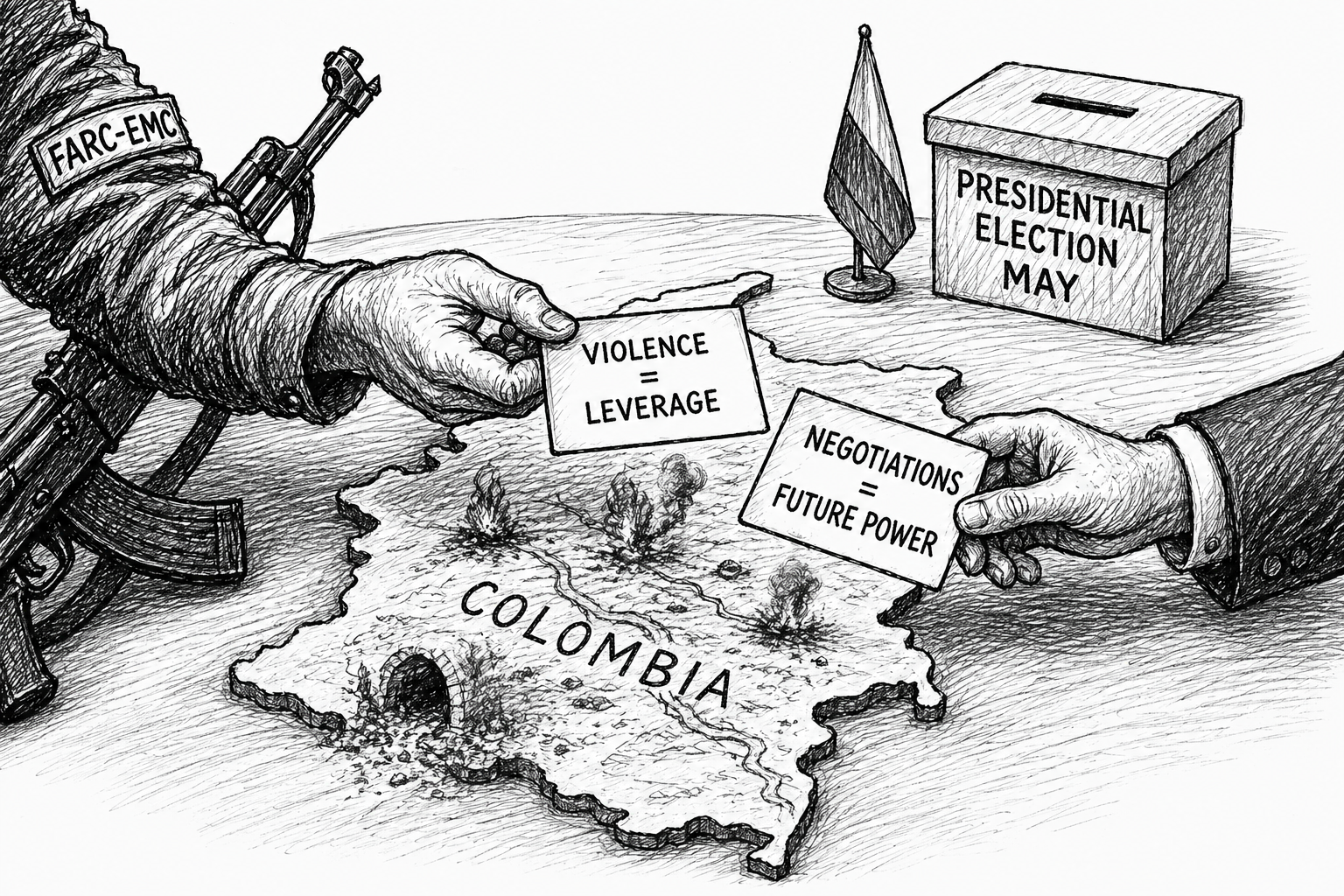
The group behind the attacks is the FARC-EMC, led by Iván Mordisco, a former FARC commander who refused to participate in the 2016 peace deal that ended Colombia’s decades-long civil conflict. Mordisco’s faction abandoned peace talks with the Colombian government in April 2024 and has been fighting the government since, with particular strength in Cauca and Valle del Cauca, where the group controls drug trafficking routes and illegal gold mines. The Micay Canyon, a coca-producing region that the FARC-EMC has held for years, has been the site of sustained military pressure from the Colombian government — and the current wave of attacks is, in part, a response to that pressure. The escalation is symmetrical: military offensive met with civilian-targeting escalation, designed to raise the cost of continued enforcement.
Political risk analyst Sergio Guzmán described the FARC-EMC’s current posture plainly: “Part of what they are doing is establishing leverage towards the future.” The group is positioning itself for negotiations with whoever wins the May election, demonstrating that it retains the capacity to do serious damage and must be taken seriously as a negotiating partner. This dynamic — armed groups escalating violence before political transitions to improve their bargaining position — is not unique to Colombia. It is a documented pattern in post-conflict environments where peace processes have partially collapsed, and it produces a specific kind of political pressure on incoming governments: negotiate, or absorb the cost of the alternative.
The implications extend beyond Colombia’s borders in ways that matter directly to communities in Miami, New York, and Houston with significant Colombian, Venezuelan, and Caribbean diaspora populations. Colombian political instability shapes migration patterns, remittance flows, and the conditions under which families make decisions about whether and where to move. The Pan-American Highway, where Saturday’s deadliest attack occurred, is a critical logistics corridor connecting Colombia to Panama and the broader regional economy. Sustained attacks on infrastructure of that significance affect trade, movement, and the economic conditions that drive migration decisions — connecting what happens in Cauca directly to what happens in the cities where Colombian diaspora communities are concentrated.
The mainstream coverage of this story has focused on the security dimension — attack counts, death tolls, government response — without sufficiently examining the political logic underneath it. The FARC-EMC is not simply acting out. It is executing a pre-election strategy with a clear objective: arrive at the negotiating table with the next Colombian government having demonstrated that the cost of exclusion is higher than the cost of engagement. Whether that strategy succeeds depends on who wins in May and what they decide to do with the leverage being assembled against them right now. The election will determine a government. The violence is determining what that government will inherit.