
Part of Culture in Motion — an ongoing series examining who defines culture, how it moves, and what it reveals about the moment.
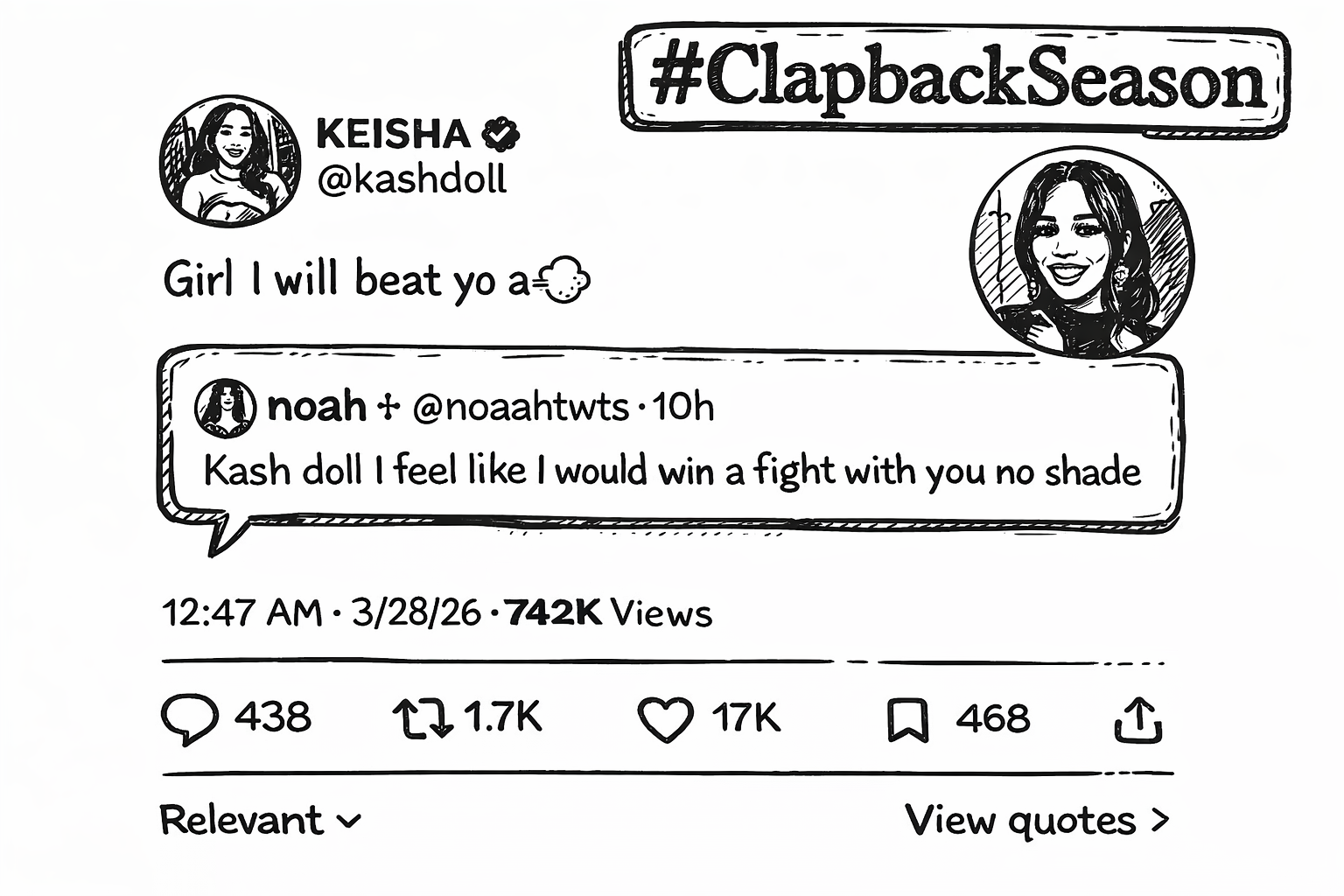
A single exchange can still take over the internet, but what matters now is not just what is said — it is how quickly it can be turned into content. When @noaahtwts posted “Kash doll I feel like I would win a fight with you no shade,” the response from Kash Doll came back just as direct: “Girl I will beat yo a—.” The exchange had already accumulated 742K views by the time The Shade Room amplified it under #ClapbackSeason early this morning — a number that reflects not just the reach of the original post but the speed at which platform infrastructure converts a two-line exchange into a cultural moment.
That shift is the story. The phrase “clapback season” has evolved into more than a descriptor — it signals a recognizable format, a quick and sharp response delivered with enough precision to circulate widely. What was once spontaneous now operates with informal structure, shaped by the expectations of the audience watching.
The clapback has become a performance of control. It allows public figures to reclaim narrative in real time, responding to criticism in a way that reinforces presence rather than diminishes it. But that control is conditional. The response has to land. It has to feel natural while still being calibrated for visibility. Too measured and it feels inauthentic. Too aggressive and it risks backlash. The balance is part of the craft — and it is a craft that has to be executed under pressure, in public, with an audience already forming opinions before the response is fully out.
This dynamic is not new, but it has evolved significantly. As SSC examined in Black Twitter Was Infrastructure, the clapback was never just a reaction — it was an expression of wit, community awareness, and shared language. Timing and cultural fluency shaped early digital discourse in ways that were specific and legible to the communities generating them. Clapbacks carried context. They were funny or sharp or devastating precisely because the audience understood the full weight of what was being said and what was being left unsaid. What is different now is scale. What once lived within a more culturally specific ecosystem now circulates across broader audiences, often detached from the context that originally gave it meaning. The format travels. The cultural specificity frequently does not.
That shift changes the function of the exchange. The initiating comment becomes secondary once the response is amplified. Visibility moves upward. The person with the platform determines how the moment is framed, while the original voice becomes part of the setup rather than the focus. The interaction is no longer a conversation. It is content shaped by hierarchy — and the hierarchy was already in place before the first word was typed.
At the same time, the expectation of response has intensified. Public figures are no longer simply reacting when they choose to. They are operating within an environment where response is assumed, silence carries meaning, and engagement carries risk. Every interaction exists within a feedback loop where audience reaction is immediate and measurable, shaping not just perception but future behavior. The clapback isn’t optional anymore. It’s a labor expectation baked into the visibility economy — one that disproportionately falls on Black women, who are simultaneously expected to be sharp, unbothered, and entertaining on demand. The culture celebrates the response without acknowledging the cost of always having to produce one.
This connects to what SSC has tracked in Why Stories Are Missing — the gap between what circulates and what gets examined. The clapback is one of the most circulated formats in digital culture, and one of the least analyzed. Its DNA, its cultural origins, the specific communities that built the language and timing it depends on — these rarely travel alongside the content itself.
Why This Matters
Clapback culture reflects a broader shift in how communication functions in public spaces. What appears spontaneous is often structured by audience expectation, platform dynamics, and the need for visibility. The DNA of these exchanges traces back to spaces like Black Twitter, where timing and cultural awareness defined the moment. What has changed is how widely that format now travels — and how quickly it is absorbed into a larger system where response itself becomes strategy, the labor behind it becomes invisible, and the communities that built the language rarely receive credit for the architecture.