
The debate inside China’s strategic community is no longer whether American power is diminishing. That question has largely been settled. China’s leadership, state media, and foreign policy analysts now broadly consider the U.S. a declining but dangerous power — an assessment that has remained durable and is grounded in genuine readings of U.S. internal contradictions, reinforced by the Chinese Communist Party’s ideological predisposition to view capitalist powers as inherently unstable. What is actively being debated is what China should do with that conclusion.
The analytical framework driving Beijing’s posture traces back further than the current moment. The narrative characterized by Xi Jinping’s 2020 declaration that “the East is rising and the West is falling” gained serious traction during the COVID-19 pandemic, when China brought its domestic outbreak under control while the U.S. struggled — and has been amplified steadily through state media ever since. Trump’s return to power did not shake that framework. It deepened it. Even assertive foreign policy moves — sweeping tariffs, the capture of Venezuelan President Nicolás Maduro, and last year’s bombing of Iran’s nuclear facilities — did not erode Beijing’s view of American decline but rather further damaged Washington’s global reputation in Chinese strategic circles.
The irony, documented by NPR and multiple foreign policy analysts, is that the perception runs in both directions. The U.S. and China each believe the other is a declining power, creating what Johns Hopkins scholar David Lampton describes as a mirror image process — two countries locked in cycles of embedded hostility, each reading the other’s actions as confirmation of their own strategic assumptions. That dynamic makes miscalculation more likely, not less, because neither side is operating from a shared reality.
What makes this moment distinct is how China is translating its assessment into policy behavior. Until recently, the view that U.S. power was fading had led Chinese officials to judge that time was on China’s side — that the PRC should avoid provoking the U.S. and wait. That patience appears to be shifting. Following the October 2025 Trump-Xi Busan summit, a growing consensus emerged within Chinese strategic circles that China had essentially won the trade war and successfully drawn the United States into a strategic stalemate — and that the post-Cold War international order is undergoing a profound reorientation with China ascending. The strategic patience of the previous decade is giving way to a more active positioning.
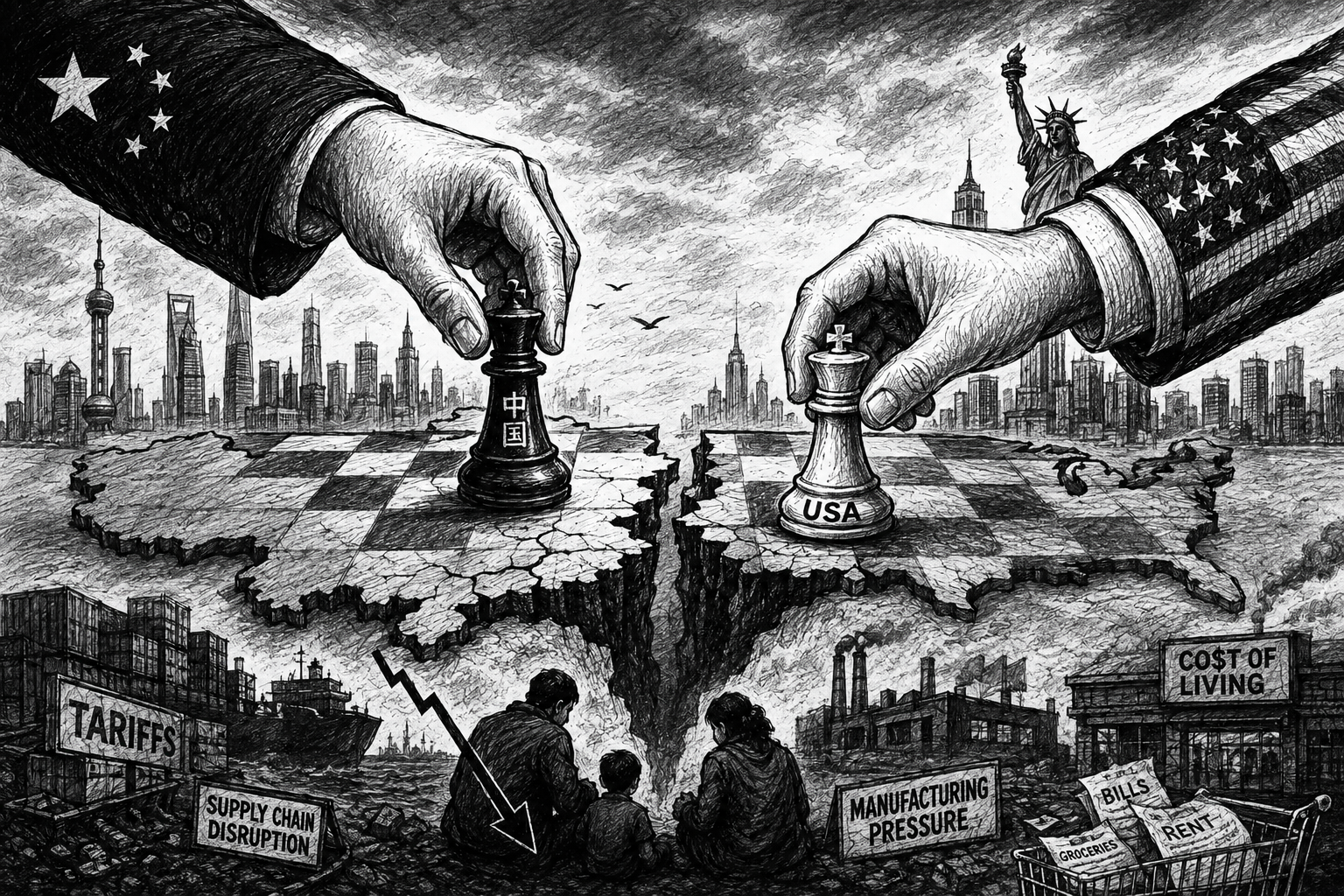
The domestic dimension of this story matters for how communities in the U.S. absorb its consequences. Tariffs, supply chain disruptions, manufacturing reshoring pressures, and the cooling of global retail demand — all of which disproportionately land on working-class and low-income households — are downstream effects of a great power competition that is rarely framed that way in domestic coverage. When Nike reports a 20% sales decline in China this quarter, or when global consumer spending softens across markets tied to U.S.-China trade tensions, those numbers register as corporate data points. They are also signals of a geopolitical realignment that is actively redistributing economic risk — and the people absorbing the most of it are not the ones setting the terms.
Fewer people-to-people interactions between the U.S. and China mean both countries are increasingly trapped in their own narratives about each other, with less capacity to course-correct. Beijing has decided what America is. Washington has decided what China is. The structural consequences of both countries acting on those conclusions — simultaneously, with limited communication and escalating economic pressure — will not be abstract. They will land somewhere specific. They always do.