
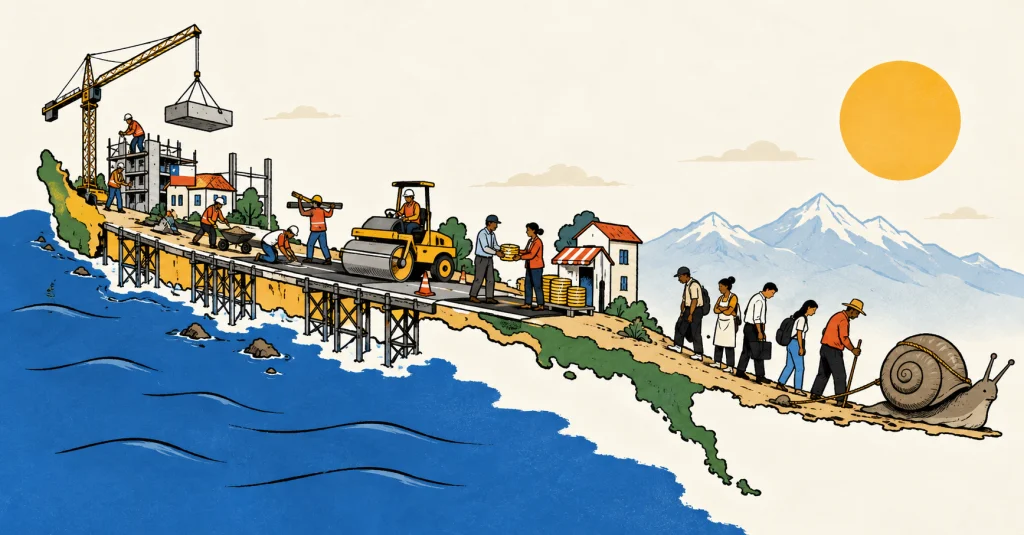
President José Antonio Kast’s new plan speeds up public works, subsidizes hiring and gets money to businesses faster. It’s a short-term fix for what he calls a structural problem.
Chile’s unemployment rate has been above 8% for 43 consecutive months. In the May-to-July period it reached 9.5%, the highest in five years, and it has become the biggest political weakness for President José Antonio Kast, whose approval ratings have slipped as the economy has stalled.
On Monday, Kast responded with Plan Chile Despega, which would mobilize 1.3 trillion Chilean pesos, roughly $1.3 billion, to create more than 100,000 jobs through infrastructure, reconstruction, housing and community projects. According to Reuters, the government says the effects will begin to show in the coming months and continue through 2027.
The plan is a sensible, targeted package. It is also mostly a plan to spend faster, and that says a lot about how much room Chile has to act.
What’s in the plan
The package has four parts. It speeds up public works, expands hiring subsidies, frees up cash for businesses and suppliers, and sends the effort out to the regions under local management and monitoring.
Hiring subsidies are the most direct piece. The existing Modo Empleo program had 25,000 subsidized positions, and the plan adds 75,000 more. Employers receive half of a monthly minimum wage for each man hired and 60% for each woman, for four months, according to local reporting cited by The Rio Times. The first round drew 66,000 applications by Friday. The plan also includes about $311 million in loan guarantees for small businesses and roughly $135 million in early payments to health-ministry suppliers. Kast argued that a company that gets its cash flow back can start buying and hiring again.
Mostly faster, not bigger
Kast was direct about what the plan is. He described it as a way to carry out, “with maximum speed,” what is already in the budget. The public works ministry is set to spend about $3.2 billion by December and the housing ministry about $477 million. Those are large figures, but much of that money was already allocated.
Local reporting identified about $603 million for fast-track new projects, plus 623 municipal projects, and noted that it’s unclear how much funding beyond that is actually new. Different outlets have put the short-term public works and jobs portion at different totals.
Speeding up already budgeted spending is a reasonable choice for a government that wants quick results without adding to its deficit. But it also means the plan is mainly moving money earlier, not adding much new money. If projects are pulled forward into late 2026 and early 2027, the question is what fills the gap once that spending runs its course.
A short-term plan for a long-term problem
Kast himself described the unemployment as structural. That creates a mismatch the plan doesn’t resolve. Public works and four-month hiring subsidies are designed to fix a temporary drop in demand. Forty-three months of high unemployment suggests something more persistent.
Scale is part of the issue. Chile’s labor force is roughly 9.8 million people. At 9.5% unemployment, that works out to well over 900,000 people out of work. Even if the plan reaches its goal of 100,000 jobs, it would address about one in nine. That’s meaningful for those workers, but it won’t change the overall picture on its own.
Chile’s economy also depends heavily on copper and other natural resources. When commodity-driven growth slows, a construction-heavy stimulus can support employment, but it doesn’t create the kinds of jobs that would make the labor market less exposed to the next copper downturn.
Business leaders are skeptical of the longer-term goal. Susana Jiménez, who leads Chile’s main business confederation, the CPC, called the government’s target of 6.5% unemployment by 2030 “super ambitious.”
The detail worth watching
One feature of the subsidies could matter more than its size suggests. Subsidized hires must be on open-ended contracts with pension contributions paid, so only formal jobs qualify.
That links Chile’s plan to the broader regional challenge. Across Latin America, roughly half of workers are informal, with no contracts, pensions or social protections. Inter-American Development Bank research released last week found that whether AI raises or lowers wages in the region depends on whether workers can move into growing sectors, and that path usually runs through formal employment. Kast was among the leaders at that IDB meeting in New York. Chile’s plan, deliberately or not, uses subsidies to pull people into formal work, which the region’s AI outlook suggests will matter.
Whether 100,000 jobs actually materialize will become clearer over the next several months. The first test comes Wednesday, when Chile’s statistics agency, INE, releases unemployment figures for June through August. The plan won’t have had time to affect those numbers, but they will set the baseline Kast’s plan will be judged against, as the approval ratings he’s trying to recover depend on how quickly things improve.
Sources: Reuters via Investing.com, Bloomberg, The Rio Times, El Mostrador, The Clinic, Latin Times