
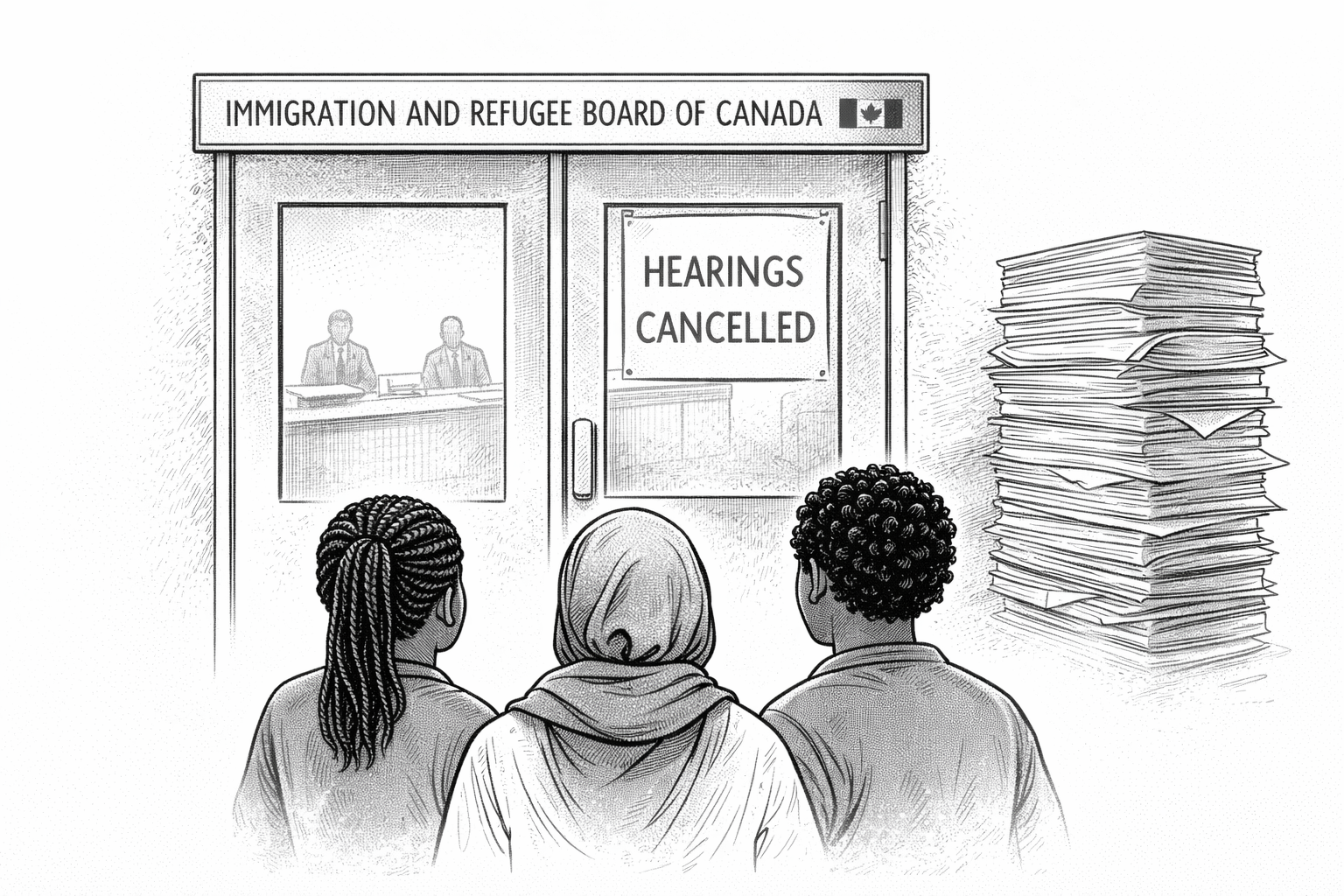
Canada passed Bill C-12 on March 26, 2026 — one of the most significant restructurings of its immigration and asylum system in decades. The government’s framing was administrative: close loopholes, reduce backlog pressure, modernize a system that had grown from fewer than 10,000 pending cases in 2015 to nearly 300,000 by 2026. The mechanism is sharper than that framing suggests.
Any asylum claim filed more than one year after a claimant’s first entry into Canada — where that entry occurred after June 24, 2020 — will not be referred to the Immigration and Refugee Board for a full hearing. Approximately 37% of asylum claims filed between June 3 and October 31, 2025 would be disallowed under this rule — roughly 19,000 applications. The retroactive reach is one of the law’s defining features. The date a claim was made now matters as much as the date the law received Royal Assent. For some claimants, the legal change arrived this week but governs claims already filed.
The one-year clock sounds neutral. It is not. The communities most likely to have waited before filing — for reasons of fear, lack of legal access, language barriers, unfamiliarity with a system that does not explain itself clearly, or the practical reality of stabilizing housing and employment before navigating bureaucracy — are disproportionately African and Caribbean migrants. The law does not account for why people wait. It simply eliminates their access to a full hearing because they did.
The vice-president of the Canadian Association of Refugee Lawyers called Bill C-12 “the most significant rollback of refugee rights in more than a decade,” and said the legislation will face constitutional challenges before the courts. More than two dozen human rights organizations warned that the law “will put thousands of individuals at risk of persecution, violence and precarity.” The UN Human Rights Committee issued its own warning that the legislation “may weaken refugee protection.” The bill passed anyway, with support from both the Conservatives and the Bloc Québécois — a bipartisan consensus on restriction that mirrors the political environment in the US and UK simultaneously.
As SSC covered in The Airport Isn’t Just a Transit Hub Anymore — It’s a Checkpoint, the infrastructure of immigration enforcement is being expanded and tightened simultaneously across multiple countries — the US deploying ICE to airports, the UK signing deportation agreements with Nigeria, and now Canada retroactively barring asylum hearings for claims already in the system. These are not parallel accidents. They are a coordinated tightening of the same border logic, and as SSC documented in the Adam Mahoney deportations piece, the communities absorbing the consequences are disproportionately African and Caribbean.
What is displaced by that tightening is not just legal access. It is the possibility of a full hearing — the moment where an individual case is examined on its specific circumstances rather than processed against a rule that was written after the claim was filed. The Pre-Removal Risk Assessment that claimants denied an IRB hearing can still access is a paper-based evaluation conducted by the same immigration department that denied the hearing. It applies a narrower standard. For the 19,000 people whose claims are now governed retroactively by a law they could not have anticipated, that is the only door left open.
Why This Matters
Canada has long presented itself as a model of humane immigration. Bill C-12 does not dismantle that self-presentation — it adjusts the criteria for who qualifies for it. The one-year rule is not designed to screen out persecution. It is designed to screen out the people most likely to have needed time before they could navigate a system that was not designed with them in mind. When the system removes the hearing, it also removes the record — the documented accounting of why someone waited, what they faced, and what they were owed. That removal is not a side effect of the policy. For the communities most affected, it is the point.