
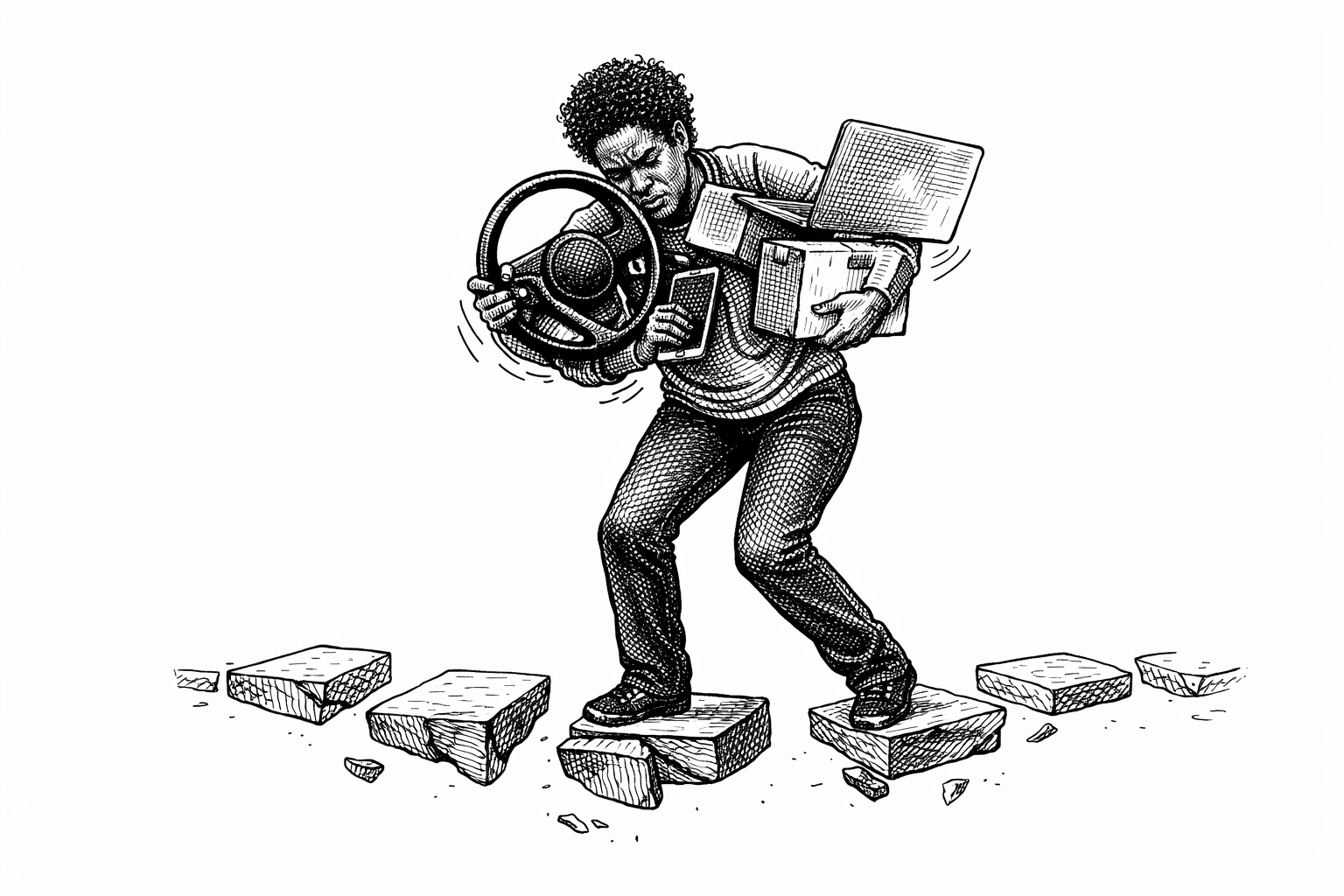
For many workers, the workday no longer begins or ends in one place. It moves. A morning shift might start behind a wheel, an afternoon might be spent completing short-term tasks, and the evening might bring a second or third stream of income. None of these roles are necessarily connected, but together they form something that resembles a livelihood. The structure is no longer a job — it is a patchwork built in real time.
This shift is often framed as flexibility — an expansion of choice in how and when people work. And for some, that framing holds. But for many others, especially those navigating inconsistent access to stable employment, this structure is not driven by preference. It is a response to constraint. When steady, full-time roles are harder to access or maintain, income does not disappear. It fragments into smaller, more immediate opportunities that can be activated quickly. According to a 2025 survey of more than 900 gig workers, 88 percent have taken on more work specifically to combat rising prices, and 55 percent rely on gig work for more than half their total earnings. ADL As explored in our earlier reporting on bridge work, short-term and gig-based roles are increasingly functioning as a financial bridge between periods of traditional employment rather than a supplement to it.
What emerges is a form of work that fills gaps rather than resolves them. Bridge work allows movement between income sources without ever fully arriving at stability. It provides continuity in the short term, but not the predictability required to plan beyond the present. The bills get paid, but the margin for error remains thin. A Human Rights Watch investigation found that six of the seven largest platform companies use opaque algorithms to assign jobs and determine wages — meaning workers often do not know how much they will be paid until after completing the job, and in some cases earn less than the applicable minimum wage. Yahoo! Nearly half of gig workers cite the lack of health insurance and retirement plans as their biggest concern, and 24 percent say they cannot always cover basic living expenses. ADL
This dynamic is not evenly distributed. As explored in a recent analysis of Black unemployment, workers who already face structural barriers to stable employment are more likely to rely on this kind of income assembly. For Black workers, that often means navigating longer job searches, fewer referral pathways, and greater exposure to roles more vulnerable to disruption. Bridge work becomes a buffer — absorbing the instability the formal labor market does not.
Black women, in particular, are often positioned at the center of this system. They are more likely to carry both economic and caregiving responsibilities, making flexibility necessary but not sufficient. The ability to move between roles can help manage competing demands, but it does not resolve the underlying issue: access to consistent, adequately compensated work. As a result, flexibility functions less as autonomy and more as a way to maintain stability in the absence of it.
Over time, the limitations of this structure become more visible. Income fluctuates. Benefits are minimal or nonexistent. Time becomes fragmented, making it difficult to pursue advancement, rest, or long-term planning. Ninety-one percent of gig workers report being deactivated, penalized, or shadowbanned by platforms without explanation ADL — a reminder that the same systems offering access can withdraw it without warning or recourse. Bridge work is often presented as a defining feature of a modern, evolving economy. But its growth also reflects where the system falls short — expanding most where stability is hardest to secure, filling the space between participation and security. And as long as that gap remains, work will continue to be available without necessarily providing a foundation to build on.