
Botswana has officially removed colonial-era provisions from its Penal Code that criminalized same-sex relations, aligning statutory law with a constitutional interpretation first established in 2019 and upheld on appeal in 2021. The move is being framed as a milestone. The timeline tells a more revealing story. Botswana decriminalized same-sex relations in 2019, joining a short list of African countries that have done so in the 21st century — including Cape Verde in 2004, Lesotho and São Tomé and Príncipe in 2012, Mozambique in 2015, Seychelles in 2016, Angola in 2021, Mauritius in 2023, and Namibia in 2024. The formal repeal in 2026 completes what the courts began seven years ago. The gap between those two moments is where the deeper story sits.
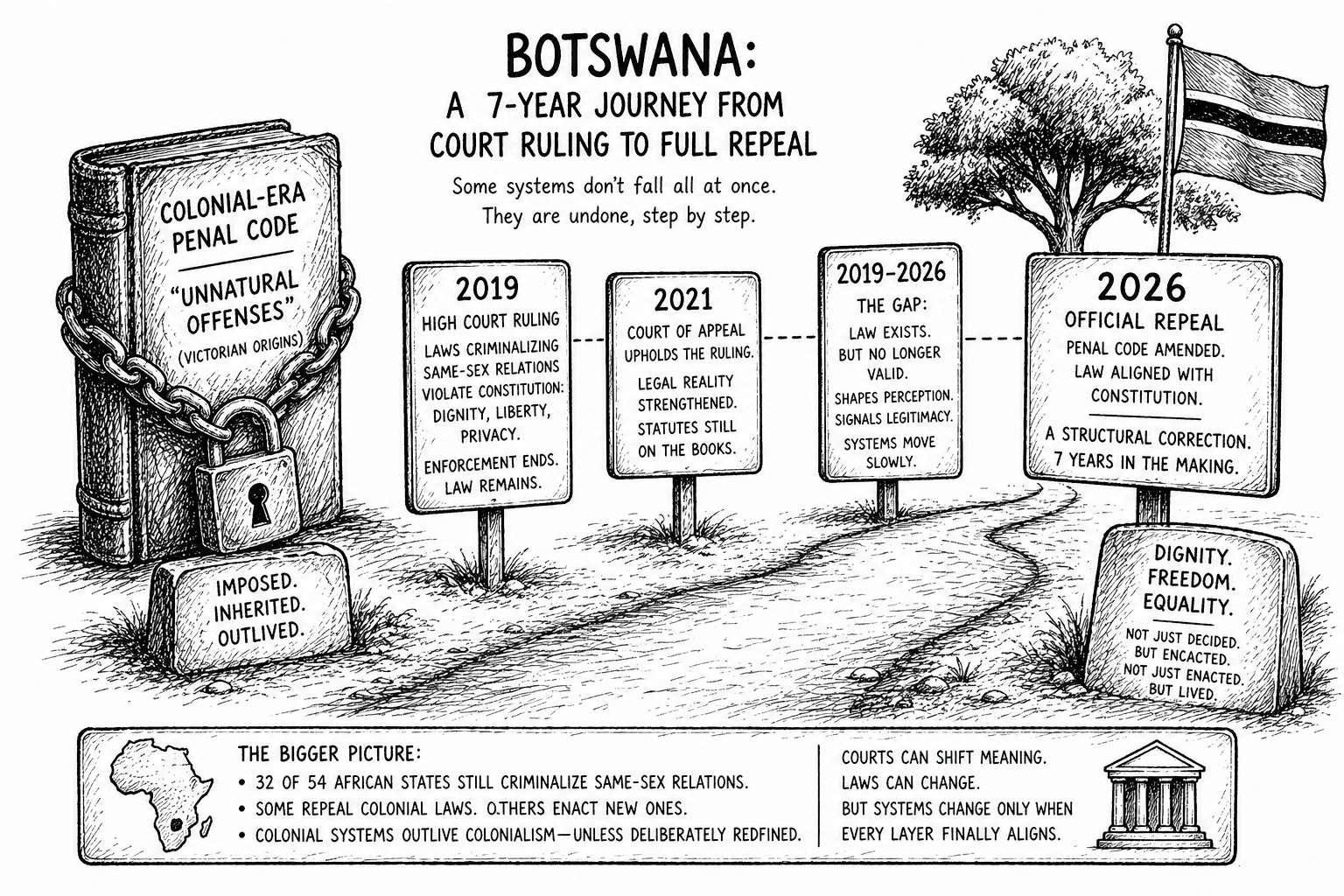
As of 2025, homosexuality remains outlawed in 32 of Africa’s 54 UN-recognized states. The laws criminalizing same-sex relations across Commonwealth jurisdictions are often referred to as “unnatural offenses” provisions — originating primarily from Victorian England and appearing in criminal codes across countries ranging from Tanzania to Sri Lanka to Tuvalu. They were not indigenous to the societies they governed. They were imposed structures, designed to regulate behavior through a colonial moral framework, and they outlasted the colonial governments that created them by decades — in many cases by more than half a century. The same Britain that once exported anti-sodomy laws to its colonies now calls on those nations to repeal them — a striking irony that reveals how colonial accountability rarely extends to the systems colonial power left behind.
The Botswana timeline illustrates how institutional change is staged rather than immediate. The High Court ruled in 2019 that laws criminalizing same-sex relations violated constitutional protections around dignity, liberty, and privacy. That decision directly invalidated enforcement — but the underlying statutes remained embedded in the Penal Code. The Court of Appeal affirmed the ruling in 2021, reinforcing its legal weight. What has happened in 2026 is not the creation of a new legal reality. It is the alignment of written law with a judicial reality that had already been established. Courts can shift the meaning of the law, but full structural alignment requires multiple layers of institutional action — and those layers move at different speeds.
The persistence of the law between 2019 and 2026 was not administrative negligence. It reflects how systems operate beyond their formal power. A statute does not need to be actively enforced to shape behavior. Its existence continues to signal legitimacy to those who might still seek to use it — socially, politically, or institutionally. Removing it is not simply administrative cleanup. It is a redefinition of what the system recognizes as permissible. That distinction matters because the psychological architecture of a law outlasts its enforcement in ways that are harder to measure than a court ruling or a legislative amendment.
The broader regional context makes Botswana’s repeal look less like a trend and more like an exception. Burkina Faso became the latest African country to criminalize same-sex relationships in 2025, and Mali adopted a new penal code criminalizing homosexuality in 2024 — neither country had previously had laws against consensual same-sex activity. U.S. evangelical organizations have provided close to $50 million to African governments to develop laws and policies against sexual and reproductive rights, with nearly $20 million directed specifically toward supporting Uganda’s Anti-Homosexuality Act. The direction of legal change on the continent is not uniform. In some countries colonial frameworks are being removed. In others, new frameworks are being built that extend and intensify what colonialism introduced.
What this moment ultimately illustrates is a pattern that extends far beyond this single issue: systems often continue operating under inherited assumptions until they are deliberately redefined at every institutional level simultaneously. The shift does not happen at the moment of independence. It does not happen at the moment a court rules a law unconstitutional. It happens when the written law, the judicial interpretation, and the legislative record are finally brought into alignment — and even then, the social architecture the law produced continues to shape behavior in ways that no repeal can immediately undo. Botswana’s repeal is a structural correction seven years in the making. That it took seven years is the part worth remembering.