
A recent Guardian report on the U.S. job market found that the underemployment rate for recent college graduates had climbed to 42.5%, while many so-called entry-level jobs now demand years of prior experience. At the same time, federal labor projections still point to millions of openings in occupations requiring postsecondary education over the coming decade. Put together, those facts describe the contradiction shaping cities like Boston and Washington: educational attainment remains central to mobility, but the transition from credential to stable work is becoming less direct, less timely, and more stratified. The gap between what the system promises and what it delivers has not been announced. It has been quietly normalized — absorbed into the culture of fellowship applications, unpaid internships, and lateral moves that have come to define professional life in credential-dense cities.
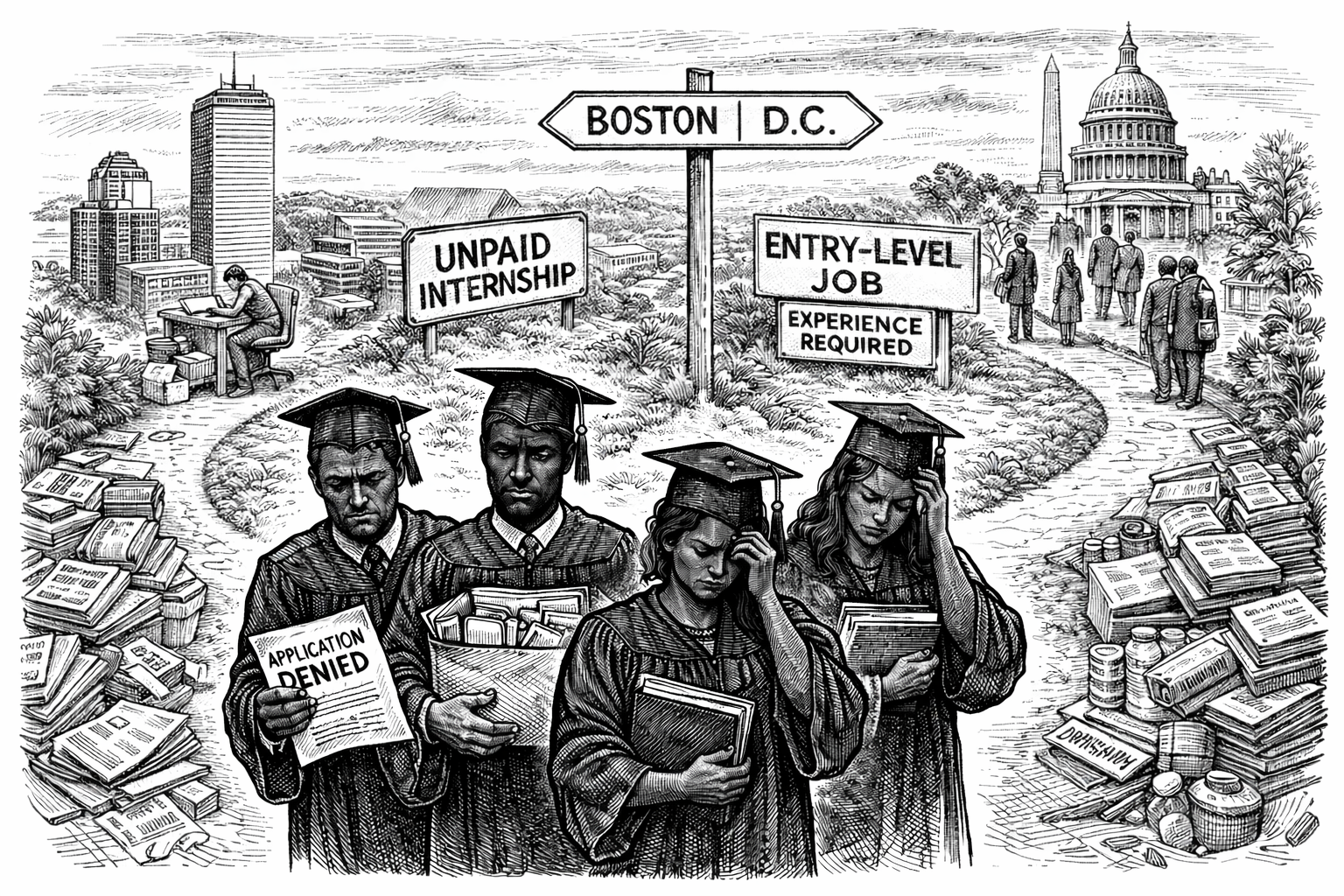
That contradiction lands especially hard in places built around degrees, policy credentials, and professional prestige. Boston and Washington are dense with universities, graduate programs, fellowships, and institutions that train people for influence. But those same ecosystems also normalize oversupply. They produce workers faster than high-quality openings emerge, and they intensify competition by treating advanced training as a baseline rather than a differentiator. The result is a labor market where qualification keeps rising even as clarity about reward diminishes. A master’s degree that once distinguished a candidate now functions as a minimum threshold in fields where a decade ago a bachelor’s was sufficient. The credential arms race is self-reinforcing — institutions benefit from producing more graduates, employers benefit from a larger and more qualified applicant pool, and the cost of that dynamic is borne by the individuals who invested in the credential expecting a return the market is no longer reliably delivering.
The stratification within that dynamic is not random. It follows existing lines of race, class, and network proximity with remarkable consistency. First-generation college graduates and Black and Brown professionals entering credential-intensive labor markets in Boston and Washington face a specific version of this contradiction — they have met the formal requirements of the system more fully than any previous generation from their communities, and they are encountering a market that has responded by raising the informal requirements. Unpaid internships that build the network access credential-holders need to convert their degrees into employment are inaccessible to workers who cannot absorb the cost. Fellowship programs that open doors to policy careers in Washington are disproportionately populated by applicants from institutions whose alumni networks already overlap with the hiring managers making decisions. The credential is real. The playing field on which it is deployed is not level. And the gap between formal qualification and actual opportunity is widest for the workers who sacrificed most to close it.
The deeper issue is not simply that young professionals are struggling. It is that the social contract around education has become more conditional while retaining all its old moral force. People are still told that more school, more specialization, and more polish will unlock opportunity. What goes unstated is that institutions benefit from this belief even when labor markets cannot absorb everyone on the promised terms. Universities, employers, and professional gatekeepers all gain from a large pool of highly credentialed applicants competing for limited roles. Scarcity raises standards while shifting risk downward — onto the graduate carrying student debt, onto the fellow extending training because stable employment hasn’t materialized, onto the family that invested in a credential as a route out of economic precarity and is now watching that route become more complicated the further their child travels down it.
The credential economy is not malfunctioning. It is operating exactly as designed. Boston and Washington do not merely reward merit — they manage aspiration through systems that convert ambition into tuition, unpaid experience, and prolonged waiting. The problem is not that education no longer matters. It is that education increasingly functions as the price of admission to a race whose finish line keeps moving. When that happens, credentials stop being a path out of precarity and start becoming the language through which precarity is organized — made to feel like a personal positioning problem rather than a structural one. The credential economy has not failed the people navigating it. It has succeeded, on its own terms, by keeping them moving forward without guaranteeing where they land.