
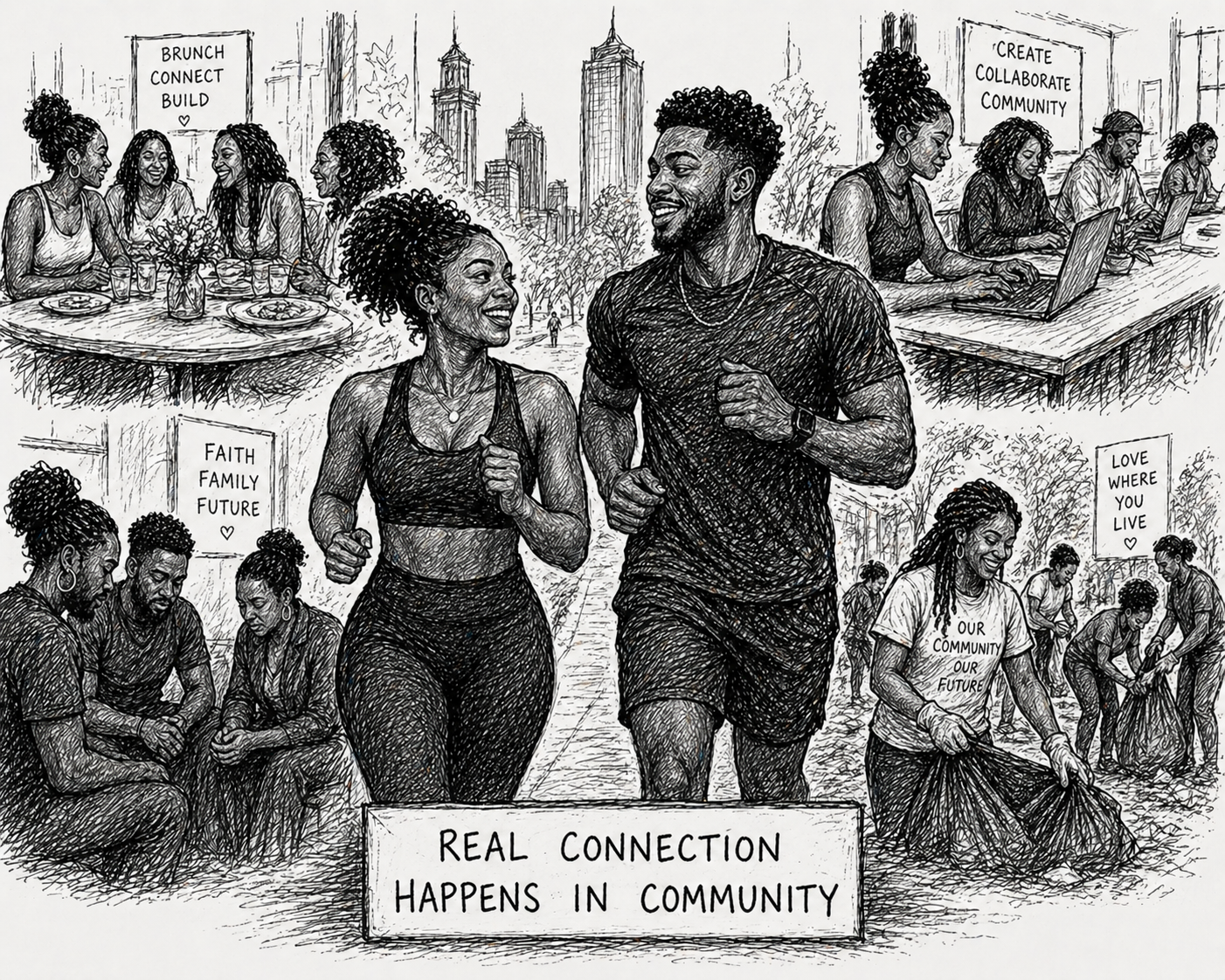
The run club meets on Saturday mornings. So does the brunch collective, the creative co-working space, the faith community, and the neighborhood cleanup crew. None of these are dating events. All of them are producing relationships — and for a growing number of Black singles, that is precisely the point. 40% of Black singles say they meet dates through shared community spaces, according to a BLK survey. The algorithm did not produce this number. The community did — deliberately, structurally, as a response to a platform system that was not designed for them and has not performed well enough to earn their exclusive loyalty.
The failure of dating apps for Black singles is not primarily a feature problem. It is a design problem. Apps built around swipe mechanics, algorithmic matching, and engagement optimization were designed around assumptions about how attraction works, what safety looks like, and what connection is supposed to feel like — assumptions that were not built from or tested against Black cultural norms, relational values, or the specific safety concerns that shape how Black women in particular navigate public space and digital interaction. 66.5% of Black singles report experiencing ghostlighting — the combination of ghosting and gaslighting — at least once, a figure that reflects the emotional cost of a system where accountability is structurally absent and the exit is always one swipe away.
What has emerged in response is not an app. It is infrastructure — the kind that embeds romantic possibility inside existing community life rather than extracting it into a separate digital context. The run club that SSC has documented as one of the fastest-growing social formations in urban life is also, for many of its members, one of the most reliable environments for meeting people worth knowing. Not because it was designed for that purpose, but because it was designed for community — and community, it turns out, is what dating was always supposed to happen inside.
The implications extend beyond individual relationship outcomes. When Black singles build romance infrastructure inside community spaces, they are not just solving a dating problem. They are reinforcing the community itself — bringing people into shared physical space, building repeated low-stakes interactions that generate trust over time, and creating the kind of social fabric that produces everything from relationships to mutual aid to political organization. The run club is doing more than its description suggests. So is the brunch, the collective, the creative space. They are the infrastructure of connection in a moment when the commercial alternative has failed to earn the trust required to replace them.
The platform companies will eventually notice this and attempt to replicate it — community features, interest-based matching, event integrations. They have already started. What they cannot replicate is the accountability that comes from showing up in person, in a community where people know you, week after week. That is the feature the app cannot build. It is also the one that makes the run club work.