
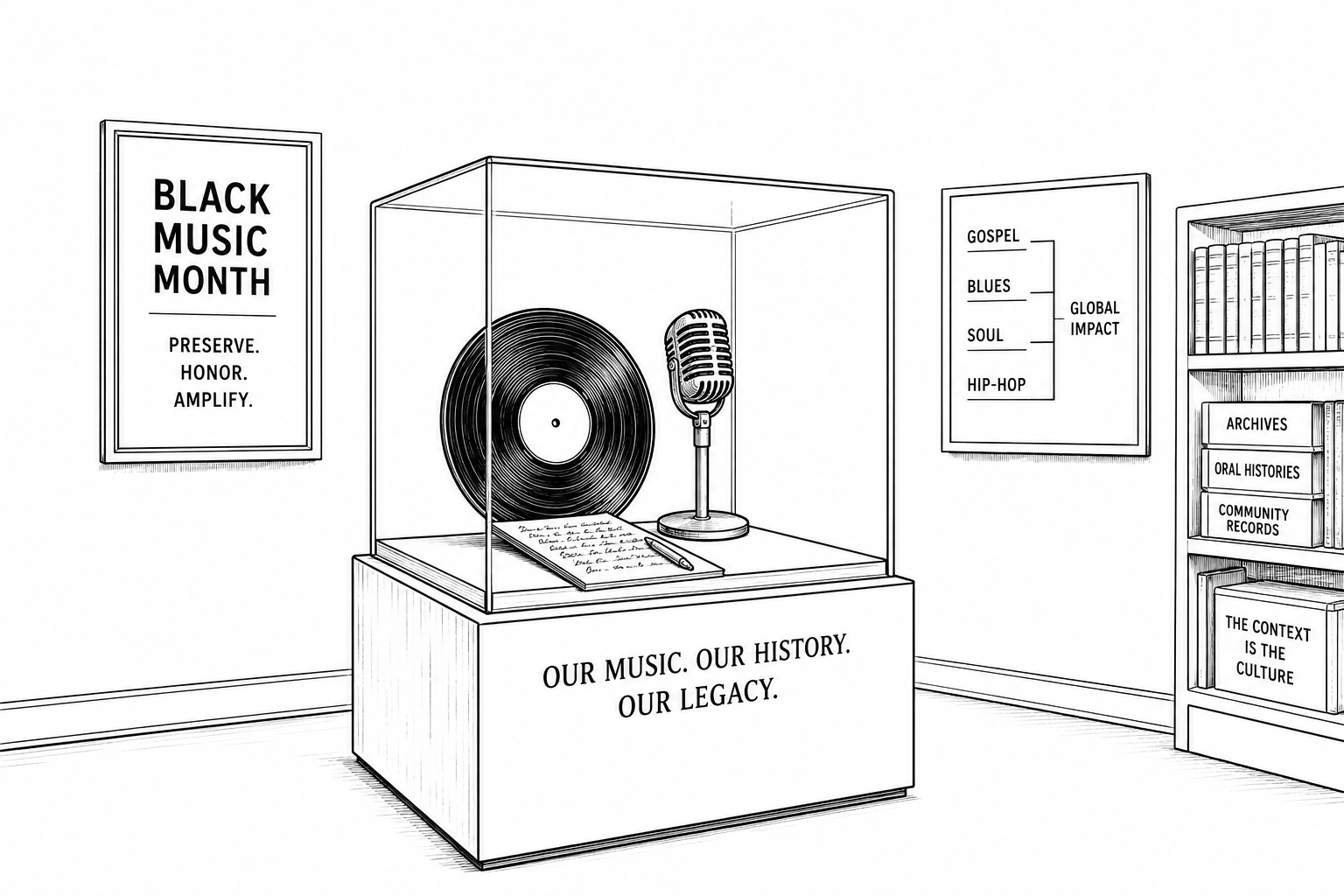
The National Museum of African American Music launched Black Music Month 2026 with PJ Morton serving as Grand Marshal, anchoring a month of programming tied to the institution’s fifth anniversary. The celebration includes performances, exhibitions, and educational events designed to honor the history and continuing influence of Black music across genres. The announcement arrives at a moment when Black music is more commercially valuable than at any point in recorded history — and the institutions responsible for preserving its context remain comparatively few.
Streaming platforms are designed to optimize discovery and engagement. Preservation requires something different: curation, interpretation, and the kind of storytelling that explains how gospel shaped soul, how soul influenced hip-hop, and how regional communities transformed local sounds into global movements. Those explanations do not generate revenue. They generate public record. The business model that dominates music consumption today rewards listening. The infrastructure that sustains cultural memory rewards neither.
Black music has repeatedly served as the creative engine behind new American genres while the commercial systems surrounding those genres rewarded distributors and platforms more consistently than the communities that produced them. Jazz, rock and roll, rhythm and blues, house music, and hip-hop each followed different historical paths — and each demonstrates how innovation travels faster than attribution. When culture circulates at scale, ownership of the narrative detaches from ownership of the creation.
Museums operate under a different incentive structure. Their mission is not to maximize streams but to establish historical continuity — connecting artists to neighborhoods, social movements, churches, migration patterns, recording studios, and local economies. The National Museum of African American Music is preserving relationships that algorithms flatten into playlists. That is not a minor distinction. Recommendation systems are exceptionally effective at predicting what listeners will enjoy next. They rarely communicate how musical traditions developed or whose labor created them.
The economic stakes of that gap are not abstract. Artists generate intellectual property. Cities build tourism strategies around musical heritage. Brands borrow aesthetic language rooted in Black communities to sell products worldwide. When history becomes detached from place and authorship, commercial value keeps growing while public understanding of the culture producing it gets thinner. Preservation functions as economic and historical accountability — keeping influence connected to the communities that produced it.
The institutions shaping Black music’s future may not be record labels or streaming services. Museums, archives, community organizations, and educational spaces are becoming the cultural infrastructure that determines whose stories survive and whose disappear. As platforms continue monetizing music at scale, the organizations preserving its history will increasingly define the public record by which that culture is ultimately remembered — and who gets credit for building it.