When I heard about the Black Enterprise layoffs, my first instinct was to mourn. Then I looked more carefully at what the company has actually built — and I reconsidered.
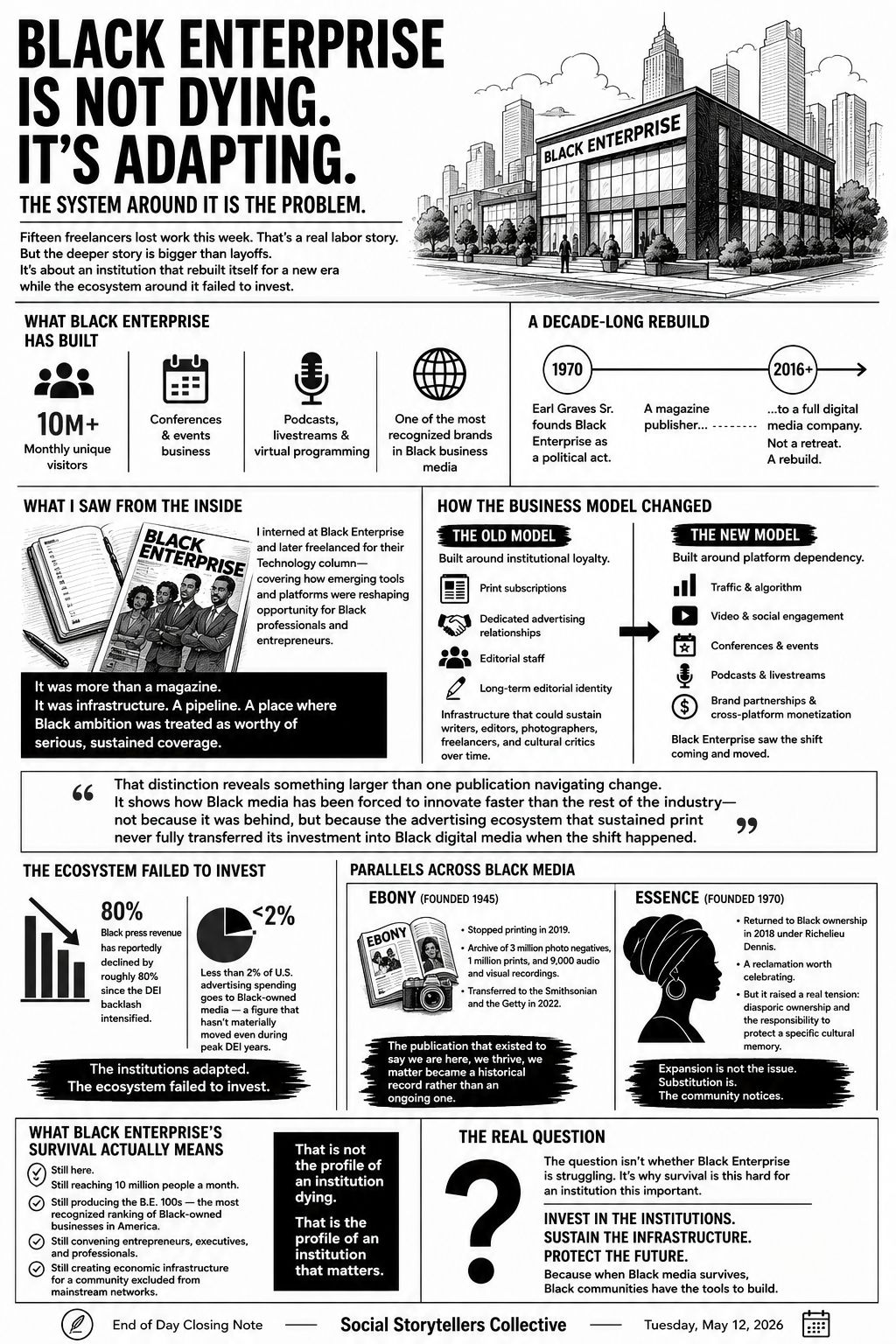
Black Enterprise completed its transition from a magazine publisher to a full digital media company by 2016. Today it reaches more than 10 million monthly unique visitors, operates a robust conference and events business, produces podcasts, livestreams, and virtual programming, and has built one of the most recognizable brand identities in Black business media. The pivot was not a retreat. It was a rebuild — executed over a decade, in public, while the entire media industry was falling apart around it.
The fifteen freelancers who lost work this week are a real labor story and deserve to be named as such. But they are not evidence of an institution in decline. They are evidence of an institution making hard structural decisions inside an ecosystem that has changed fundamentally — and choosing to survive it on its own terms.
Earl Graves Sr. founded Black Enterprise in 1970 as a political act. What his institution has done since is adapt to every economic environment it has encountered without surrendering its mission. That is not a slow death. That is institutional resilience. The deeper question worth asking is not whether Black Enterprise is struggling. It is why the ecosystem surrounding it — advertising, investment, corporate partnership — has made survival this hard for an institution this important.
What I saw from the inside
I interned at Black Enterprise and later freelanced for them, writing for their Technology column — covering how emerging tools and platforms were reshaping opportunity for Black professionals and entrepreneurs. At the time, the magazine felt like infrastructure. Not just an editorial product, but a pipeline. A place where Black ambition was treated as worthy of serious, sustained coverage. Walking in as a young journalist, the weight of what the institution represented was tangible. This was where Earl Graves had built something that was supposed to last.
That sense of weight is not nostalgia. It is institutional memory — and it matters when you are trying to understand what Black Enterprise’s continued existence actually represents.
How the business model changed
According to a 2022 statement from executive editor-at-large Alfred Edmond Jr., Black Enterprise no longer measured magazine circulation, no longer maintained a traditional editorial staff, and increasingly depended on digital content, livestreams, podcasts, virtual events, and conferences as its primary revenue structure. It emphasized scale through audience reach, citing more than 10 million monthly unique visitors.
That distinction reveals something larger than one publication navigating change. It shows how Black media has been forced to innovate faster than the rest of the industry — not because it was behind, but because the advertising ecosystem that sustained print never fully transferred its investment into Black digital media when the shift happened.
The old Black media ecosystem was built around institutional loyalty. Print subscriptions, dedicated advertising relationships, newsroom staffing, and long-term editorial identity created infrastructure that could sustain writers, editors, photographers, freelancers, and cultural critics over time. The newer system is built around platform dependency. Traffic spikes. Video clips. Social engagement. Conferences. Brand partnerships. Cross-platform monetization. Black Enterprise saw that shift coming and moved. The question the industry still hasn’t answered is why the money didn’t follow.
The ecosystem that surrounds it
Black press revenue has reportedly declined by roughly 80% since the DEI backlash intensified. Less than 2% of US advertising spending goes to Black-owned media — a figure that hasn’t materially moved even during the peak years of corporate DEI commitments. The institutions didn’t fail to adapt. They adapted. The ecosystem failed to invest.
That pressure is not isolated to Black Enterprise. The parallel across Black media institutions is hard to ignore.
Ebony — founded in 1945 by John H. Johnson to document Black American life and provide positive images in a world of negative ones — stopped printing in 2019. Its archive of three million photo negatives, one million prints, and nine thousand audio and visual recordings was transferred to the Smithsonian and the Getty in 2022 for preservation. The publication that existed to say we are here, we thrive, we matter became a historical record rather than an ongoing one.
Essence returned to Black ownership in 2018 under Richelieu Dennis, the Liberian-born founder of SheaMoisture and Sundial Brands. The reclamation was celebrated — and it deserved to be. But it also introduced a tension that has only grown louder since. Foundational Black Americans, descendants of the enslaved people whose experience Essence was built to document and affirm, have raised a pointed concern: that diasporic ownership, however well-intentioned, carries a different relationship to the specific cultural memory the publication was created to carry. Expansion is not inherently misaligned with Essence’s mission. But when expansion begins to feel like substitution, the community notices.
What Black Enterprise’s survival actually means
Black Enterprise is still here. It is reaching 10 million people a month. It is producing the B.E. 100s — its annual ranking of the largest Black-owned businesses in America — as an accountability document the industry still relies on. It is convening Black entrepreneurs, executives, and professionals at events that function as infrastructure for a community that has historically been excluded from mainstream business networks.
That is not the profile of an institution dying. That is the profile of an institution that has survived the death of its original format, rebuilt itself inside a hostile advertising ecosystem, and continued to fulfill its founding mission without surrendering to either.
The fifteen freelancers who lost work this week deserved better. The answer to that is not to redirect corporate advertising dollars toward Black media institutions that have already proven they know how to reach and serve Black audiences. It is to finally do it — consistently, at scale, and not just when a news cycle makes it politically convenient.
Earl Graves Sr. built something that was supposed to last. It has. The question now is whether the ecosystem surrounding it will finally decide to invest in what it has always claimed to value.