
Part of Structural Reality — examining how systems produce unequal outcomes and how communities name and navigate them.
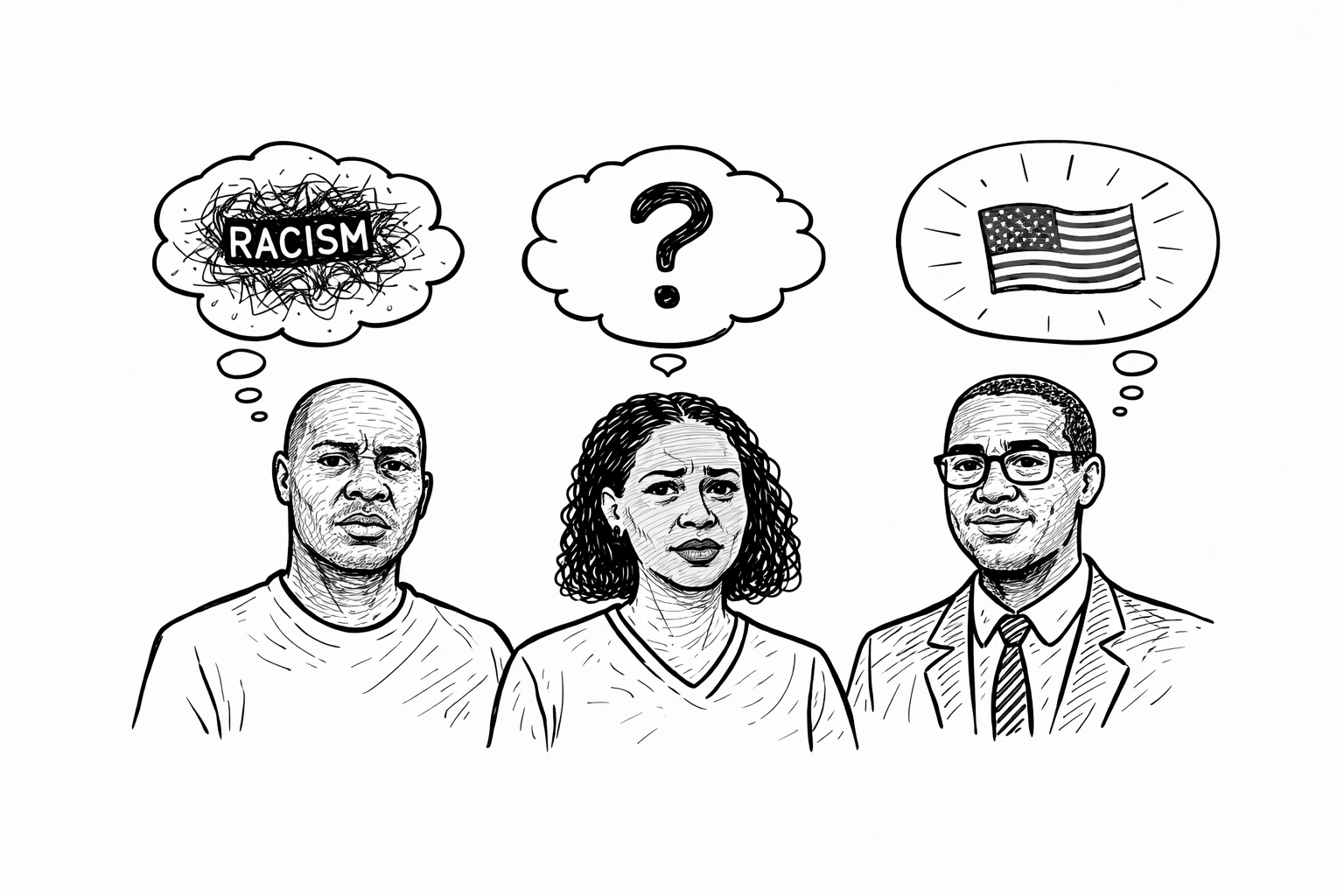
The assumption that Black Americans share a single, unified view of race in America has always been false. It has also been politically convenient for people who prefer to dismiss structural critiques as fringe, or to position racial optimism as the default Black perspective. A new national study from Rice University puts data behind what has long been observable: Black America holds a range of distinct, documented outlooks on race — and understanding that range matters more than flattening it.
The study offers one of the first national measures of “racial realism” — defined as the belief that racism is a lasting and durable feature of American life — and documents how it sits alongside other distinct outlooks including colorblind optimism and political agnosticism among Black adults. Racial realism, a concept originating in critical race theory, does not position racism as something to be overcome through individual effort or institutional goodwill. It positions it as a structural condition that shapes outcomes regardless of individual achievement — a framework that aligns closely with the analytical lens SSC has applied consistently across its coverage of education, housing, labor, health, and civic life.
The study’s significance extends beyond taxonomy. The researcher found that the findings challenge the idea that political milestones alone shift public opinion within the Black community, and underscore the need to understand the diversity of perspectives shaping how Black Americans interpret both progress and setbacks. That challenge matters in the current policy environment, where the language of racial progress is being deployed — by the administration, by courts, by corporate interests — to justify the dismantling of the structural remedies that racial realism identifies as necessary. If you can flatten Black opinion into a single optimistic narrative, the argument for structural intervention weakens. The data from Rice makes that flattening harder to sustain.
This research arrives from Houston — SSC’s home market — at a moment when the city’s own demographics are shifting faster than its institutional response.
Pew Research recently corrected its Houston Black population data upward, placing the growth rate at 39% since 2010. A city whose Black population has grown that significantly, in a policy environment that is actively contracting the infrastructure of equity, is precisely the context in which the difference between racial realism and colorblind optimism is not academic. It is a question of how communities read the room they are actually in, and what they do about it.