
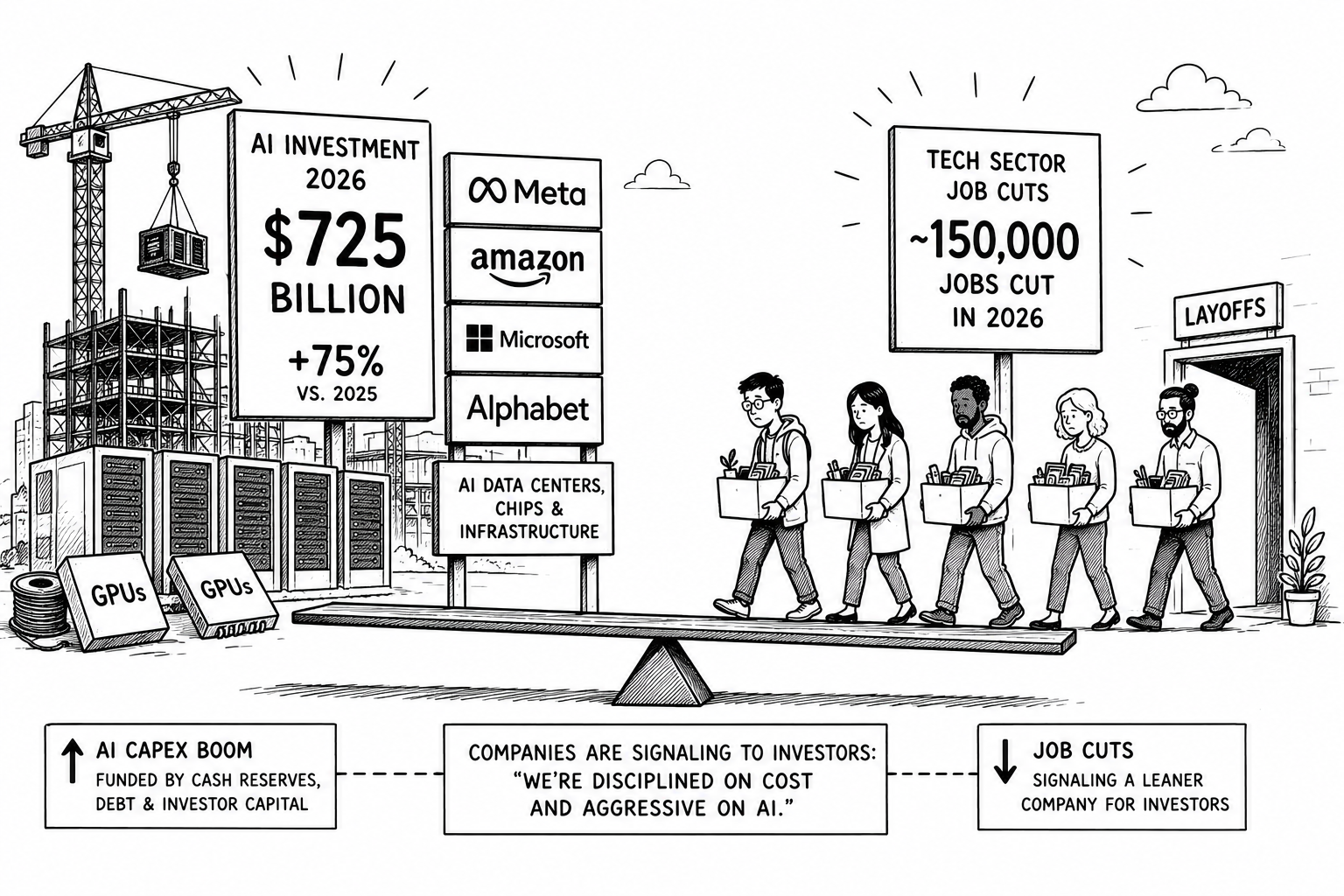
The tech sector has cut nearly 150,000 jobs in the same period.
Meta, Amazon, Microsoft, and Alphabet have collectively committed roughly $725 billion in capital expenditure for 2026 — a 75% increase over 2025 — aimed almost entirely at AI data centers, chips, and infrastructure. In the same period, the broader tech sector has cut nearly 150,000 jobs, with TrueUp projecting the year’s total could reach 370,000— surpassing the post-pandemic correction of 2023, which hit 430,000.
These two numbers are usually reported separately — one in the markets section, one in the jobs section. Put them side by side and a blunter version of the story appears: companies are firing people and buying GPUs with some of the savings.
That framing is too clean on its own, and worth complicating. $725 billion is vastly larger than what any plausible amount of payroll savings from 150,000 layoffs would cover — even at generous average compensation, that’s a gap of tens of billions, not hundreds. The AI capex boom is being funded primarily through other channels: cash reserves, debt issuance, and investor capital betting on AI’s future returns. Layoffs are not the primary funding source for this spending.
What the layoffs do represent is something more specific: a signal to the same investors funding that capex that the companies asking for hundreds of billions in AI investment are simultaneously running lean everywhere else. The labor cuts and the infrastructure spending are both inputs into the same pitch — “we’re disciplined on cost AND aggressive on AI” — even if the dollar amounts don’t directly offset each other.
This matters for how the AI buildout gets evaluated going forward. If layoffs were purely a funding mechanism, the story would be straightforward: companies trading jobs for compute. The reality — that the spending dwarfs any plausible savings from the cuts — means the layoffs are doing something else: demonstrating to markets that the AI bet doesn’t require maintaining the old cost structure alongside the new one. The old jobs aren’t being sacrificed to fund AI. They’re being declared no longer necessary in the world AI is being built to create — a different and, in some ways, more permanent claim than a temporary funding tradeoff would be.