
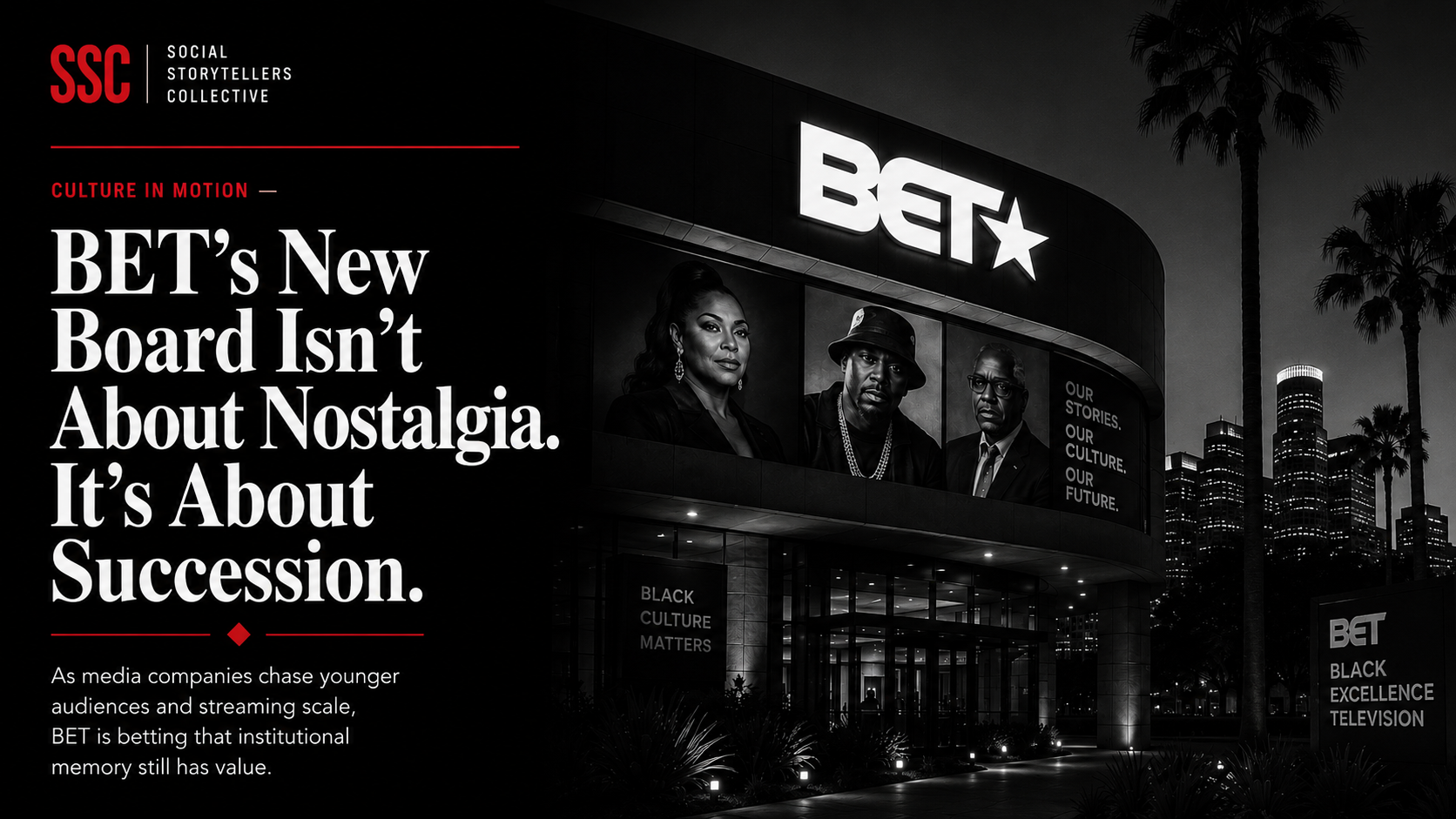
When BET announced its first-ever advisory board this week, the headline naturally focused on the names. Queen Latifah. LL Cool J. Bob Johnson. On paper it reads like a gathering of Black cultural royalty. The significance of the move is not who is sitting at the table. It is why BET suddenly believes it needs one.
The board arrives during one of the most uncertain periods in the network’s modern history. BET is navigating life under the newly consolidated Paramount Skydance structure while preparing for the shutdown of BET+, whose content will migrate to Paramount+. Longtime executives have departed. Ownership has shifted. Streaming economics continue to pressure every legacy media brand. In that context, the creation of an advisory board feels less like a ceremonial honor and more like an attempt to answer a fundamental strategic question: what should BET actually be in its next chapter?
That question carries weight because BET occupies a position no other media brand quite holds. It was never simply a content distributor. For generations of Black Americans, the network functioned as a cultural institution, a talent incubator, and a public square — creating visibility for artists, entrepreneurs, and conversations that mainstream media routinely ignored. But younger audiences today encounter Black culture through TikTok, YouTube, podcasts, and creator platforms long before they interact with BET, if they interact with it at all. The challenge facing the network is not preserving relevance. It is redefining relevance in an ecosystem where cultural authority is increasingly decentralized and no single institution controls the signal.
The composition of the board offers clues about how BET is framing that challenge. Queen Latifah and LL Cool J are not simply legacy artists — they are performers who successfully made the transition into business principals. Bob Johnson represents the founding entrepreneurial logic that built the network. The inclusion of leaders from finance, sports, and corporate media suggests BET is thinking beyond television. That may be the most consequential signal embedded in the announcement: the network appears to be positioning itself not merely as a channel but as a platform — one capable of connecting entertainment, capital, community influence, and cultural storytelling under a single institutional umbrella.
Beneath the corporate strategy is a deeper generational story. Many Black institutions face a version of the same succession dilemma. Founders and first-generation builders carry knowledge, relationships, and historical context that cannot be easily replicated or transferred. Younger audiences demand different formats, new voices, and different priorities — and they have little patience for institutions that mistake familiarity for value. By returning Bob Johnson to an advisory role more than two decades after his departure, BET is effectively acknowledging that history remains an asset — even as the company attempts to build a future that looks very little like its past. The question is whether institutional wisdom can be moved forward without being trapped by it.
Whether the board ultimately shapes programming or strategy is genuinely open. Advisory boards often function more as symbols than as governing bodies. But symbols matter, particularly now. In an era when media companies are consolidating, shrinking, and quietly retreating from identity-driven programming, BET is publicly signaling that culture itself remains central to its business model. The implicit argument is that audiences are not simply looking for content. They are looking for institutions that understand them. The real test will be whether BET can convert that understanding into something the next generation finds essential — rather than something the last generation simply remembers.