
Drake gifting DJ Akademiks a custom OVO chain before ICEMAN dropped was not a celebrity moment. It was infrastructure maintenance performed in public. The image circulated instantly because people understood what it symbolized: loyalty, amplification, and access. That Akademiks and Drake were reportedly meeting in person for the first time only sharpened the reaction. The chain wasn’t about friendship. It was about recognizing that digital loyalty — years of narrative-shaping, discourse-driving, rumor-amplifying — had become valuable enough to reward publicly. Proximity in modern music culture no longer requires physical presence. The internet made that irrelevant long ago.
What followed around ICEMAN, and the simultaneous conversations surrounding J. Cole’s The Fall Off and Kendrick Lamar’s GNX, revealed how hip-hop now operates: the music still matters, but the ecosystem surrounding it matters just as much. Fans weren’t simply debating songs. They were comparing rollout execution, narrative control, streaming momentum, symbolism, and cultural positioning across all three projects at once. One post framed the conversation as “hits versus substance versus vindication.” Others debated which project would define 2026 in hindsight. The comparison itself became the event — a live, crowdsourced referendum on three different theories of what rap dominance actually looks like right now.
That dynamic reflects a fundamental shift in how platform-era music culture works. In earlier eras, artists largely disappeared between releases, re-emerging through singles, videos, and tours. Now the rollout never stops. Every chain, livestream, cryptic caption, co-sign, or symbolic gesture becomes part of a continuous mythology cycle. Drake has mastered this structure more than almost anyone. ICEMAN didn’t arrive through a traditional announcement. It arrived through accumulation — visual motifs, influencer appearances, internet speculation, and symbolic gestures that kept audiences engaged before most people had heard a single bar. Kendrick took the opposite approach: GNX landed with minimal warning, letting the music absorb the full weight of a cultural moment he had already won. Cole landed somewhere between the two — deliberate, long-telegraphed, and framed as a statement of craft in a climate increasingly hostile to patience.
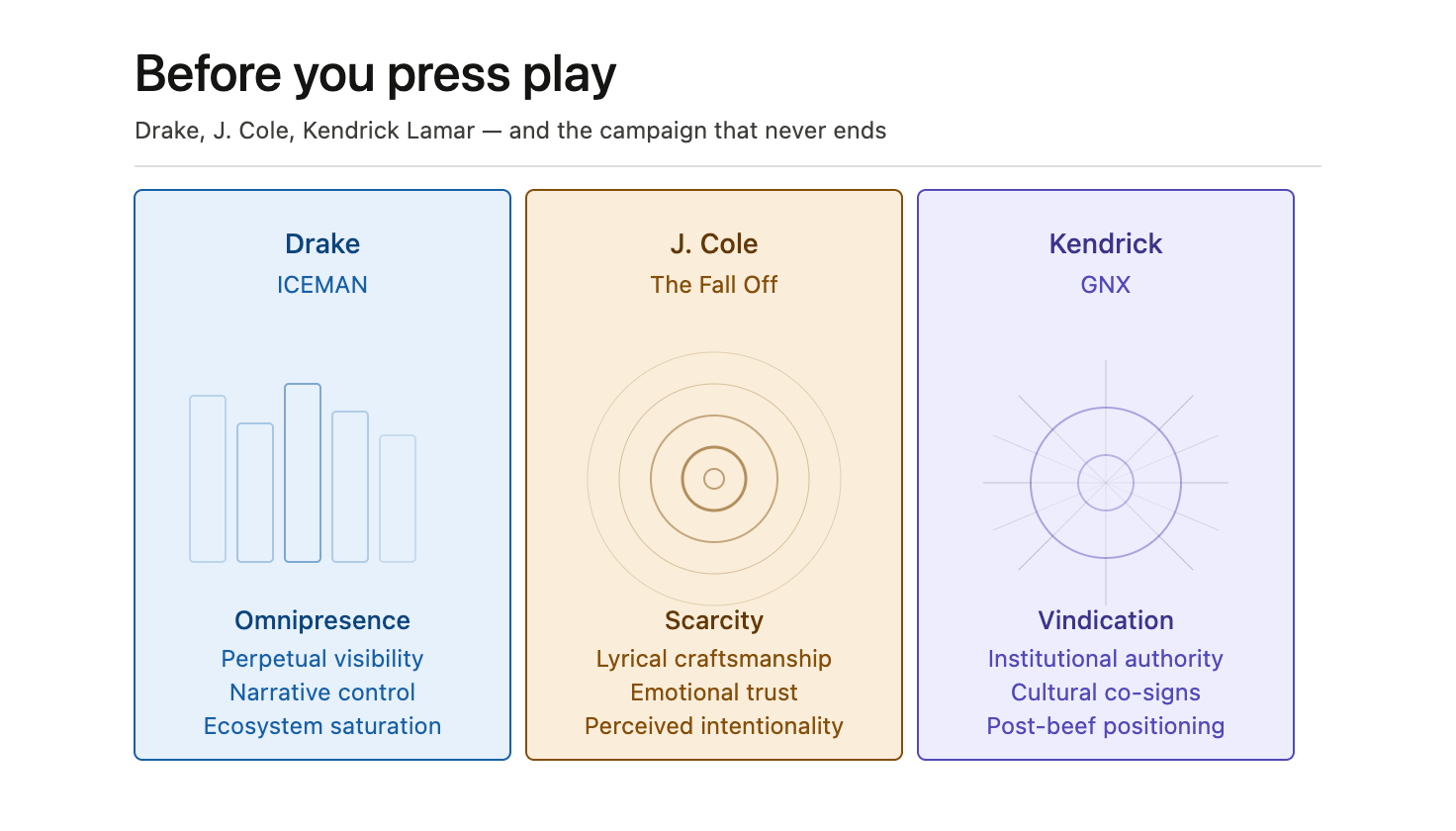
The three projects put three distinct philosophies of relevance in direct competition. Drake’s dominance runs on omnipresence and narrative control — the ability to manufacture moments that dominate attention regardless of critical response. Cole’s cultural value runs on scarcity, craftsmanship, and perceived lyrical integrity. Kendrick’s positioning is something different entirely: cultural vindication, institutional co-signs, and the gravitational pull of an artist who just swept the Grammys, headlined the Super Bowl, and won the most public beef in rap history. Fans weren’t just comparing albums. They were comparing what each artist’s relevance is actually built on — and whether any of it holds under pressure.
Streaming data reinforced the tension. Posts circulating numbers for all three projects became ammunition in real time, each side selectively citing momentum, replayability, or longevity depending on which argument they were making. What matters structurally is that ICEMAN, The Fall Off, and GNX each demonstrate a different way to sustain attention in an overcrowded entertainment economy. Drake manufactures perpetual visibility. Cole builds emotional trust through perceived intentionality. Kendrick converted a cultural war into institutional authority and let that authority do the work. All three generate loyalty — but they build fundamentally different audience relationships, and the current moment is the clearest test yet of which approach actually lasts.
Hip-hop discourse now runs on sports media logic. Artists are discussed through rankings, eras, statistics, legacy calculations, and competitive framing in real time. The release is no longer enough. Every project must immediately enter a debate ecosystem where audiences measure dominance before first-week numbers even arrive. That environment rewards artists who generate conversation loops beyond the music itself — and it explains why someone like Akademiks holds structural importance inside Drake’s orbit, why Cole’s scarcity creates anticipation that functions almost like scarcity economics, and why Kendrick can drop with minimal rollout and still own the narrative because the preceding twelve months did the promotional work for him.
Albums are no longer isolated cultural products. They are campaign headquarters inside larger attention economies. ICEMAN, The Fall Off, and GNX — alongside streaming leaderboards, fan edits, rollout symbolism, beef history, Grammy stages, and influencer alignment — all function as interconnected parts of the same machine. The rollout is no longer promotion for the music. It is the music’s cultural meaning — delivered before most listeners ever press play.