
LOCAL | AUSTIN | ANALYSIS
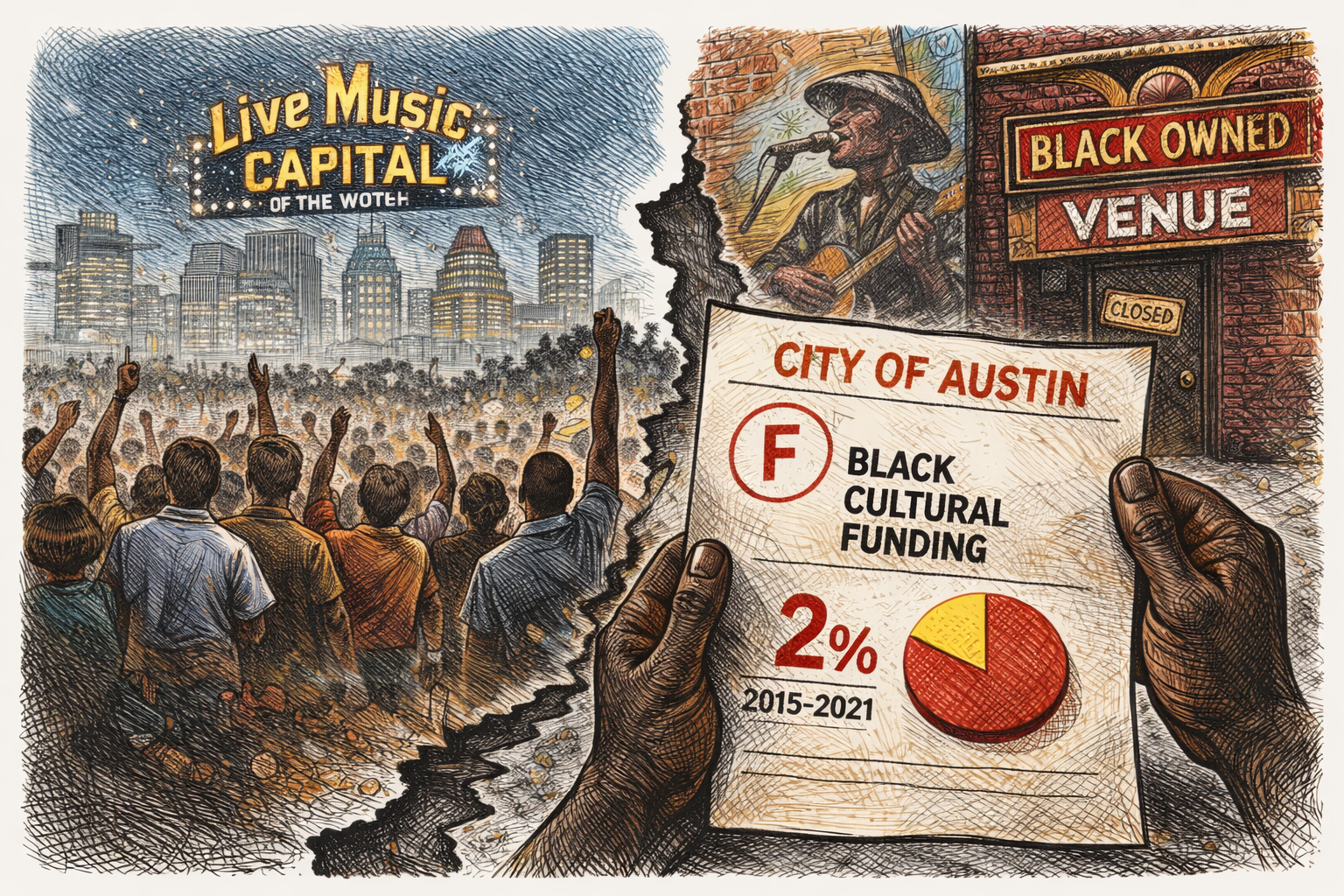
A new report from the Austin Justice Coalition and Measure is putting numbers to a long-standing tension in Austin: who builds culture, and who benefits from it. Their “State of Black Austin” study found that between 2015 and 2021, just 2% of the city’s cultural funding reached Black communities. In a city that brands itself as the “Live Music Capital of the World,” that figure is difficult to separate from the identity Austin continues to sell.
Black artists, venues, and communities have played a foundational role in shaping Austin’s music ecosystem. The public investment meant to sustain that ecosystem has flowed elsewhere. The result is a cultural economy where the output is widely celebrated and the inputs — the communities that produced it — remain chronically under-resourced.
The funding gap is not happening in isolation. Austin’s Black population has declined in recent years, driven by rising housing costs and displacement pressures that have accelerated as the city’s cultural brand has grown. The communities being priced out are the same ones that made the brand worth selling. That sequence is not coincidental. It is structural.
What the data reveals extends beyond Austin. Cities commodify culture at scale while systematically underinvesting in the communities that produce it. Cultural identity becomes a marketing asset. The people behind it become increasingly peripheral to the economy built around their work — present enough to generate value, under-resourced enough to remain replaceable.
That pattern runs through reporting we’ve already published. In Black Media Isn’t Just Growing, the question was who controls narrative power as platforms expand. In In Atlanta, Going Green Is Pushing Black Homeowners Out, the focus was on how investment reshapes neighborhoods without preserving the people who lived there. Austin sits at the intersection of both: culture being scaled while community is being displaced.
The 2% figure is what a city’s priorities look like when the numbers are finally forced into view. Funding decisions, like housing patterns, reveal what a system is actually designed to sustain — regardless of what it says about itself.
Austin continues to market itself through music, creativity, and cultural vibrancy. The report raises a more grounded question: who still has access to participate in that culture — and who is being written out of it in real time.