

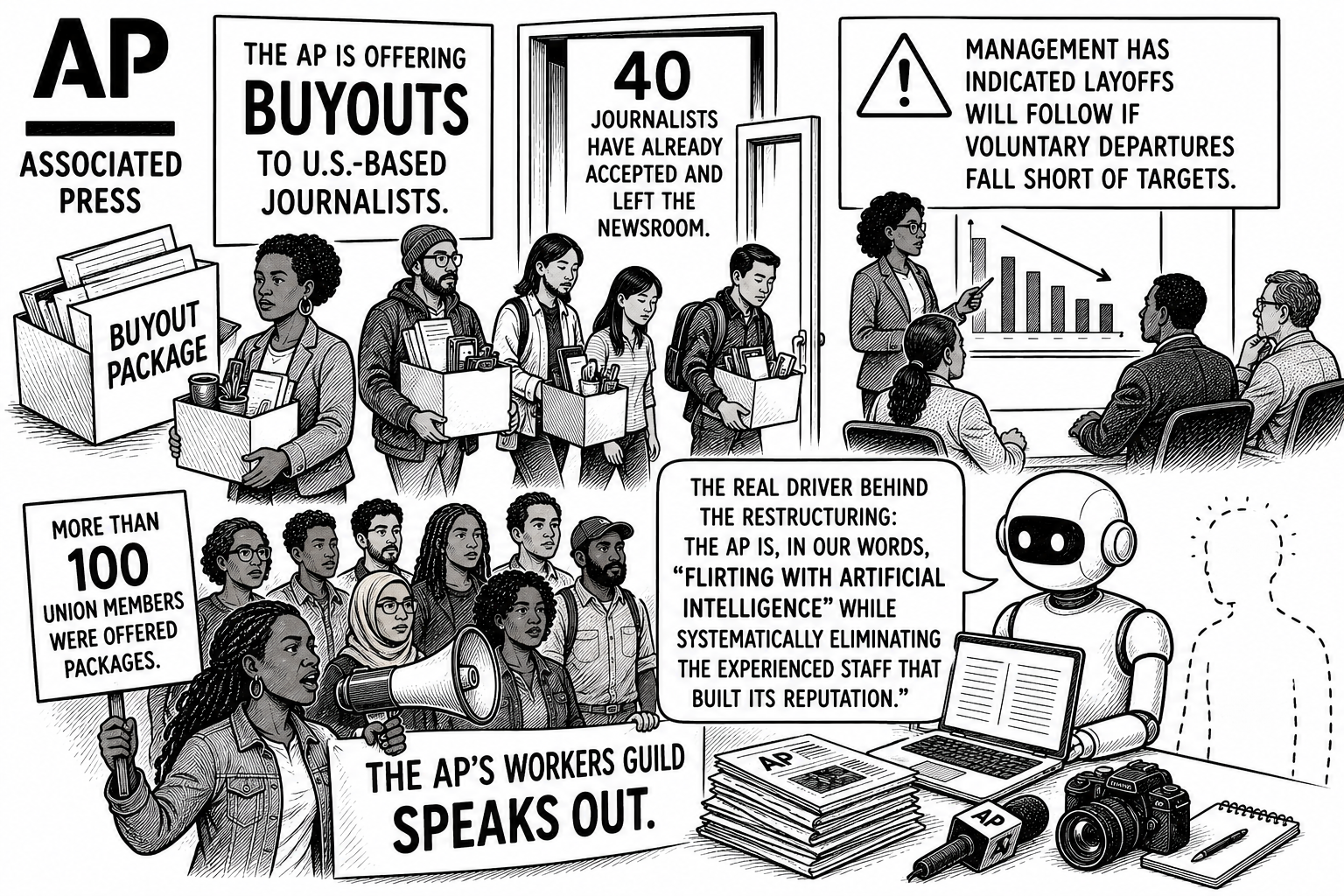
The Associated Press is offering buyouts to U.S.-based journalists. Forty reporters, photographers, and videographers have already accepted and left the newsroom. Management has indicated layoffs will follow if voluntary departures fall short of targets. More than 100 union members were offered packages — and the AP’s workers guild responded by calling out what it sees as the real driver behind the restructuring: the organization is, in the guild’s words, “flirting with artificial intelligence” while systematically eliminating the experienced staff that built its reputation.
That framing is worth sitting with.
AP is not a standard media company navigating a difficult market. It is a global wire service — founded in 1846, operating across nearly 100 countries, supplying reporting to thousands of newspapers, broadcasters, websites, and institutions worldwide. When AP restructures, the effects move through the entire information ecosystem. This is not one organization adjusting headcount. It is infrastructure changing shape.
The business rationale is real. Revenue from U.S. newspaper groups has declined 25% over the past several years while revenue from tech companies has grown roughly 200%. Newspaper groups now account for less than 10% of AP’s overall revenue. The organization has already made this transition in practice — it is now making it official in staffing. Executive editor Julie Pace wrote in a memo to staff that “too much of our operations are still tied to large U.S. newspaper groups” and that the moment calls for being “bolder about making this transformation.”
What the memo does not address is what gets lost in the transformation. Wire service journalism is built on institutional knowledge — source relationships developed over years, beat expertise that cannot be automated, the kind of contextual judgment that distinguishes a story from a data point. The workers guild’s objection is precisely this: that AP is using AI adoption as cover for eliminating the capacity it actually needs, and offering buyout packages as the mechanism for doing it quietly.
The Washington Post Ran This Playbook First
The AP situation is not an isolated case. In February, the Washington Post cut more than 300 journalists — roughly one third of its 800-person newsroom. Sports, books, podcasts, foreign desks, business and national teams were all gutted in a single morning. Staffers were told to stay home, join a Zoom call, and wait for an email telling them whether they still had jobs.
Executive editor Matt Murray explicitly named AI as a factor, noting that organic search — once a primary driver of the Post’s digital reach — had fallen by nearly half in three years. The argument was that the organization needed to restructure around AI-driven distribution rather than traditional reporting infrastructure. Experienced journalists absorbed the cost of that argument.
What followed exposed the flaw in the logic. Within weeks of the layoffs, editors who had been given little say over who was dismissed began quietly contacting laid-off staff, asking them to return under what the union called a “delayed layoff.” At least three newsroom employees were rehired full-time. Fifteen more were placed in a holding pattern — told that if positions opened over the summer, they would be considered. The Columbia Journalism Review described the sequence plainly: the chaotic nature of the layoffs, followed by delayed layoffs and possible rehires, does not reflect well on the company’s strategy.
Race and ethnicity reporter Emmanuel Felton, who was among those cut, put it more directly. “This wasn’t a financial decision,” he wrote. “It was an ideological one.”
The Post’s reversal is instructive not because it represents a correction, but because it confirms what the guild at AP is arguing right now. Newsrooms do not actually know what they need until after they have eliminated the people who were providing it. The buyout is the mechanism. AI is the justification. Experienced workers are what disappears.
The Pattern Across the Industry
The AP and Washington Post situations are data points in a broader contraction that has been reshaping American journalism for years. The Pittsburgh Post-Gazette announced it is shutting down entirely. CBS News Radio, which has served roughly 700 affiliate radio stations for nearly a century, is closing in May. ABC News is cutting staff as Disney eliminates approximately 1,000 positions across its portfolio. The layoff tracker at Press Gazette has been running continuous updates since January.
SSC has covered elements of this contraction across beats — from the Daily Wire’s restructuring amid its own audience and revenue pressures, to Black Enterprise navigating a media environment that was abandoning diverse coverage long before the current DEI rollback made it politically convenient. The thread connecting all of it is consistent: when media organizations restructure, they reach for the same set of tools regardless of their ideological positioning or audience. They offer buyouts, cite technology transitions, and eliminate the institutional knowledge that takes years to build.
What changes between organizations is who absorbs the cost. At the Washington Post, a race and ethnicity reporter lost his job while the owner was simultaneously donating millions to a presidential inaugural fund. At AP, journalists who built global source networks over decades are being handed separation agreements while the organization invests in AI content platforms. The restructuring is presented as inevitable. The distribution of its consequences is not.
What This Means for the Information Ecosystem
AP’s unique position in the media landscape makes this restructuring consequential in ways that go beyond any individual outlet’s internal decisions. The wire service model exists because local and regional outlets cannot afford to staff every beat, every geography, every breaking news situation independently. They rely on AP to fill those gaps. When AP contracts its U.S. reporting capacity, the gaps do not disappear. They simply go uncovered.
Industry analysts have documented the civic consequences of journalism’s contraction for years — lower public accountability, reduced community information access, weaker local political engagement. Those consequences do not arrive as dramatic events. They accumulate quietly, in the stories that do not get filed, the sources that stop being cultivated, the beats that no algorithm can replicate because no algorithm knows why they matter.
The Associated Press has been reporting the news for 180 years. What it is doing now is not a pivot. It is a recalibration of what it believes the news is worth — and who it is willing to pay to cover it.