
The timing is not coincidental. As the United States approaches the 250th anniversary of the Declaration of Independence, the federal government has moved aggressively to narrow what version of American history gets told in schools, museums, and publicly funded institutions. Executive orders targeting “divisive narratives,” gutted agency budgets, and terminated grants have reshaped what cultural institutions can afford to say and display. Into that environment, a different kind of commemoration is being built — one that does not wait for federal sanction and does not depend on federal funding to survive.
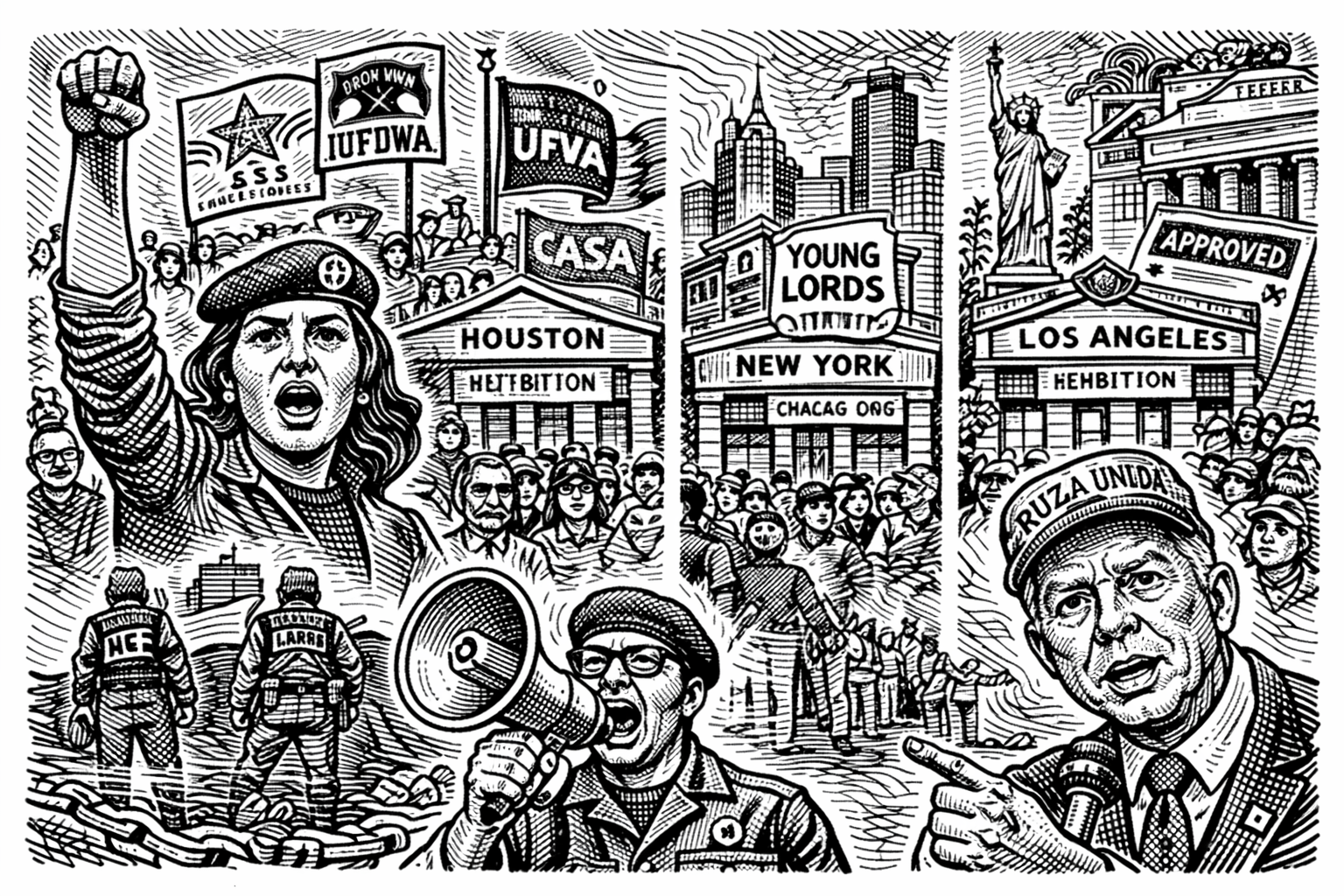
The Latinx Freedom Movement Conference, held at the CUNY Graduate Center in New York earlier this month, brought together veterans of the Latinx freedom and revolutionary movements of the 1960s with academics, university students, and the general public for the first time at this scale. Organized by historians Johanna Fernández of Baruch College and Felipe Hinojosa of Baylor University in Texas, the conference is the opening act in a series of exhibitions planned across Houston, Chicago, Washington D.C., Los Angeles, and New York — framed explicitly as an alternative view of the 250th anniversary of the Declaration of Independence. The participants included original leaders of the Brown Berets, the Young Lords, CASA, the United Farm Workers, and the Raza Unida Party — figures whose contributions to American political and labor history have been systematically underrepresented in mainstream commemorations of the nation’s founding ideals, and whose organizing strategies shaped the landscape of American civil rights far beyond the Latinx community.
What makes this initiative structurally significant is not just the content but the method. These exhibitions are not being built inside federally funded institutions waiting for grant approvals that may never come. They are being constructed through university partnerships, community organizations, and diaspora networks — the same infrastructure that the Latinx freedom movement itself relied on when formal channels were closed. That parallel is intentional. The movement being commemorated was built outside of official sanction, and the commemoration is being built the same way. In a moment when the federal government has demonstrated willingness to terminate grants for exhibitions on enslaved people’s resistance and direct museums to remove what it calls divisive narratives from their programming, the decision to route around that infrastructure is not just practical. It is political.
The Houston dimension carries particular weight. Houston is one of the most diverse cities in the United States and home to one of the largest Latinx populations in the country — a community whose history of labor organizing, political resistance, and cultural production has rarely been centered in the city’s official historical narrative. The planned exhibition arriving in Houston as part of this series represents an opportunity to place that history directly in the community it belongs to, outside the donor-driven programming calendars and dynamic pricing models that have increasingly shaped what major cultural institutions present and to whom. That the exhibition is coming to Houston at a moment when the city is simultaneously navigating a $174 million budget deficit, a World Cup hosting obligation, and a state-level immigration funding standoff adds another layer to what is already a complex cultural moment for the region.
The broader pattern this initiative reflects is one that has been building quietly across the country as federal cultural policy has tightened. Community-based archives, oral history projects, university-housed exhibitions, and diaspora-funded commemorations are filling space that defunded and politically pressured institutions can no longer occupy. The Latinx Freedom Movement exhibitions are among the most organized and geographically ambitious of these efforts, but they are not alone. What is emerging is a distributed infrastructure of counter-memory — history being preserved and transmitted not through the institutions that were built to do that work, but through the communities that lived it. As SSC has covered in its ongoing museum and cultural access reporting, the history that doesn’t get told in official rooms does not announce its own absence. These exhibitions are one answer to that silence — built city by city, outside the system, and arriving exactly on time.