
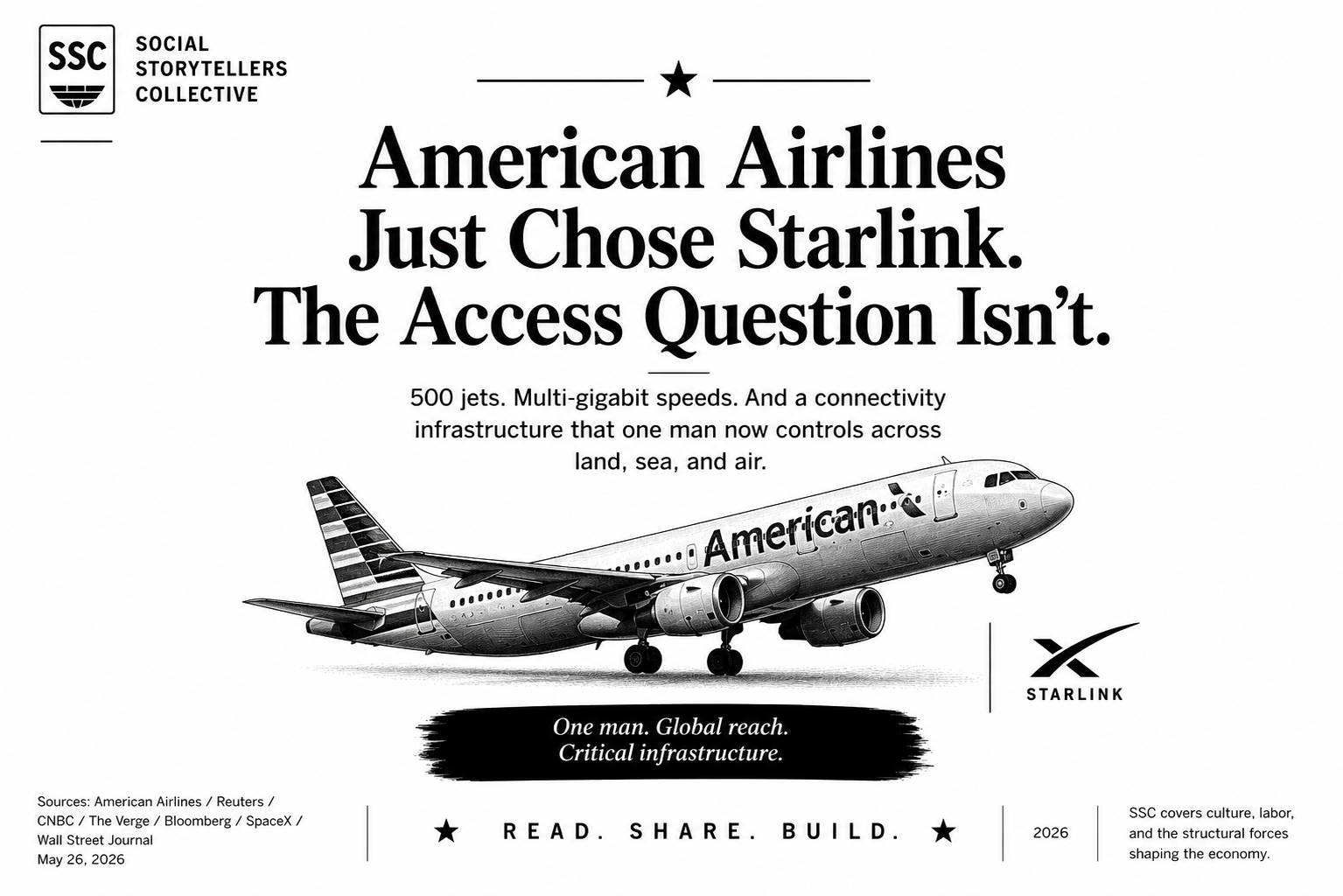
American Airlines announced it will install SpaceX‘s Starlink on 500 Airbus narrow-body planes beginning next year — joining Delta and United in a broad industry pivot toward satellite-based connectivity that promises multi-gigabit speeds, low latency, and true gate-to-gate service. The move is being framed as a passenger experience upgrade, and technically it is. Starlink Aviation delivers meaningfully better in-flight internet than the legacy systems it replaces — faster, more consistent, and capable of handling the kind of bandwidth that business travelers and remote workers actually need at 35,000 feet. American‘s Boeing fleet will continue using Viasat and Panasonic in the near term, creating a split-fleet connectivity experience that will be invisible to most passengers until they notice the difference between the two.
The timing is not incidental. SpaceX is preparing to go public next month in what analysts expect to be a record-breaking IPO. American‘s announcement — and the broader airline industry alignment around Starlink — arrives as SpaceX is building the narrative of its aviation connectivity unit into a public market story. Three of the largest U.S. carriers committing to Starlink before the IPO is not just a technology adoption story. It is a revenue validation story. Every airline contract that lands before the offering strengthens the case that Starlink Aviation is a durable, scalable business — and that the man who owns it, Elon Musk, is assembling something significantly larger than a satellite internet company.
That ownership context belongs in this story. Musk now controls the connectivity infrastructure being installed across a significant share of American commercial aviation, the satellite internet serving remote communities and developing nations through consumer Starlink, the maritime connectivity market through Starlink at sea, and the federal government contracts that have made SpaceX the backbone of U.S. space access. He simultaneously ran DOGE — the initiative that, as SSC documented in The Federal Government Was the Most Reliable Path to the Middle Class for Black Americans. DOGE Just Dismantled It., cut 279,445 federal jobs disproportionately from Black workers — while his companies held and pursued federal contracts worth billions. American, Delta, and United are not simply choosing a technology vendor. They are choosing to route their passengers’ data, browsing behavior, and connectivity through infrastructure controlled by a single individual who has demonstrated a willingness to use platform access as leverage — a dynamic that connects directly to what SSC examined in The Business Community Just Said It Out Loud, where institutional actors are increasingly being asked to weigh in on whether the mechanisms of democratic and economic stability are still functioning. Starlink cut service to Ukraine during a critical military operation. It restored it after political pressure. That is not a hypothetical about what infrastructure concentration enables. It is a documented case study.
The passenger experience argument is real but uneven. Gate-to-gate connectivity at multi-gigabit speeds changes the calculus for business travelers who have historically written off flight time as a productivity dead zone. It also changes the premium cabin value proposition — carriers can now offer a genuinely differentiated digital experience to passengers in first and business class, making connectivity a retention and yield management tool rather than just an amenity. What it doesn’t change is the access architecture underneath the upgrade. In-flight Wi-Fi has always been tiered — free for some, paid for others, meaningfully fast for neither until now. Starlink makes the fast tier genuinely fast. It does not make it free. The traveler in the back of the plane on a basic economy fare is still making a separate calculation about whether the connectivity is worth the add-on cost — and that calculation is happening inside an infrastructure they have no choice about if they want to connect at all.
What the American-Starlink deal reveals is where the airline industry has decided its competitive differentiation lives in 2026 — not in legroom, not in food, not in gate experience, but in digital infrastructure. That is a specific bet about who their most valuable customers are and what those customers need. The remote worker who can bill hours on a transcon flight. The executive who needs a reliable video connection over the Atlantic. The consultant who treats the aircraft cabin as a mobile office. Starlink serves that traveler extremely well. It serves the leisure traveler on a basic fare to visit family somewhat well, at a price they may or may not pay. The infrastructure is being built around the customer who generates the most revenue — while the man who owns that infrastructure has made it clear that access is a decision he is willing to make unilaterally. SpaceX‘s IPO next month will price that reality. The airlines have already decided to build on top of it.