
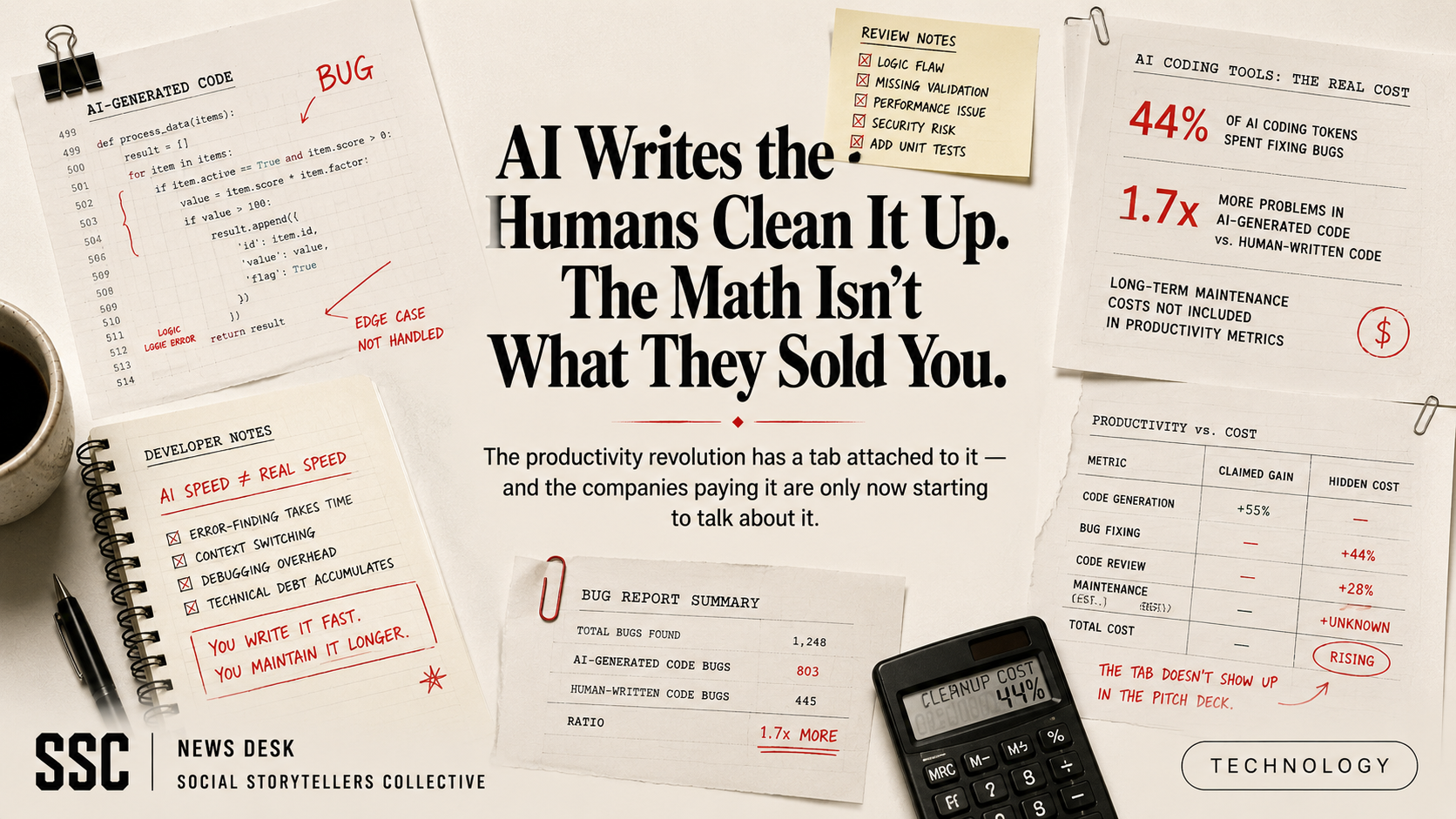
The pitch for AI coding tools has always been straightforward: write faster, ship faster, need fewer developers. The data coming back from actual deployment tells a different story. TechCrunch reported this week that companies are spending 44% of their AI coding tokens fixing bugs the AI generated in the first place. CodeRabbit found that AI-produced code created 1.7 times more problems than human-written code. Researchers from Singapore Management Universitywarned in April that AI-generated code introduces long-term maintenance costs that don’t show up in the initial productivity numbers. The efficiency gain and the cleanup bill are running simultaneously. The accounting being presented to the public tends to feature one and footnote the other.
The dependency problem is as striking as the quality problem. METR attempted in February to repeat a landmark 2025productivity study — and couldn’t. Developers refused to work without AI tools even temporarily for a research study. The original study had already found that while developers felt more productive, AI actually slowed them down: code generated faster, but error-finding and steering consumed the time saved. Amazon shut down its internal AI productivity leaderboard after employees gamed it by running agents excessively and driving up costs. Uber blew through its entire 2026 AI budget in four months with no measurable increase in output. These are not small companies running unsophisticated experiments. Both found the same thing.
The labor story underneath is the one that doesn’t get told. As SSC documented in The AI Resume Screen Won’t See You Coming and The Class of 2026 Did Everything Right. The Market Moved Anyway., the junior developers being cut to make room for AI tools are often the same workers who would have caught the problems these tools are now generating. Programmer James Shore put the structural trap plainly: “You write code twice as quick now? Better hope you’ve halved your maintenance costs. Otherwise, you’re screwed.” The 44% bug-fix number is not temporary friction. It is the current state of a technology being sold as a replacement for human judgment — and the people who absorbed the first wave of displacement are not the ones collecting the productivity dividend.